
TL;DR:
Paid social advertising carries a reputation it does not deserve. Many marketing directors treat it as a brand awareness tool, something to run when budgets are healthy and results can afford to be vague. The reality is sharply different. When structured with clear objectives and the right targeting logic, paid social becomes one of the most measurable, scalable acquisition channels available to mid-sized businesses. The debate today sits between broad AI-driven automation and granular human-led targeting, and navigating that tension is where competitive advantage lives. This guide cuts through the noise and gives you a practical framework to act on.
PointDetailsPaid social is measurableIt enables targeting and accurate ROI tracking, not just awareness building.AI and human expertise combineThe best results come from blending automation with strategic oversight.Objectives drive strategyChoose targeting and campaigns based on business goals—brand or performance.Data and testing winContinuous review and optimisation, not ‘set and forget’, lead to sustained success.
Paid social advertising is the practice of running sponsored campaigns on social media platforms, paying to place your message in front of specific audiences rather than relying on organic reach. The major platforms are LinkedIn, Meta (Facebook and Instagram), X (formerly Twitter), TikTok, and Pinterest. Each serves distinct audience segments and campaign goals, and choosing the wrong one is a common and costly mistake.
Before evaluating strategy, it helps to know the terminology that shapes every campaign decision:
Paid social campaigns fall into a few distinct types. Sponsored posts appear natively in feeds and feel less intrusive than banner ads. Retargeting campaigns re-engage users who have already visited your website or interacted with your content, making them particularly efficient. Lead generation campaigns collect contact details directly within the platform, reducing friction and often lowering cost per lead significantly.
For B2B businesses, LinkedIn dominates because of its professional targeting depth. You can reach a financial director at a 200-person manufacturing firm in the Midlands with remarkable precision. For B2C and mixed audiences, Meta’s scale is hard to match, with over three billion monthly active users across its platforms. B2B growth with AI-powered campaign insights has changed what is possible across both contexts.
The broader strategic debate, however, is not simply about which platform. Contrasting viewpoints on paid social highlight how some practitioners advocate broad AI-powered targeting while others insist on granular custom audiences, and neither camp has a clean universal answer. What is clear is that automation without human oversight introduces real risk, particularly for mid-sized businesses where budgets are significant but not unlimited. Understanding results-driven B2B SEO strategy principles can sharpen your thinking about how paid and organic channels should work together.
This is exactly the balance of AI-driven targeting and human strategy we bring to every Performance PPC engagement.
Once you understand what paid social is, the most consequential decision you face is how to target. Two schools of thought dominate current practice, and they lead to very different campaign structures.

Broad AI-driven targeting hands control to the platform’s algorithm. Meta Advantage+ is the clearest example: you define a product, set a budget, and let the machine identify who is most likely to convert. The system learns fast and can reach audiences you might never have thought to target manually. For campaigns with strong creative and large enough budgets to generate data quickly, this approach can genuinely outperform human-built audiences.
Granular audience control takes the opposite approach. You manually define audiences using your own customer data, CRM lists, lookalike audiences built from existing buyers, and demographic filters. This gives you precision but requires more ongoing management and a deeper understanding of your customer profile.
FactorBroad AI targetingGranular audience controlSetup timeFastSlower, requires dataBudget efficiencyBetter at scaleBetter with limited spendLearning curveLowHigherCreative dependencyHighModerateTransparencyLowHighBest forB2C, large reach campaignsB2B, niche audiences
Contrasting viewpoints on paid social show that broad targeting and AI can outperform manual setups in many scenarios, but custom audiences retain real relevance for businesses selling complex or high-value products. The risk of pure automation is that you sacrifice strategic intent for algorithmic efficiency, and the two are not always aligned.
A hybrid approach suits most mid-sized businesses well. Use AI-driven targeting to prospect broadly, then layer in granular retargeting and custom audiences for users who have shown intent. This captures the scalability of machine learning without abandoning the commercial logic your team brings to the table. Understanding AI-powered SEO follows a similar logic: automation accelerates, but human judgement directs.
Pro Tip: Before launching any AI-driven campaign, make sure your creative assets are genuinely strong. The algorithm optimises for performance, but it cannot fix weak messaging. Poor creative fed into a broad targeting system will simply amplify waste at speed. Pair AI targeting with your best conversion best practices thinking from the start.
With targeting settled, the next strategic question is objective. What are you actually trying to achieve, and how quickly?
Brand campaigns prioritise reach, engagement, and recall. They build familiarity over time and make your performance campaigns more efficient downstream. The trade-off is that impact on revenue is harder to measure in the short term, and leadership teams often grow impatient with the timeline.
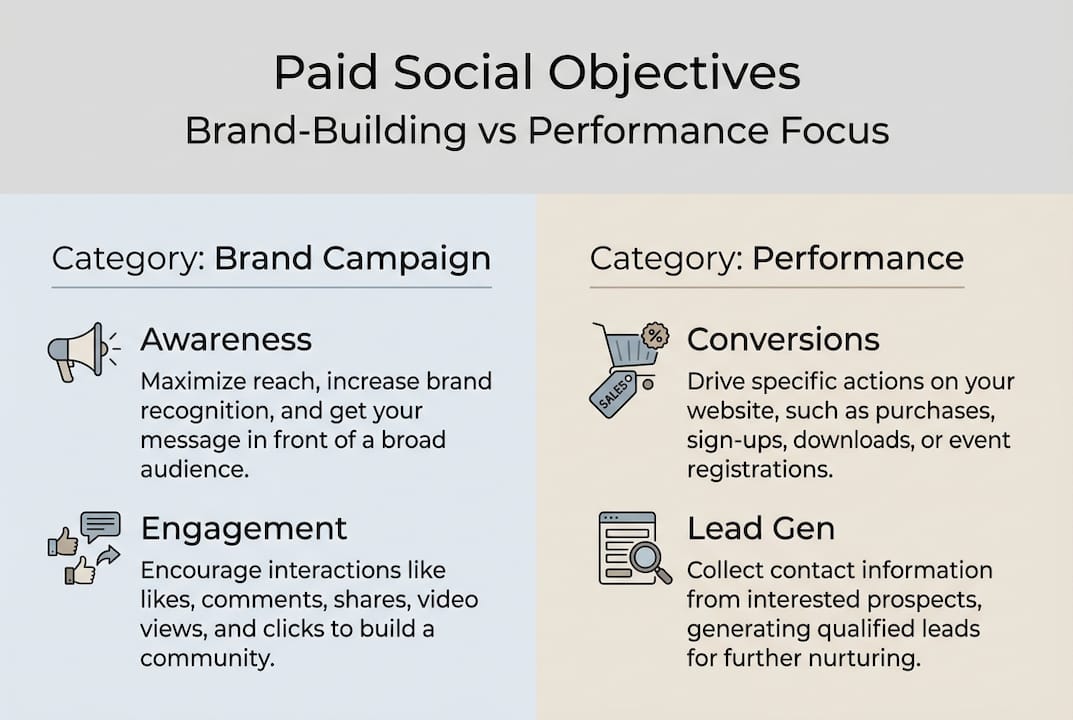
Performance campaigns are direct-response in nature. They drive specific actions: form completions, product purchases, demo bookings. Results are faster to measure and easier to justify in budget conversations. The risk is that brands that focus exclusively on performance can find themselves buying from an ever-shrinking pool of already-aware prospects.
Campaign typePrimary metricTime to impactBudget approachBrand awarenessImpressions, reach, recall liftWeeks to monthsSteady, ongoingLead generationCost per lead, lead volumeDays to weeksBurst or always-onDirect salesROAS, revenue, conversion rateImmediatePerformance-linkedRetargetingConversion rate, cost per saleFastProportional to traffic
The most effective B2B campaigns often run both in parallel. Brand activity warms an audience, and performance campaigns capture that warmed demand efficiently. This is why brand strategy for B2B growth is not a soft optional extra. It is the infrastructure that makes your direct-response spend work harder.
Some marketers focus on direct sales via performance campaigns alone, while others prioritise brand-building first. The practical truth for mid-sized businesses is that your budget size often dictates your approach. If you are spending under £5,000 per month on paid social, lead generation campaigns with tight audience control tend to produce clearer, faster returns. As budgets grow, the case for investing in brand-building alongside performance becomes much stronger.
The businesses that win at paid social are not the ones with the biggest budgets. They are the ones who understand their audience well enough to know when to build brand equity and when to harvest it.
Key performance indicators to track across both campaign types:
Theory matters, but paid social is a discipline where execution separates the effective from the expensive. Here is the practical framework we see produce consistent results.
For practical evidence of what structured paid social looks like in practice, real client examples show how integrated strategies compound over time rather than producing isolated results.
Pro Tip: Set a minimum learning period of two weeks before making significant changes to a new campaign. Platforms need time to exit their learning phase, and early interference often resets the algorithm’s optimisation progress, costing you both time and money.
There is a tempting idea circulating in marketing circles: that AI will eventually handle paid social so well that strategic input becomes unnecessary. We think this misunderstands what AI actually does well and where it falls short.
AI excels at pattern recognition and rapid optimisation across large data sets. It does not understand your commercial context, your competitive positioning, or the qualitative reasons a customer chose you over a competitor. Those insights come from human experience and genuine customer understanding.
The lesson from AI-powered SEO runs parallel here: businesses that treat AI as a replacement for strategic thinking tend to plateau. Those that use it to accelerate and scale good strategic decisions see compounding returns. The same applies to paid social. Your team’s ability to interpret data, spot anomalies, and make contextual decisions is not being made redundant by AI. It is being made more valuable because the volume of data to interpret is growing faster than any individual could manage manually.
The practical takeaway is this: invest in upskilling your team to read campaign data critically, not just to manage dashboards. The competitive edge in 2026 belongs to businesses where human judgement and machine efficiency operate together, not in opposition.
If this guide has sharpened your thinking on paid social, the natural next step is applying it within a broader growth system. At Viaduct Generation, we integrate paid social within a connected digital engine that includes conversion rate optimisation, search engine optimisation services, and full-funnel performance strategy. Every channel we manage is designed to compound rather than operate in isolation. Our senior-led, AI-native model means you get strategic depth alongside genuine executional scale. To see how this translates into real commercial outcomes, explore our client success stories and discover what an integrated growth system can achieve for a business at your stage.
Paid social ads appear within social media feeds and use platform-level audience targeting based on user behaviour and profile data, whereas traditional digital ads encompass search and display placements that target based on keywords or browsing context.
Set specific goals at the outset, implement platform conversion tracking, and compare total spend against tangible outcomes such as revenue, qualified leads, or cost per acquisition. Tracking both performance and brand-building metrics together gives the clearest picture of true ROI.
Neither is universally superior. AI-powered targeting scales quickly and can surface unexpected audiences, but it performs best when paired with human oversight and a strong creative strategy rather than used as a fully autonomous solution.
LinkedIn remains the strongest channel for B2B audiences due to its professional targeting capabilities, though Facebook and X (Twitter) offer viable options for reaching business audiences depending on your sector, message, and budget level.

