
Google has changed how we search before. AI Overviews are something bigger. They're the AI-generated summaries that now sit at the top of search results, answering the question directly instead of handing you a list of blue links. For businesses, this isn't a tweak to ranking factors. It's a shift in what "being found" even means.
If you're not yet sure how to respond, you're not alone. Here's what AI Overviews are, why Google is doing this, and how to keep your brand visible as search becomes answer-first.
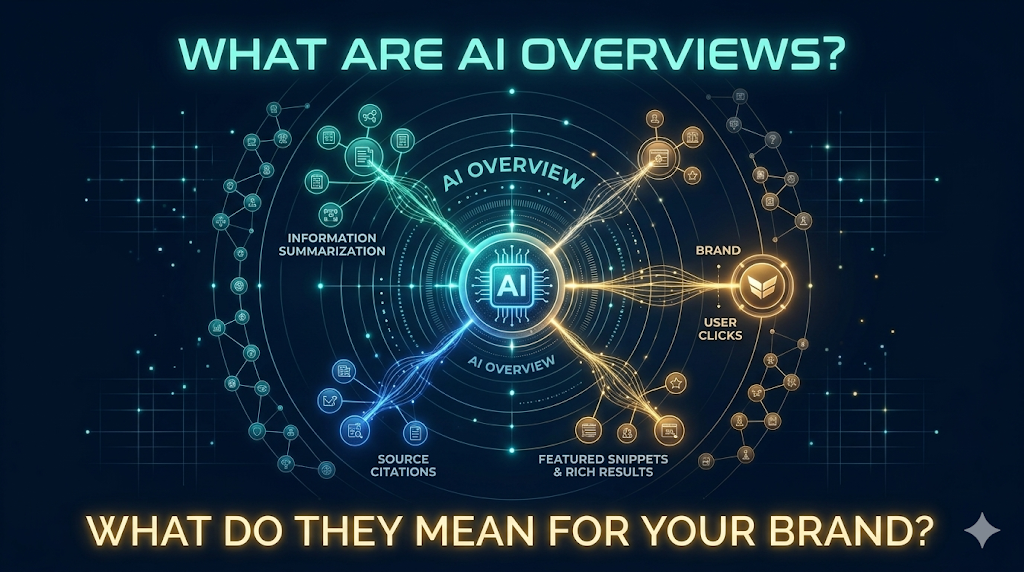
AI Overviews are Google's move into generative AI-powered search. Instead of listing websites, Google pulls information from across the web and generates a short, conversational answer, citing a few sources along the way.
Search "are electric cars better for the environment?" and you may now get a ready-made paragraph summarising the key points and a handful of citations, with no need to click. Multiply that across millions of queries and you can see why this matters.
Google's stated mission has always been to organise the world's information and make it useful. AI Overviews aim to make results faster and more intuitive, powered by models like Gemini. It's the latest step in a long line of updates that have steadily woven AI into search, and Google isn't alone. ChatGPT and Perplexity are answer engines too, and customers now move fluidly between all of them.
Convenience: a quick, direct answer with no scrolling. The trade-off is nuance, as summaries can flatten context, and if the AI draws on weak sources, the answer can be wrong.
This is the real story. If your content is strong enough to be cited in an AI Overview, that's visibility and authority. But if users get everything they need from the summary, they may never click through. AI Overviews raise the bar: engines need trustworthy, well-structured content to feed their answers, so the brands that earn citations are the ones that win.
The discipline of earning those citations has a name, Answer Engine Optimisation (AEO), and it's now as important as traditional SEO. We've written the definitive AEO guide for ChatGPT, Perplexity, and Google AI Overviews if you want to go deep.
AI Overviews mark a new phase in how people search and how brands get found. The fundamentals haven't changed: be useful, be clear, and keep showing up. What has changed is that you now need to show up across three engines, traditional search, AI answer engines, and generative results, not one.
That's exactly what our unified SEO, AEO and GEO service is built for. If you're not sure how visible your brand is inside AI answers today, run our free AI Visibility Checker and get in touch when you're ready to make your next move.

