
Digital public relations is the practice of earning online visibility and authority through data-led stories, original research, and targeted outreach — measured by meaningful coverage, mentions, and commercial outcomes. Success looks like this: a journalist at a trade publication runs your proprietary data, the piece earns a followed link to your resource hub, branded search volume ticks up over the following quarter, and your sales team starts fielding warmer inbound enquiries. That chain, from story to coverage to commercial signal, is what separates a functioning digital PR programme from a press release distribution habit.
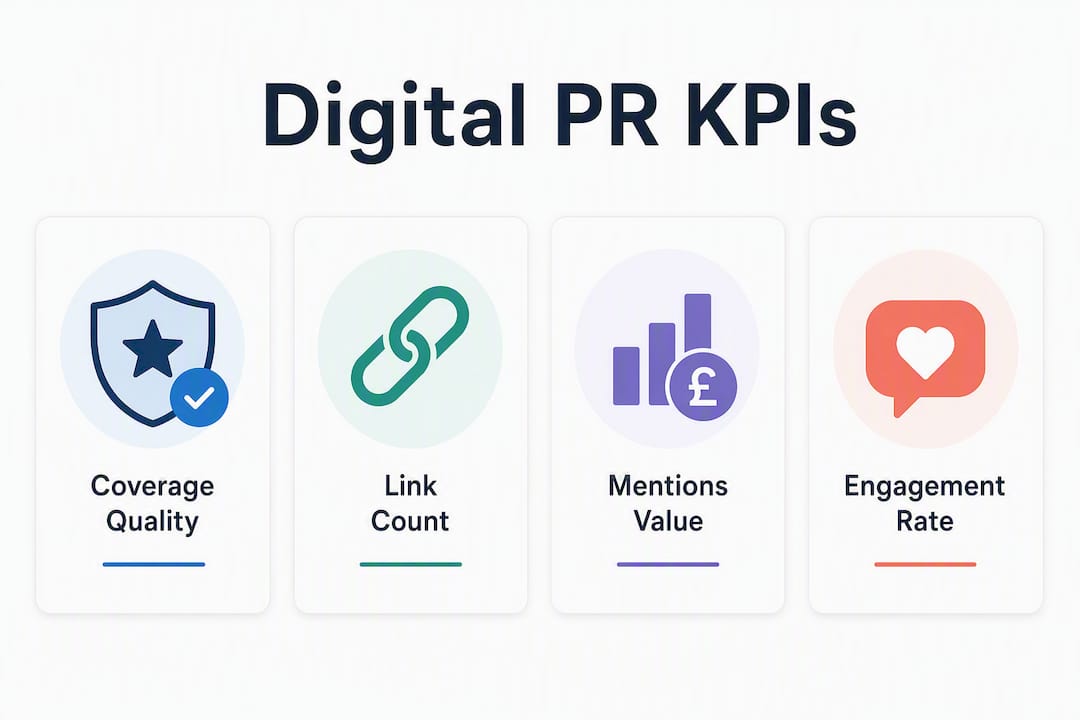
An effective programme typically rests on four elements:
The UK market has shifted considerably. Search engines now surface AI-generated overview answers above organic results for a growing share of queries, which means a brand that earns citations across credible publications gets referenced in those overviews, not just ranked below them. Journalists, meanwhile, are under greater editorial pressure: fewer staff, faster cycles, and a higher bar for what they will actually run. Generic commentary no longer clears that bar.
According to industry reporting, 71% of UK businesses consider digital PR very important, while 12% report lacking the resources or skills to include it effectively. That gap is where most mid-market brands sit: they understand the value but have not yet built the operating model to deliver consistently.
The commercial case is direct. Digital PR placements can be repurposed across sales materials and continue to drive referral traffic and leads long after publication. A single tier-one placement in a respected trade title can shorten a sales conversation that would otherwise take three more touchpoints. At the same time, earned coverage builds the kind of brand demand that paid search cannot manufacture: a prospect who has read about you in a credible publication arrives with a different level of trust than one who clicked an ad.
A well-run programme draws on several channels simultaneously, because no single outlet type delivers every outcome you need.
Primary channels:
Core outreach tactics:
The choice between earned mentions, influencer partnerships, and owned amplification depends on where your audience actually spends time and what stage of the funnel you are targeting. Earned editorial builds authority at the top; influencer partnerships accelerate reach in niche communities; owned amplification extends the shelf life of both. For most mid-market B2B brands, earned editorial and original research should anchor the programme, with influencer and social amplification layered on top.
Pro Tip: Pitch fewer outlets with more precision. A personalised pitch to six journalists who cover your exact beat will outperform a mass send to sixty every time. Quality of placement, not volume of pitches, is what moves the needle on both coverage and SEO.

Not all content is equally pitchable. Journalists and editors respond to formats that give them something genuinely usable: a data point they can quote, a visual they can embed, or a perspective that adds something their readers have not seen.
These are the workhorses of data-led digital PR. A well-constructed survey of 500–1,000 respondents in your sector produces multiple story angles, can be pitched to several publications simultaneously with different cuts of the data, and generates a citable asset that earns links for months. PR Fire recommends original data studies as one of the highest-value tactics for UK B2B brands, particularly when targeted at niche trade publications where the data is directly relevant to the readership.

A named executive with a clear point of view, placed in a relevant trade title, builds personal authority and brand credibility simultaneously. The key is genuine opinion: editors can spot a thinly veiled product pitch dressed as commentary. The best bylines take a position that a segment of the readership will disagree with. That friction is what gets shared.
These perform particularly well with digital-native publications that need embeddable assets. A well-designed interactive tool or chart gives editors a reason to link back to your hosted version rather than simply citing the finding in text.
Podcast placements are underused by most B2B brands. A 40-minute conversation with a respected host in your sector reaches a highly engaged audience, generates a citation surface that AI-driven search tools increasingly reference, and produces clip content for social amplification. The format rewards genuine expertise over polished messaging.
A case study pitched as a story, rather than a testimonial, can earn editorial placement when the outcome is specific and the numbers are real. Follow-up coverage, returning to a story six months later with updated data, is an underused tactic that strengthens journalist relationships and extends the life of an original campaign.
Pro Tip: Prepare a journalist-ready asset pack for every campaign: a one-page data summary, three to five pull-quote options, a high-resolution chart or visual, and a named spokesperson available for comment within 24 hours. Editors on deadline will take the path of least resistance.
A digital PR strategy that actually delivers commercial outcomes follows a clear sequence. Here is the operating blueprint.
Pro Tip: Build your story ideas bank at the start of each quarter, not the week before you need to pitch. The best reactive opportunities go to brands that already have a spokesperson briefed and a data point ready.
Most digital PR programmes are measured on the wrong things. Link count is a proxy, not an outcome. Coverage volume tells you how busy the team was, not whether the programme is working.
KPIWhat it measuresWhy it mattersCoverage quality scoreEditorial prominence, publication authority, placement contextDistinguishes a tier-one feature from a passing mentionRelevant backlinksLinks from topically aligned, high-authority domainsPasses authority to commercial pages and improves rankingsBranded search liftMonth-on-month change in branded query volumeIndicates growing brand demand driven by earned mediaReferral and assisted conversionsTraffic and goal completions attributed to PR placementsConnects coverage directly to pipeline activitySentiment and share of voiceProportion of positive mentions vs competitorsTracks reputation health over timeCitation shareBreadth of independent mentions across media typesMeasures resilience of authority signals across AI-driven search
The most useful measurement approach combines qualitative and quantitative signals. A placement in a respected trade title that drives 40 referral visits but generates three qualified sales enquiries is worth more than a high-traffic consumer piece that produces no commercial activity. Tracking assisted conversions through your analytics platform, and tagging PR-sourced traffic consistently, makes this attribution possible.
One measurement warning: a high raw backlink count from low-authority or topically irrelevant domains can actively dilute your authority profile. The quality of the linking domain and the relevance of the surrounding content matter far more than the number.
Mentions without links and co-citation now contribute meaningfully to topical authority, particularly for AI-driven search. A brand cited consistently across podcasts, trade reports, and reference pages builds a citation surface that search engines and AI overviews draw on, even when no followed link is present.
Earned coverage only delivers its full search value when the technical foundations are in place. A link from a respected publication pointing to a poorly structured page, or one that redirects through several hops, loses much of its authority signal before it reaches your commercial content.
Technical integration checklist:
For AEO (Answer Engine Optimisation), the goal is to appear in AI-generated overviews and direct answers. This requires building a citation surface across multiple media types, not just earning backlinks. A brand cited in a podcast transcript, a trade report, and a reference page on an authoritative site is more likely to be surfaced by an AI overview than one with a single high-authority link. Viaductgen’s AI citation rates guide explains how to track and prioritise this signal.
For GEO (Geographical Optimisation), regional angles matter. A UK-specific data cut from a national survey, pitched to regional business media, builds local authority signals that support both traditional local search and AI-driven local recommendations. Align landing pages to the regional angle, and ensure your Google Business Profile and local citations are consistent with the coverage.
Pro Tip: When planning where earned links should point, prioritise your resource hub pages and commercial landing pages over your homepage. A link to a well-structured B2B SEO resource passes more targeted authority than a generic homepage link.
Journalist expectations have shifted. The volume of pitches hitting editorial inboxes has increased, while the time available to evaluate them has decreased. What cuts through is not a longer press release; it is a shorter, more useful one.
A compact pitch structure that works:
Personalisation is non-negotiable. A pitch that references a journalist’s recent piece, explains why this story fits their beat, and offers something genuinely exclusive will always outperform a mass send. Research the journalist’s last five articles before you write a single word of the pitch.
Dos and don’ts:
Pro Tip: Set a response window of five working days for embargoed stories. If a journalist has not responded by then, offer the story to your next-choice outlet. Holding a story indefinitely for a non-response damages your cadence and your relationship with the second-choice journalist who would have run it.
Running a digital PR programme at the level that produces consistent commercial outcomes requires a defined team, a clear cadence, and realistic budget expectations.
Core roles:
Mid-sized brands typically organise digital PR around a quarterly cadence, aiming for several tier-one placements per quarter alongside ongoing reactive commentary. A sprint-based 90-day delivery model, with defined outputs and a review point at the end of each sprint, keeps the programme accountable and allows for rapid adjustment.
Typical UK budget ranges by programme intensity:
Specific budget figures vary considerably by agency, scope, and sector. Any agency that quotes a fixed price without understanding your story pipeline and target outlets is guessing.
In-house vs agency: a decision checklist:
If the answer to two or more of these is no, an agency or hybrid model will deliver more consistent results than an in-house team built from scratch.
The most common failure mode in digital PR is not a bad story. It is a good story pitched badly, to the wrong people, with no follow-through.
Common operational mistakes:
On the legal and compliance side, the UK has clear rules that apply directly to digital PR activity. The Advertising Standards Authority requires that paid or incentivised placements are clearly disclosed. Attempting to pass sponsored content as independent editorial not only risks ASA action; it damages relationships with the premium journalists whose trust is the most valuable asset in your programme. Copyright in research assets belongs to the commissioning brand unless otherwise agreed in writing, but data sourced from third parties requires proper attribution and, in some cases, a licence.
Data protection matters too. If your survey or research programme collects personal data from respondents, it must comply with UK GDPR, including lawful basis for processing and appropriate retention limits.
Pro Tip: Build a short compliance checklist into your campaign sign-off process: Is this placement disclosed if paid? Is the data methodology documented and shareable? Are third-party data sources properly attributed? Five minutes at sign-off prevents problems that take weeks to resolve.
The gap between a digital PR strategy on paper and one that delivers consistent results usually comes down to operating model. A sprint-based approach, structured around 90-day cycles, gives mid-market brands the cadence and accountability that ad hoc campaigns cannot.
A well-run 90-day sprint looks like this:
Sprint phases:
Senior involvement at every phase, not just sign-off, is what separates programmes that compound from those that plateau. When the strategist who designed the story is also reviewing the coverage and adjusting the next pitch, the learning loop closes faster.
Viaductgen’s AI-powered delivery model applies this sprint structure across its client engagements, using AI-enabled research to accelerate story discovery and journalist mapping while keeping senior strategists in the room for creative and editorial decisions. The result is a programme that moves at the pace of a larger agency without the overhead.
Expected near-term signals from a well-run first sprint: two to four earned placements, at least one followed link from a domain with meaningful authority, and a measurable uptick in branded search queries by week twelve. Medium-term authority gains, including improved rankings for target commercial terms and a broader citation surface across media types, typically become visible over two to three quarters of consistent activity.
A digital PR programme that ties earned coverage directly to commercial outcomes requires data-led storytelling, a quarterly operating cadence, and measurement that goes beyond link counts.
PointDetailsLead with original dataProprietary surveys and benchmark reports consistently earn the highest-quality coverage and links for UK brands.Adopt a quarterly cadenceMid-market brands should plan around 90-day sprints with defined outputs, a measurement review, and a story pipeline for the next cycle.Measure commercial outcomesTrack branded search lift, referral conversions, and citation share alongside backlink quality — not raw link volume.Integrate with searchEnsure earned links point to technically sound, commercially relevant pages, and build a citation surface across media types for AEO and GEO gains.Viaductgen’s sprint modelViaductgen runs 90-day digital PR sprints combining AI-enabled research with senior-led strategy, tied directly to pipeline and revenue outcomes.
Mid-market and scale-up brands that want consistent coverage, authority, and commercial outcomes from their PR investment often find that the missing ingredient is not budget — it is operating model. Viaductgen runs 90-day digital PR sprints that combine AI-enabled story research, senior-led outreach strategy, and rigorous measurement tied to pipeline, not just placements.
The programme suits B2B businesses, e-commerce brands, and charities that need a senior team to own the story pipeline, manage journalist relationships, and connect earned coverage to search and demand outcomes. Every sprint ends with a measurement review that attributes coverage to commercial signals, not just traffic.
If you want to see how the model works in practice, explore how Viaductgen uses AI in client work or get in touch to discuss a 90-day sprint for your brand.
Further reading and primary sources cited in this guide:
Digital public relations is the practice of earning online coverage, backlinks, and brand mentions through data-led stories, original research, and targeted journalist outreach. Unlike traditional PR, it is measured by search authority, referral traffic, and commercial outcomes alongside editorial placement.
No. AI is accelerating research, trend discovery, and distribution workflows for PR professionals who adopt it strategically, but editorial judgement, journalist relationships, and creative story development remain human-led. The practitioners who use AI as a research and efficiency tool are outperforming those who do not.
The core types include original data and research campaigns, expert commentary and reactive newsjacking, executive bylines and thinkpieces, podcast and interview placements, influencer and creator partnerships, and owned newsroom content. Most effective programmes combine several of these within a quarterly cadence.
Salaries vary by seniority and sector. Senior digital PR strategists and heads of PR at agency and in-house level command competitive salaries in the UK, particularly where the role spans SEO, content strategy, and commercial measurement. The specialism is growing in demand as brands recognise the search and authority value of earned media.
Near-term signals, including earned placements and initial referral traffic, typically appear within the first 90-day sprint. Meaningful authority gains, such as improved rankings for commercial terms and a broader citation surface, generally become visible over two to three quarters of consistent, well-measured activity.
Digital public relations is the practice of earning online visibility and authority through data-led stories, original research, and targeted outreach — measured by meaningful coverage, mentions, and commercial outcomes. Success looks like this: a journalist at a trade publication runs your proprietary data, the piece earns a followed link to your resource hub, branded search volume ticks up over the following quarter, and your sales team starts fielding warmer inbound enquiries. That chain, from story to coverage to commercial signal, is what separates a functioning digital PR programme from a press release distribution habit.
An effective programme typically rests on four elements:
The UK market has shifted considerably. Search engines now surface AI-generated overview answers above organic results for a growing share of queries, which means a brand that earns citations across credible publications gets referenced in those overviews, not just ranked below them. Journalists, meanwhile, are under greater editorial pressure: fewer staff, faster cycles, and a higher bar for what they will actually run. Generic commentary no longer clears that bar.
According to industry reporting, 71% of UK businesses consider digital PR very important, while 12% report lacking the resources or skills to include it effectively. That gap is where most mid-market brands sit: they understand the value but have not yet built the operating model to deliver consistently.
The commercial case is direct. Digital PR placements can be repurposed across sales materials and continue to drive referral traffic and leads long after publication. A single tier-one placement in a respected trade title can shorten a sales conversation that would otherwise take three more touchpoints. At the same time, earned coverage builds the kind of brand demand that paid search cannot manufacture: a prospect who has read about you in a credible publication arrives with a different level of trust than one who clicked an ad.
A well-run programme draws on several channels simultaneously, because no single outlet type delivers every outcome you need.
Primary channels:
Core outreach tactics:
The choice between earned mentions, influencer partnerships, and owned amplification depends on where your audience actually spends time and what stage of the funnel you are targeting. Earned editorial builds authority at the top; influencer partnerships accelerate reach in niche communities; owned amplification extends the shelf life of both. For most mid-market B2B brands, earned editorial and original research should anchor the programme, with influencer and social amplification layered on top.
Pro Tip: Pitch fewer outlets with more precision. A personalised pitch to six journalists who cover your exact beat will outperform a mass send to sixty every time. Quality of placement, not volume of pitches, is what moves the needle on both coverage and SEO.
Not all content is equally pitchable. Journalists and editors respond to formats that give them something genuinely usable: a data point they can quote, a visual they can embed, or a perspective that adds something their readers have not seen.
These are the workhorses of data-led digital PR. A well-constructed survey of 500–1,000 respondents in your sector produces multiple story angles, can be pitched to several publications simultaneously with different cuts of the data, and generates a citable asset that earns links for months. PR Fire recommends original data studies as one of the highest-value tactics for UK B2B brands, particularly when targeted at niche trade publications where the data is directly relevant to the readership.
A named executive with a clear point of view, placed in a relevant trade title, builds personal authority and brand credibility simultaneously. The key is genuine opinion: editors can spot a thinly veiled product pitch dressed as commentary. The best bylines take a position that a segment of the readership will disagree with. That friction is what gets shared.
These perform particularly well with digital-native publications that need embeddable assets. A well-designed interactive tool or chart gives editors a reason to link back to your hosted version rather than simply citing the finding in text.
Podcast placements are underused by most B2B brands. A 40-minute conversation with a respected host in your sector reaches a highly engaged audience, generates a citation surface that AI-driven search tools increasingly reference, and produces clip content for social amplification. The format rewards genuine expertise over polished messaging.
A case study pitched as a story, rather than a testimonial, can earn editorial placement when the outcome is specific and the numbers are real. Follow-up coverage, returning to a story six months later with updated data, is an underused tactic that strengthens journalist relationships and extends the life of an original campaign.
Pro Tip: Prepare a journalist-ready asset pack for every campaign: a one-page data summary, three to five pull-quote options, a high-resolution chart or visual, and a named spokesperson available for comment within 24 hours. Editors on deadline will take the path of least resistance.
A digital PR strategy that actually delivers commercial outcomes follows a clear sequence. Here is the operating blueprint.
Pro Tip: Build your story ideas bank at the start of each quarter, not the week before you need to pitch. The best reactive opportunities go to brands that already have a spokesperson briefed and a data point ready.
Most digital PR programmes are measured on the wrong things. Link count is a proxy, not an outcome. Coverage volume tells you how busy the team was, not whether the programme is working.
KPIWhat it measuresWhy it mattersCoverage quality scoreEditorial prominence, publication authority, placement contextDistinguishes a tier-one feature from a passing mentionRelevant backlinksLinks from topically aligned, high-authority domainsPasses authority to commercial pages and improves rankingsBranded search liftMonth-on-month change in branded query volumeIndicates growing brand demand driven by earned mediaReferral and assisted conversionsTraffic and goal completions attributed to PR placementsConnects coverage directly to pipeline activitySentiment and share of voiceProportion of positive mentions vs competitorsTracks reputation health over timeCitation shareBreadth of independent mentions across media typesMeasures resilience of authority signals across AI-driven search
The most useful measurement approach combines qualitative and quantitative signals. A placement in a respected trade title that drives 40 referral visits but generates three qualified sales enquiries is worth more than a high-traffic consumer piece that produces no commercial activity. Tracking assisted conversions through your analytics platform, and tagging PR-sourced traffic consistently, makes this attribution possible.
One measurement warning: a high raw backlink count from low-authority or topically irrelevant domains can actively dilute your authority profile. The quality of the linking domain and the relevance of the surrounding content matter far more than the number.
Mentions without links and co-citation now contribute meaningfully to topical authority, particularly for AI-driven search. A brand cited consistently across podcasts, trade reports, and reference pages builds a citation surface that search engines and AI overviews draw on, even when no followed link is present.
Earned coverage only delivers its full search value when the technical foundations are in place. A link from a respected publication pointing to a poorly structured page, or one that redirects through several hops, loses much of its authority signal before it reaches your commercial content.
Technical integration checklist:
For AEO (Answer Engine Optimisation), the goal is to appear in AI-generated overviews and direct answers. This requires building a citation surface across multiple media types, not just earning backlinks. A brand cited in a podcast transcript, a trade report, and a reference page on an authoritative site is more likely to be surfaced by an AI overview than one with a single high-authority link. Viaductgen’s AI citation rates guide explains how to track and prioritise this signal.
For GEO (Geographical Optimisation), regional angles matter. A UK-specific data cut from a national survey, pitched to regional business media, builds local authority signals that support both traditional local search and AI-driven local recommendations. Align landing pages to the regional angle, and ensure your Google Business Profile and local citations are consistent with the coverage.
Pro Tip: When planning where earned links should point, prioritise your resource hub pages and commercial landing pages over your homepage. A link to a well-structured B2B SEO resource passes more targeted authority than a generic homepage link.
Journalist expectations have shifted. The volume of pitches hitting editorial inboxes has increased, while the time available to evaluate them has decreased. What cuts through is not a longer press release; it is a shorter, more useful one.
A compact pitch structure that works:
Personalisation is non-negotiable. A pitch that references a journalist’s recent piece, explains why this story fits their beat, and offers something genuinely exclusive will always outperform a mass send. Research the journalist’s last five articles before you write a single word of the pitch.
Dos and don’ts:
Pro Tip: Set a response window of five working days for embargoed stories. If a journalist has not responded by then, offer the story to your next-choice outlet. Holding a story indefinitely for a non-response damages your cadence and your relationship with the second-choice journalist who would have run it.
Running a digital PR programme at the level that produces consistent commercial outcomes requires a defined team, a clear cadence, and realistic budget expectations.
Core roles:
Mid-sized brands typically organise digital PR around a quarterly cadence, aiming for several tier-one placements per quarter alongside ongoing reactive commentary. A sprint-based 90-day delivery model, with defined outputs and a review point at the end of each sprint, keeps the programme accountable and allows for rapid adjustment.
Typical UK budget ranges by programme intensity:
Specific budget figures vary considerably by agency, scope, and sector. Any agency that quotes a fixed price without understanding your story pipeline and target outlets is guessing.
In-house vs agency: a decision checklist:
If the answer to two or more of these is no, an agency or hybrid model will deliver more consistent results than an in-house team built from scratch.
The most common failure mode in digital PR is not a bad story. It is a good story pitched badly, to the wrong people, with no follow-through.
Common operational mistakes:
On the legal and compliance side, the UK has clear rules that apply directly to digital PR activity. The Advertising Standards Authority requires that paid or incentivised placements are clearly disclosed. Attempting to pass sponsored content as independent editorial not only risks ASA action; it damages relationships with the premium journalists whose trust is the most valuable asset in your programme. Copyright in research assets belongs to the commissioning brand unless otherwise agreed in writing, but data sourced from third parties requires proper attribution and, in some cases, a licence.
Data protection matters too. If your survey or research programme collects personal data from respondents, it must comply with UK GDPR, including lawful basis for processing and appropriate retention limits.
Pro Tip: Build a short compliance checklist into your campaign sign-off process: Is this placement disclosed if paid? Is the data methodology documented and shareable? Are third-party data sources properly attributed? Five minutes at sign-off prevents problems that take weeks to resolve.
The gap between a digital PR strategy on paper and one that delivers consistent results usually comes down to operating model. A sprint-based approach, structured around 90-day cycles, gives mid-market brands the cadence and accountability that ad hoc campaigns cannot.
A well-run 90-day sprint looks like this:
Sprint phases:
Senior involvement at every phase, not just sign-off, is what separates programmes that compound from those that plateau. When the strategist who designed the story is also reviewing the coverage and adjusting the next pitch, the learning loop closes faster.
Viaductgen’s AI-powered delivery model applies this sprint structure across its client engagements, using AI-enabled research to accelerate story discovery and journalist mapping while keeping senior strategists in the room for creative and editorial decisions. The result is a programme that moves at the pace of a larger agency without the overhead.
Expected near-term signals from a well-run first sprint: two to four earned placements, at least one followed link from a domain with meaningful authority, and a measurable uptick in branded search queries by week twelve. Medium-term authority gains, including improved rankings for target commercial terms and a broader citation surface across media types, typically become visible over two to three quarters of consistent activity.
A digital PR programme that ties earned coverage directly to commercial outcomes requires data-led storytelling, a quarterly operating cadence, and measurement that goes beyond link counts.
PointDetailsLead with original dataProprietary surveys and benchmark reports consistently earn the highest-quality coverage and links for UK brands.Adopt a quarterly cadenceMid-market brands should plan around 90-day sprints with defined outputs, a measurement review, and a story pipeline for the next cycle.Measure commercial outcomesTrack branded search lift, referral conversions, and citation share alongside backlink quality — not raw link volume.Integrate with searchEnsure earned links point to technically sound, commercially relevant pages, and build a citation surface across media types for AEO and GEO gains.Viaductgen’s sprint modelViaductgen runs 90-day digital PR sprints combining AI-enabled research with senior-led strategy, tied directly to pipeline and revenue outcomes.
Mid-market and scale-up brands that want consistent coverage, authority, and commercial outcomes from their PR investment often find that the missing ingredient is not budget — it is operating model. Viaductgen runs 90-day digital PR sprints that combine AI-enabled story research, senior-led outreach strategy, and rigorous measurement tied to pipeline, not just placements.
The programme suits B2B businesses, e-commerce brands, and charities that need a senior team to own the story pipeline, manage journalist relationships, and connect earned coverage to search and demand outcomes. Every sprint ends with a measurement review that attributes coverage to commercial signals, not just traffic.
If you want to see how the model works in practice, explore how Viaductgen uses AI in client work or get in touch to discuss a 90-day sprint for your brand.
Further reading and primary sources cited in this guide:
Digital public relations is the practice of earning online coverage, backlinks, and brand mentions through data-led stories, original research, and targeted journalist outreach. Unlike traditional PR, it is measured by search authority, referral traffic, and commercial outcomes alongside editorial placement.
No. AI is accelerating research, trend discovery, and distribution workflows for PR professionals who adopt it strategically, but editorial judgement, journalist relationships, and creative story development remain human-led. The practitioners who use AI as a research and efficiency tool are outperforming those who do not.
The core types include original data and research campaigns, expert commentary and reactive newsjacking, executive bylines and thinkpieces, podcast and interview placements, influencer and creator partnerships, and owned newsroom content. Most effective programmes combine several of these within a quarterly cadence.
Salaries vary by seniority and sector. Senior digital PR strategists and heads of PR at agency and in-house level command competitive salaries in the UK, particularly where the role spans SEO, content strategy, and commercial measurement. The specialism is growing in demand as brands recognise the search and authority value of earned media.
Near-term signals, including earned placements and initial referral traffic, typically appear within the first 90-day sprint. Meaningful authority gains, such as improved rankings for commercial terms and a broader citation surface, generally become visible over two to three quarters of consistent, well-measured activity.

