
A composable CDP is a customer data platform assembled from separate components that sit on top of your existing cloud data warehouse, rather than a single packaged product that keeps its own copy of your customer data. The warehouse remains the source of truth for identity and profiles, and modular tools handle ingestion, modelling, segmentation and activation. It suits organisations with data engineering capacity and a need for control. It is a poor fit for teams that need to launch quickly without technical support.
This guide explains what makes a CDP composable, how the architecture works, where a CRM fits, what changes for B2B businesses, and how to decide between building and buying.
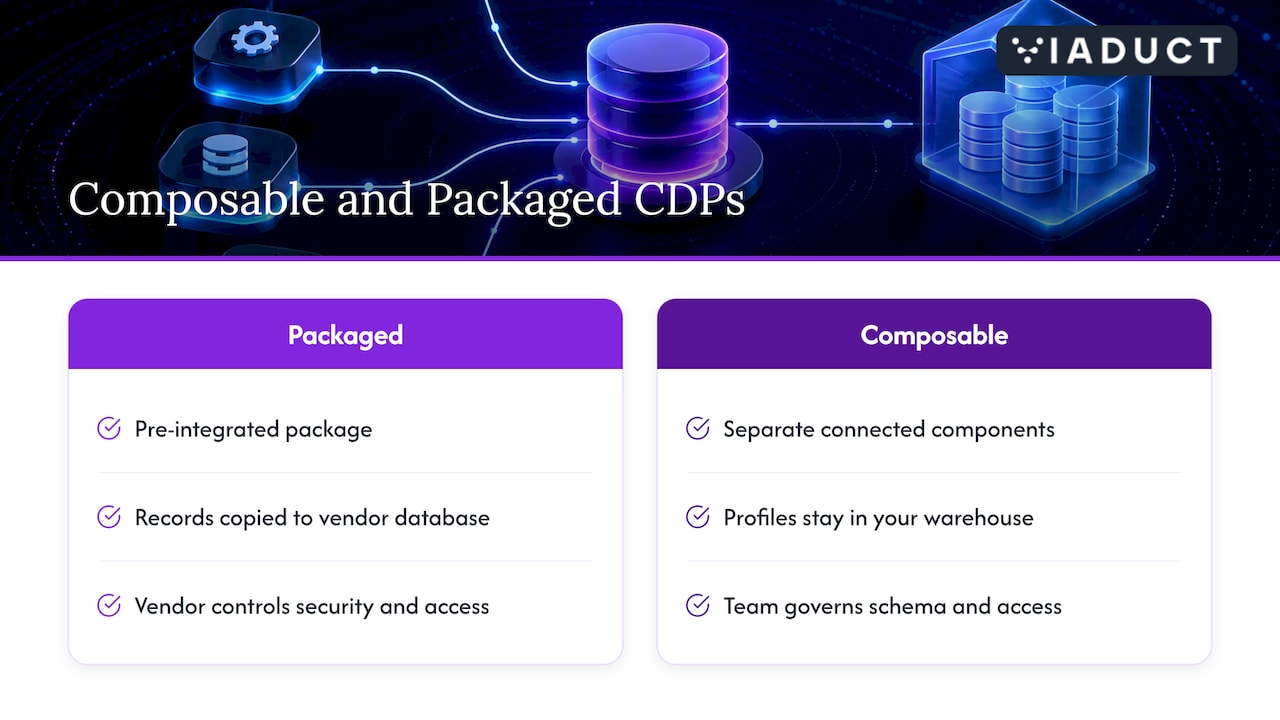
The term describes an architecture, not a product category. According to the CDP Institute, a composable CDP assembles its services from separate, best-of-breed components connected to the data warehouse you already own, instead of relying on a pre-integrated package. The decisive feature is where the data lives. In a packaged CDP, customer records are copied into the vendor’s database. In a composable model, the warehouse holds the profiles, and the surrounding tools read from it and write to it.
The idea borrows from composable software more generally: systems treated as interchangeable modules that can be orchestrated around a specific business need. Redpoint Global describes the CDP version as freedom to choose the best tool for collection, modelling and activation, and to swap one as requirements change.
For a commercial leader, the practical consequence is ownership. Your schema, your access rules and your retention decisions stay inside infrastructure your own team governs. Andreessen Horowitz frames this as minimising or removing replication while keeping customer-owned security and access controls.
A composable CDP is easiest to understand as a sequence of layers, each of which can be provided by a different tool.
The CDP Institute’s guide lists the same functions: ingestion, identity resolution, profile building, segmentation and activation, all running against the warehouse.
The reporting foundation underneath matters as much as the tooling. If your warehouse is not already trusted for cross-channel reporting, a composable CDP inherits that weakness, which is why we treat a marketing data warehouse for reliable cross-channel reporting as a precondition rather than an afterthought.
Neither model is better in the abstract. The CDP Institute’s assessment is that packaged CDPs are faster to deploy and easier for business teams to operate, while composable CDPs reuse the warehouse and offer more control and flexibility but demand more engineering effort to assemble, integrate and maintain.
| Criterion | Packaged CDP | Composable CDP |
|---|---|---|
| Time to first use case | Usually quicker | Depends on warehouse readiness |
| Data location | Vendor’s database holds a copy | Your warehouse holds the profiles |
| Schema flexibility | Typically fixed entities | Defined by your team |
| Engineering effort | Lower | Higher, and ongoing |
| Marketer self-service | Built in | Needs a layer on top |
| Governance and residency | Vendor controlled | Controlled by you |
Two cautions are worth stating plainly. First, the CDP Institute notes that real-time access or updates may require special structures that effectively create a separate CDP database, so the promise of zero duplication does not hold for every use case. Second, the assembled model concentrates risk in identity: CIOPages notes that building dependable cross-channel identity in SQL or dbt is genuinely difficult, whereas packaged products ship identity resolution, an interface for marketers and connectors out of the box.
That same source suggests the approach suits organisations with a mature cloud warehouse, established data engineering teams and a requirement for full control over identity and residency. For UK businesses, the control point is relevant to data protection, since you decide the region in which the data is stored, though your lawful basis and consent obligations remain exactly the same under either model.
The question of how a CDP differs from a CRM is often framed as a choice, but the two do different jobs. Salesforce explains that a CDP unifies customer data from many sources into a comprehensive profile for marketing, whereas a CRM manages interactions and relationships for sales and service. A CDP draws on website visits, social activity and purchase history; a CRM organises emails, sales calls and service requests.
They are strongest together. The CDP feeds unified data to the CRM, and CRM interaction data flows back to enrich the CDP. Twilio gives a practical example: behavioural signals such as product usage or pages viewed are written into CRM records, so sales teams can spot upsell opportunities, understand intent and detect churn risk.
In a composable setup, the CRM is simply one more source and one more destination connected to the warehouse. Nothing is replaced. What changes is that the account and contact view your sales team sees is built from the same governed profile that powers your campaigns.
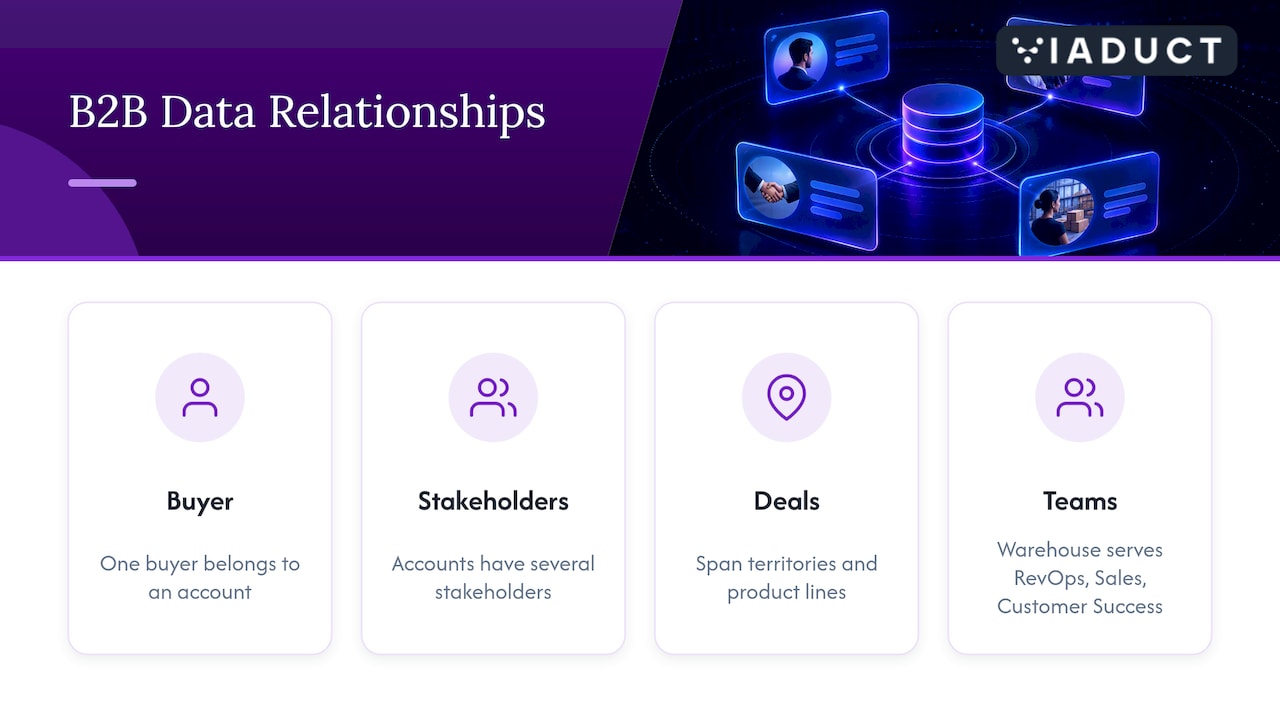
B2B data is relational before it is behavioural. One buyer belongs to an account, an account has several stakeholders, and deals span territories and product lines. Demand Gen Report observes that a composable CDP can model those relationships and activate marketing at account, contact, product-line and territory level, and that warehouse data can serve RevOps, Sales and Customer Success rather than marketing alone.
The same article stresses that implementation and governance decide the outcome. Before committing, verify how the platform obtains data, how easily it accepts future sources, how it partitions access between teams, and whether it meets your regulatory requirements.
In our work with mid-market and scale-up B2B teams, the recurring failure is not the technology. It is the absence of a defined first-party data strategy that says which signals matter and who owns them. Our first party data strategy playbook is the place to settle that before any tooling decision is made.
The composable model blurs the line between building and buying, because you are doing both: buying components, building the connections and the models between them. The CDP Institute’s build versus buy guidance remains a sound frame. Consider building when you have a large development team, substantial budget and a sufficiently unusual need. Consider buying for lower upfront cost and quicker onboarding.
In practice, four questions settle most cases:
A sensible middle path is to start with two or three high-value use cases, such as suppression of existing customers from paid audiences, lifecycle email triggers and account-level scoring, and prove them on the warehouse before widening scope.
A composable CDP earns its keep only when the audiences it builds change what customers see. That means paid media audiences, email and lifecycle flows, onsite personalisation and sales alerts. Creative is part of the same chain: once segments are reliable, tailoring assets to each audience, for example with personalised video content, becomes a practical next step rather than a guess.
For ecommerce brands, the lifecycle layer is usually the quickest return, and our e-commerce email marketing playbook shows how profile data translates into flows.
We do not sell a CDP. We design the growth system around it: the first-party data strategy, the warehouse foundation for reporting and attribution, and the channel execution that turns profiles into revenue across search, paid media, CRO and lifecycle email. Our work runs in fixed-scope 90-day sprints with defined deliverables, and the Blueprint is the right starting point if you want your data, channels and commercial targets mapped before you commit to architecture. To discuss your situation, see our services.
Not in a separate vendor database. The warehouse you own holds the profiles, and the surrounding components read from it and write back to it. Some real-time use cases may need dedicated structures that behave like a separate store.
No. A CRM manages sales and service relationships, while a CDP unifies data for marketing. They exchange data in both directions, and the CRM becomes a source and a destination in the composable architecture.
Often, yes. It can model accounts, contacts, territories and product lines, and serve Sales and Customer Success as well as marketing. Governance and implementation quality matter more than the label.
Build when you have strong engineering resource, budget and an unusual data need. Buy when speed and lower upfront cost matter more. Many teams start narrow on the warehouse and expand as use cases prove their value.

