
Most B2B companies do not have a growth problem. They have an architecture problem. They run campaigns, see a lift, watch it fade, then commission the next campaign. The cycle continues, the budget compounds, and the results stay stubbornly flat. The issue is not effort or spend. It is the structure underneath everything. Campaigns are events. Growth is a system. Until those two things stop being confused, the ceiling never moves.
The companies pulling away from their competitors over the next twelve to twenty-four months are not running better campaigns. They are operating SEO as infrastructure, not a campaign tactic, with every layer connected to the one above and below it.
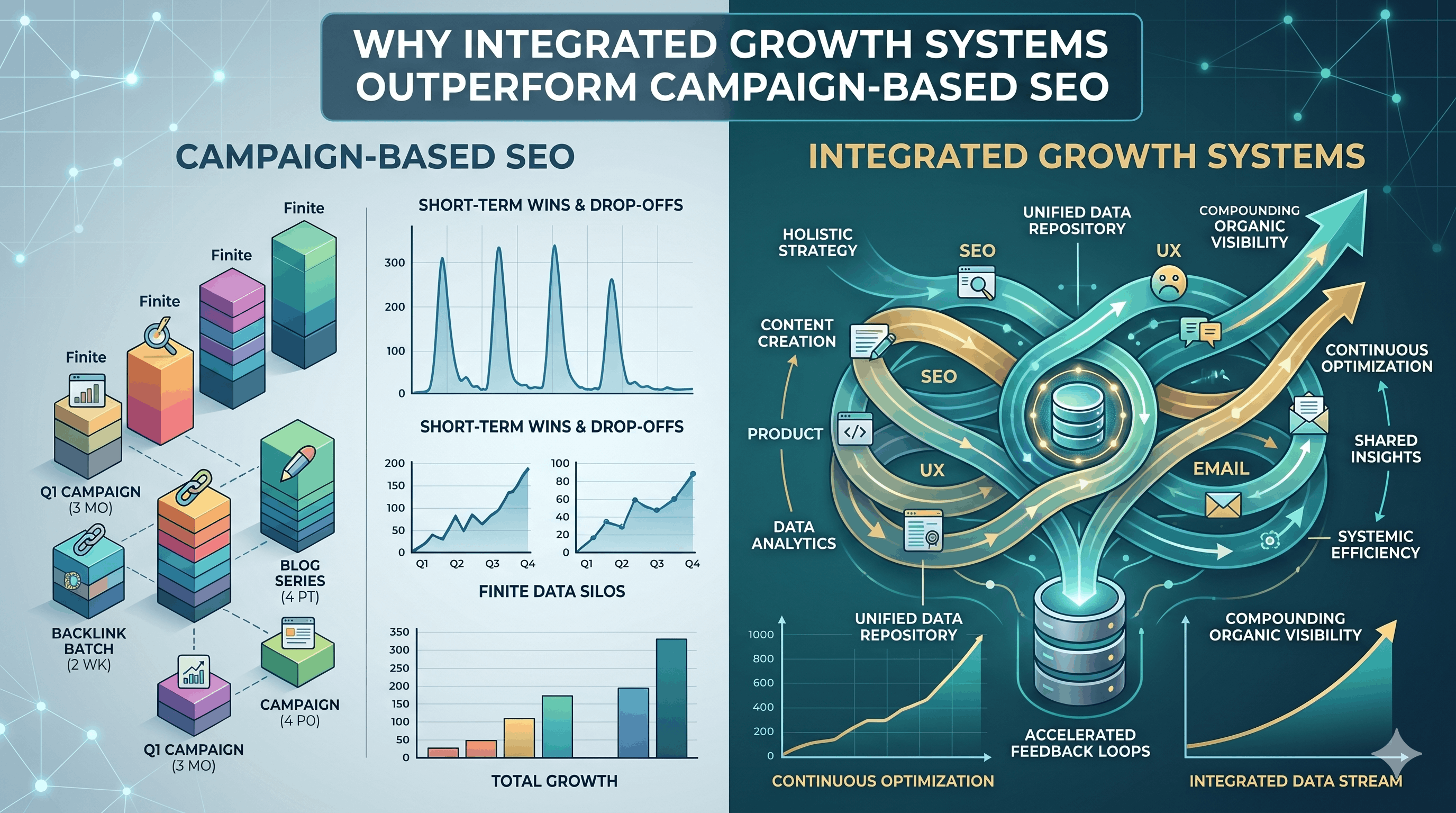
Campaign-based SEO has an intuitive appeal. You identify a problem (thin content, low domain authority, slow crawl speed), hire someone to fix it, and move on. Audits, link-building sprints, content campaigns, technical fixes: each one a discrete project with a brief, a deliverable, and an invoice.
This model makes procurement easy. It makes attribution feel clean. But it treats a compounding system as a series of isolated transactions, and that distinction matters enormously over a 12 to 24-month horizon.
The reason it feels logical is that early campaigns often do produce results. A well-executed content sprint can lift organic traffic. A focused link-building push can move domain authority. The problem emerges when you expect those results to persist and grow, because without connective tissue between tactics, they rarely do.
Growth compounds when one layer reinforces the next. Technical infrastructure makes content easier to crawl and index. Strong content generates backlinks and topical authority. Authority improves conversion rates because visitors arrive with higher intent. Conversion data reveals which content themes actually produce pipeline, which feeds directly back into content and keyword strategy. The principle is well established: content marketing has compounding returns that paid channels cannot replicate.
When tactics are siloed, that loop never closes. You publish a content campaign without addressing the technical issues that prevent it from being indexed properly. You run a link-building sprint to pages that were not designed to convert. You fix site speed but never revisit the content strategy it was supposed to support. Each intervention delivers a fraction of its potential return, and the compounding effect, the thing that separates a 3x outcome from a 10x one, never materialises.
More budget does not fix this. Throwing resource at a structurally disconnected set of activities produces diminishing returns at an accelerating rate. The ceiling is not a spend ceiling. It is an architecture ceiling.
The distinction between a campaign and a system is the distinction between activity and architecture. Campaigns are things that happen. Systems are the structures that determine what those activities produce.
An integrated growth system is not a collection of tactics running in the same quarter. It is a set of interconnected phases, each designed to feed the next, running in sequence and in parallel. Technical foundations are not a one-off audit. They are the infrastructure layer that every subsequent effort depends on. Content strategy is not a publishing schedule. It is the mechanism that builds topical authority at scale. Authority is not a vanity metric. It is the condition that makes conversion possible.
Research backs this up: integrated campaigns across four or more channels outperform single-channel efforts by 300%. When phases are designed to work together, the output is qualitatively different from the sum of the parts. A piece of content published onto a technically sound, well-structured site, targeting a keyword cluster tied to a defined conversion pathway, and supported by a deliberate link-building programme, performs categorically better than the same content published in isolation.
Viaduct Generation's six-phase Growth Engine is built on the principle that the sequence is deliberate. You cannot scale content without technical foundations. You cannot build authority without content. You cannot optimise conversion without authority. You cannot improve strategy without conversion data.
The phases work in two modes simultaneously: sequentially, because each layer enables the next, and in parallel, because maintaining and iterating on earlier phases is how the system compounds over time. This is not a waterfall process where you finish phase one and move on. It is a living architecture where earlier layers continue to evolve in response to what later layers reveal.
In practice, this means a technical audit is never truly complete, it informs content architecture, which informs internal linking, which creates new structural requirements, which loops back to technical. A content calendar is not a static plan, it is continuously shaped by conversion data, keyword opportunity, and the gaps identified by competitive analysis. The system breathes. To see compounding returns across all six phases in action, the mechanics are worth understanding in detail.
The most immediate change is time horizon. Campaigns are measured in weeks. Systems are measured in quarters and years. That shift is uncomfortable for organisations used to short-cycle reporting, but it reflects how compounding actually works: slowly at first, then faster than any campaign ever could.
The second change is ownership. Campaigns have sponsors and end dates. Systems have stewards. The marketing function stops asking "what should we run next?" and starts asking "what does the system need?" That is a different kind of strategic thinking, and it produces different outcomes.
The third change is accountability. When growth is a system, you can identify exactly where a breakdown is occurring. Traffic is not converting: look at the conversion layer. Authority is flat: look at content quality and link acquisition. Leads are not progressing to pipeline: look at whether you are attracting the right intent. Systems make problems diagnosable. Campaigns make them deniable. Treating systems this way also means measuring growth at the revenue layer, not in traffic dashboards or keyword rank reports.
The companies that compound growth over a three to five-year horizon are not running better campaigns. They are operating better systems. They built the infrastructure first, aligned the tactics to it, and created the feedback loops that let each phase improve the ones around it. The stakes are higher now than ever: unprepared brands may lose 20 to 50% of traditional search traffic as AI search reshapes discovery.
The Growth Engine is the architecture that makes this possible. Six phases, designed to work together, built for B2B companies that have outgrown the campaign model and need a structure that compounds. If your current approach has hit a ceiling, the problem is almost certainly not what you are doing, it is how it is connected. Every Growth Engine engagement begins by starting with an Intelligence audit: eight dimensions, 48 hours, zero assumptions.

