
Most B2B growth strategies produce linear results at best. You invest in a channel, you get a return proportional to that investment, and when the investment stops, so does the return. That is not compounding. That is renting. The Growth Engine operates on a different principle: each phase you activate does not just add output, it multiplies the effectiveness of everything already running. When all six phases are in motion simultaneously, the results stop being additive and start being exponential. This piece explains why, and what it looks like in practice.
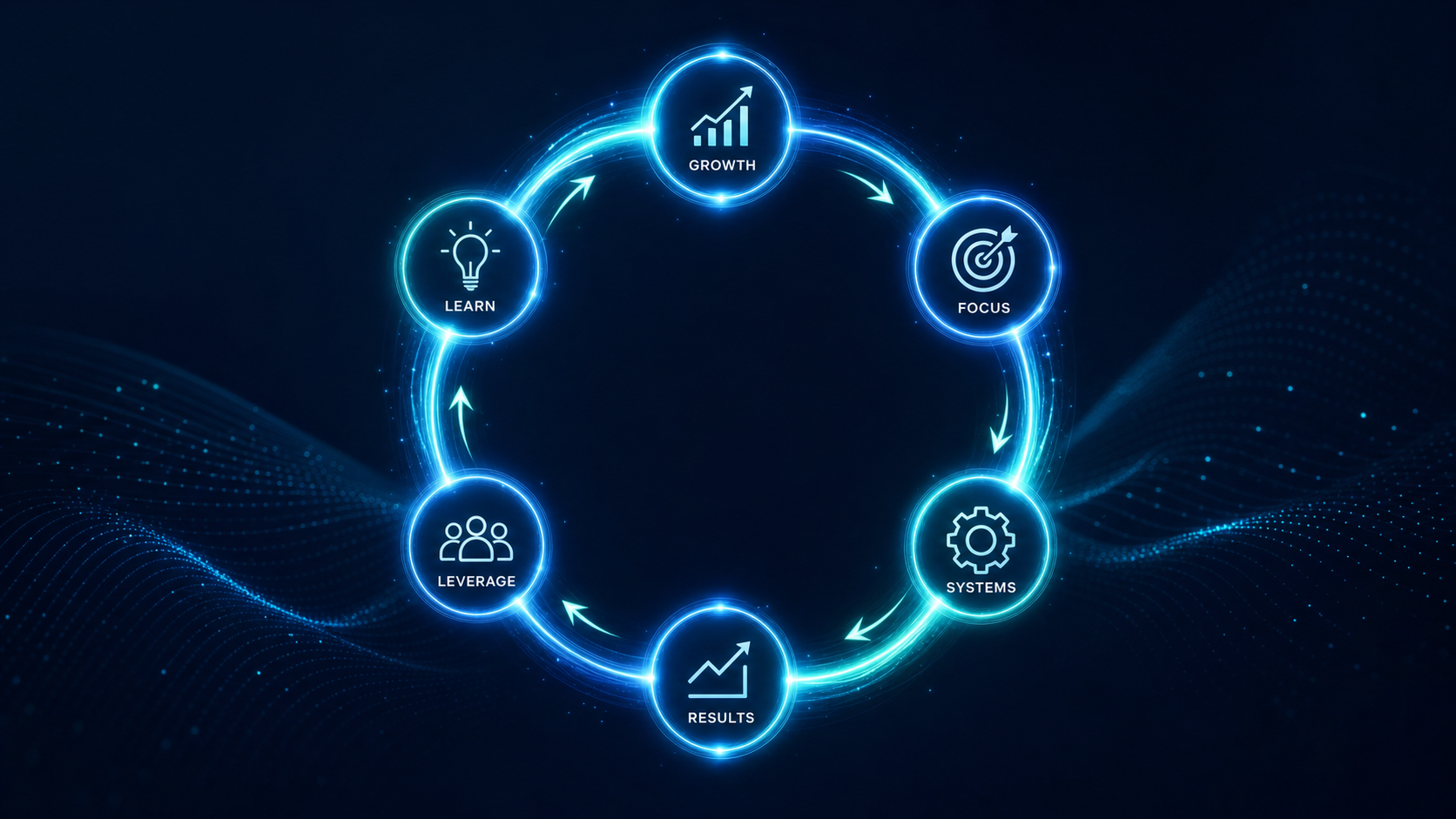
Compounding is a concept borrowed from finance, where returns generate their own returns over time. In growth, the equivalent is this: each phase creates conditions that allow the next phase to perform better than it would in isolation.
Consider the alternative. A business running two or three phases, say a paid search programme and a monthly content calendar, gets a return on those specific investments. When spend drops, traffic drops. There is no structural advantage accumulating in the background. The moment you stop paying, the output falls.
A fully integrated Growth Engine builds structural advantages that do not switch off. Technical infrastructure that search engines trust, topical authority that makes new content rank faster, earned backlinks that amplify domain credibility, conversion systems that extract more value from every visit, attribution data that tells you which bets are paying off, and an iteration loop that compounds all of the above over time. These do not operate in parallel. They operate in sequence, each one feeding the next. To see the full architecture, the full Growth Engine architecture lays out how each handoff works and what metrics govern each transition.
Start with the most common mistake in B2B content marketing. A business invests in a content programme, builds out a library of articles and thought leadership pieces, and sees underwhelming results. The content is well-written. The topics are relevant. Yet rankings plateau, traffic grows slowly, and conversions are thin. The problem is almost always Phase 1: the technical foundation.
Site speed, crawlability, Core Web Vitals, indexation logic, internal linking structure, mobile performance: these are not aesthetic preferences. They are the conditions under which a search engine decides whether your content deserves to be found. Phase 1 without Phase 2 gives you a technically pristine site that nobody reads. Phase 2 without Phase 1 gives you content that underperforms relative to its potential, regardless of quality.
When both phases run together, something different happens. The content architecture (topical clusters, intent mapping, a coherent hub-and-spoke structure) is built on a foundation that search engines can actually crawl, evaluate, and trust. Pages load inside the Core Web Vitals thresholds. Internal linking passes authority efficiently. The result is content that ranks faster and holds its position longer, because the technical substrate is not fighting against the content strategy.
Once a solid technical foundation supports a well-structured content programme, Phase 3 enters the picture: authority building through digital PR, backlink acquisition, and brand signal development.
Here is where the compounding effect becomes visible for the first time. Without Phases 1 and 2 in place, backlinks have limited leverage. A link to a slow, poorly structured site with thin topical coverage produces modest ranking improvements. The same link, pointing to a technically healthy domain with deep topical authority in a specific subject area, produces measurably larger gains. This is why authority creates compounding traffic gains that accelerate over time rather than fading after each campaign.
In practice, this shows up in new content performance. Businesses in the early phases of a Growth Engine typically see new content take three to six months to rank meaningfully. Businesses with Phase 3 running on top of Phases 1 and 2 often see new content entering the top 20 within four to eight weeks, and climbing to top-five positions within three months. That is not a marginal improvement. It is a structural shift in how quickly the content programme generates returns.
All of the above means nothing if the traffic arriving on your site does not convert. Phase 4, conversion optimisation, is where the Growth Engine starts connecting to commercial outcomes rather than just digital metrics.
CRO is often treated as a standalone discipline, something you apply to a landing page before a campaign launches. In a fully integrated Growth Engine, it is woven into every content asset, which is how CRO improvements compound month after month. Landing page structure, funnel alignment, offer clarity, trust signals, and friction reduction are applied at the point where organic traffic meets commercial intent.
The interaction between Phase 3 and Phase 4 is particularly powerful. As authority building accelerates traffic growth, conversion optimisation ensures that the incremental visitors do not simply inflate a bounce rate. A business seeing 40% year-on-year organic traffic growth combined with a CRO programme lifting conversion rate from 1.8% to 3.1% is not experiencing additive gains. The pipeline impact of that combination is disproportionate to either improvement in isolation.
Most growth programmes generate data. Very few generate insight. Phase 5 is about attribution: connecting organic performance to revenue metrics in a way that goes beyond "traffic went up this quarter."
This is the phase that most agencies skip entirely, or implement superficially. Tracking is set up. A dashboard is built. Sessions and rankings are reported. But the connection between a specific piece of content, a specific search query, a pipeline conversion, and a closed deal remains opaque.
When Phase 5 is functioning properly, you can identify which content clusters are driving the most qualified pipeline, which keywords attract buyers rather than researchers, which landing pages are generating MQLs that convert to closed revenue, and where in the funnel organic traffic is leaking. Phase 5 is powered by an attribution model that closes every sprint with a revenue statement, and that level of visibility changes the quality of every decision downstream.
Phase 6 is where the compounding effect reaches its full expression. Strategic iteration takes the attribution data from Phase 5 and uses it to continuously refine every other phase.
The technical foundation is updated based on crawl data and Core Web Vitals trends. The content architecture is refined based on which clusters are generating revenue, not just traffic. Authority building efforts are directed toward the topics and pages that attribution data shows are most commercially valuable. Conversion optimisation is tested based on real funnel data, not assumptions. Phase 3 deploys a multi-agent Execution pipeline that produces content volume at 3-5x the rate of traditional agencies, and the iteration cycle continues, with each pass through the system producing marginal improvements that accumulate into structural advantages over time.
This is the mechanism behind the asymmetric return. A business with one phase running might generate 1x the organic output of doing nothing. Two phases, perhaps 2x to 3x. But the relationship is not linear. By the time all six phases are running and the iteration loop is active, the interactions between phases create outputs that consistently exceed the sum of the parts. Not 6x, but 10x or more, because each phase is amplifying every other phase rather than simply adding to it.
The qualitative difference between partial and full engine operation is worth making concrete.
A business running two phases typically experiences this: content is published on a functional site, some pieces rank, organic traffic grows slowly, there is no clear view of which traffic converts, and the programme feels like a long game with uncertain returns. The team produces content because the strategy says to produce content. But the flywheel never really spins.
A business with all six phases running experiences something categorically different. New content enters rankings faster because the domain has authority and the technical foundation is trusted. Traffic converts at a higher rate because landing pages and CTAs are optimised against real behavioural data. Attribution connects specific content to specific revenue, so the team knows which bets are paying off. The iteration loop directs effort toward what works and away from what does not. The compounding view is reinforced by the fact that total search impressions have increased by over 49% since AI Overviews launched, expanding rather than reducing the surface area for compounding content. Over time, the cost per acquired customer drops, the lifetime value of customers increases as better content attracts better-fit buyers, and the organic programme requires proportionally less new investment to maintain and grow its output. The engine is not just running. It is self-reinforcing.
The uncomfortable truth is that most agencies operate within two or three phases by design. SEO agencies focus on Phases 1 through 3. Content agencies focus on Phase 2, occasionally Phase 3. CRO agencies focus on Phase 4. Each delivers a genuine, measurable return on its own. But the cross-phase interactions, the compounding mechanisms that produce asymmetric returns, require a single integrated system with visibility across all six phases simultaneously.
Running separate agencies for separate phases is not an integrated Growth Engine. It is a collection of independent programmes that occasionally share a reporting dashboard. The connections between phases are not managed. The feedback loops do not close. The compounding effect never materialises. This is also why architecture beats campaign thinking in the first place.
This is the structural gap that the Growth Engine is designed to close.
The businesses that commit to all six phases do not just get better marketing results. They build a fundamentally different commercial asset. This aligns with broader industry data showing website, blog, and SEO ranked as the top ROI channel for B2B brands year after year.
Organic search becomes a channel that appreciates in value over time rather than depreciating between campaigns. The brand accumulates topical authority that competitors cannot replicate quickly. Conversion systems extract increasing value from the same traffic volumes. Attribution data makes the growth programme legible to the board and the finance team. And the iteration loop ensures that the system continuously improves, regardless of how the competitive landscape shifts.
That is the compounding effect in practice. Not a chart that goes up and to the right because someone wrote more blog posts. A system that gets structurally better at generating and converting demand with every cycle, because each phase is designed to make every other phase more effective.
The growth is not rented. It compounds.

