
A strategic blueprint is an architectural framework that translates an organisation’s high-level vision into a detailed operational model, connecting vision, positioning, objectives, capabilities, and success metrics into one cohesive document. Unlike a slide deck or a wish list, it answers five fundamental questions: where are you going, how will you win, what must you achieve, how will you deliver it, and how will you measure success. Get all five aligned and the organisation moves with clarity from the boardroom to the front line.
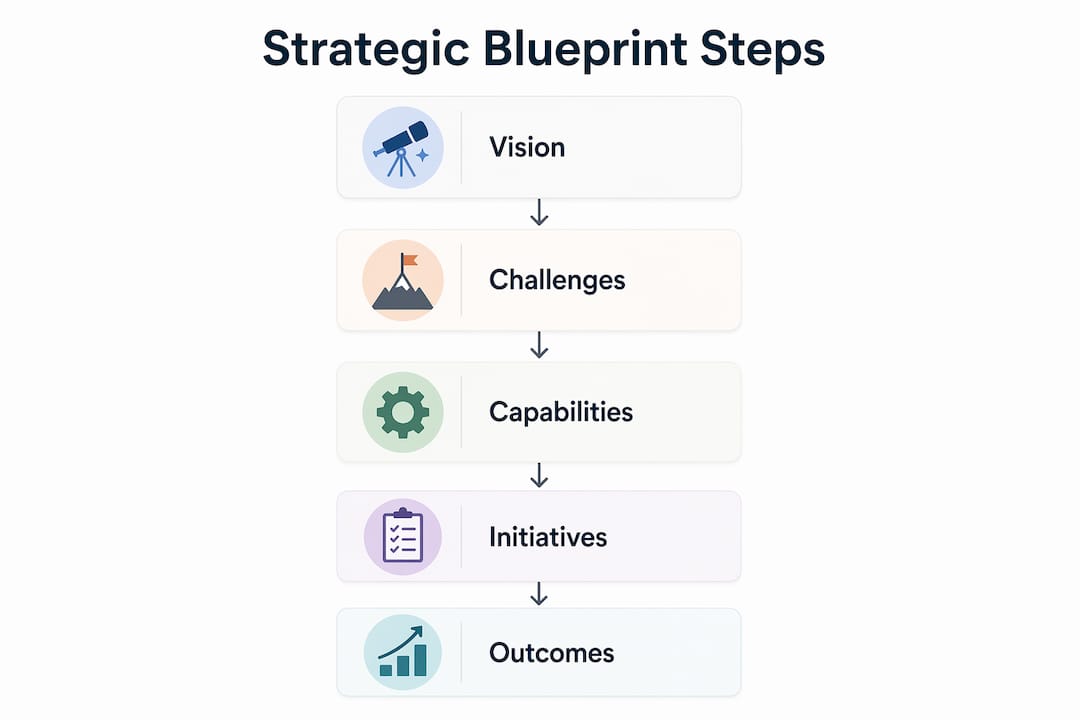
A strategic blueprint is not a plan in the traditional sense. It is a visual, architectural map that shows how every element of your strategy connects, from the challenges you face to the outcomes you are trying to reach. Think of it as the operating architecture of strategy rather than a list of tasks.
Planning horizons vary with market volatility and asset lifecycle, tailored to the organization’s context. The blueprint covers:
The difference between a blueprint and a vague strategy document is specificity. Each element above has a defined relationship with the others, so a change in one area immediately surfaces its implications across the rest.
The components of a strategic blueprint form a logical chain, not a checklist. Core elements include Challenges, Aspirations, Focus Areas, Guiding Principles, Activities, and Outcomes. Each one earns its place:
What makes a blueprint powerful is the visibility of the relationships between these elements. You can trace a line from a specific challenge through the guiding principles that shape your response, to the activities you have chosen, and directly to the outcome you expect. That traceability is what separates a blueprint from a collection of strategic statements.
Building a blueprint is a collaborative act, not a solo exercise. The process works best when it brings together senior leaders, functional heads, and anyone whose team will be responsible for execution. Here is a practical sequence:
Pro Tip: Treat the blueprint as a living document from day one. Monthly reviews and quarterly resets are a common operating cadence that keeps the blueprint current as markets shift and the organisation learns.

The distinction is not cosmetic. A traditional strategic plan is typically a linear document: objectives, initiatives, timelines, budgets. A strategic blueprint is a visual, canvas-based tool that maps the logical relationships between elements rather than sequencing tasks.
Key differences:
A strategic plan tells you the route. A blueprint shows you the terrain, the vehicle, and the fuel you need to get there. Both have their place, but when the environment is uncertain, the blueprint’s flexibility is a genuine advantage.

The practitioner consensus has shifted noticeably. Strategy is no longer treated as a fixed document produced once every three years. The most cited insight from Jim Kalbach captures the shift well:
This matters because effective strategy sits at the intersection of intended and emergent approaches. Organisations that treat their blueprint as a rigid plan miss the point entirely. The blueprint’s value comes from its ability to absorb new information without losing coherence.
Experts also flag a consistent failure mode: too many priorities. Setting more than a handful of strategic bets simultaneously dilutes focus and makes accountability almost impossible to enforce. The discipline of choosing what not to pursue is as important as deciding what to chase.
For organisations integrating multiple strategy techniques, tools that connect frameworks like SWOT, the Balanced Scorecard, and Business Model Canvas through a common modelling language can significantly improve stakeholder understanding and downstream implementation.
The framework adapts to context. What changes between sectors is the content, not the structure.
Technology scale-up: A SaaS business might anchor its blueprint around the challenge of customer retention in a crowded market. Its aspirations centre on becoming the default tool for a specific workflow. Focus areas include product depth, community, and enterprise sales. Every activity traces back to one of those three.
Professional services firm: A mid-market consultancy uses its blueprint to navigate a shift from project-based to retainer revenue. Challenges include pricing pressure and talent retention. Aspirations describe a firm known for a specific methodology. Guiding principles govern how partners price and scope work. Firms working with business real estate consulting partners often use blueprints to align property strategy with wider commercial objectives.
Public sector organisation: A local authority uses a blueprint to connect community outcomes (reduced unemployment, improved health) to internal capabilities (digital services, partnerships). The visual format makes it easier to show elected members and residents how specific activities connect to the outcomes they care about.
Manufacturing business: An asset-heavy manufacturer with a longer planning horizon uses the blueprint to map capability investments against a 5-year transformation. The blueprint makes it visible when a proposed acquisition conflicts with a guiding principle around organic growth.
The common thread is that the blueprint forces explicit choices. You cannot draw a line from a challenge to an outcome without deciding what sits in between.
Benefits:
Limitations:
The most damaging mistakes tend to happen before the canvas is even opened.
Setting too many priorities. The instinct to include everything important leads to a blueprint that is everything and therefore nothing. Choosing three focus areas feels like leaving things out. It is. That is the point.
Confusing activities with outcomes. “Launch a new website” is an activity. “Increase qualified leads by 30% within 12 months” is an outcome. Blueprints that list activities without connecting them to outcomes cannot be held accountable.
Skipping the challenges layer. Some organisations jump straight to aspirations because challenges feel uncomfortable to name. The result is a blueprint built on optimism rather than diagnosis.
Treating the first version as final. The first blueprint is always a hypothesis. The organisations that get the most from the process are the ones that schedule their first review before the ink is dry.
Excluding execution teams. A blueprint designed entirely by the leadership team and handed down to managers will be interpreted differently by every function. The people responsible for activities need to be in the room when those activities are defined.
The blueprint sits between the organisation’s long-term vision and its operational plans. It is not a replacement for either. Think of it as the translation layer: the vision sets the destination, the blueprint maps the route, and the operational plans describe the specific steps each team will take each quarter.
For the blueprint to function as a genuine alignment tool, it needs to connect upward to governance (board-level direction and risk appetite) and downward to execution (team plans, budgets, and performance reviews). Organisations that treat the blueprint as a standalone document, disconnected from how resources are actually allocated, find that it has no practical effect on behaviour.
The growth and strategy planning process at Viaductgen treats the blueprint as the second phase of a five-stage Growth Engine, sitting between AI-powered intelligence gathering and amplified execution. That sequencing reflects a broader truth: a blueprint is only as good as the quality of the intelligence that informs it, and only as valuable as the execution discipline that follows.
A UK professional services firm used a blueprint canvas to resolve a long-running disagreement about whether to expand geographically or deepen its sector specialism. By mapping both options against the same challenges and guiding principles, the leadership team could see that geographic expansion conflicted with three of their five guiding principles. The decision that had been debated for two years was made in a single workshop.
A scale-up technology business used its blueprint to align a newly acquired team with the parent company’s direction. Rather than issuing a strategy document, the leadership ran a collaborative session using the existing blueprint canvas. The acquired team identified two areas where their capabilities directly addressed gaps in the parent company’s focus areas. Those two areas became new activities within the blueprint within six weeks of the acquisition closing.
A third-sector organisation used a blueprint to make the case for funding. Funders could see, on a single page, how the organisation’s activities connected to the community outcomes the funder cared about. The visual format did what a 20-page proposal could not: it made the logic of the investment immediately obvious.
In each case, the blueprint’s value was not the document itself. It was the clarity of thinking the process forced, and the alignment it created among people who had previously been working from different assumptions.
Viaductgen builds growth systems where the strategic blueprint is a live, intelligence-informed architecture, not a planning exercise. If you want to see how AI in client work changes what a blueprint can do, the approach is worth exploring.
A strategic blueprint connects vision to execution through a visual, relational framework that forces explicit choices, surfaces interdependencies, and adapts to change in ways a linear plan cannot.
| Point | Details |
|---|---|
| Definition | A blueprint is an architectural framework linking vision, positioning, objectives, capabilities, and metrics into one cohesive map. |
| Planning horizon | Blueprints typically cover a 3–5 year period, adjusted for market volatility and asset lifecycle. |
| Core components | Challenges, Aspirations, Focus Areas, Guiding Principles, Activities, and Outcomes form the logical chain. |
| Operating cadence | Monthly reviews and quarterly resets keep the blueprint current and prevent it becoming a historical document. |
| Key distinction | Unlike a traditional plan, a blueprint visualises relationships between elements rather than sequencing tasks on a timeline. |

