
Client engagement is the active, two-way participation between a client and a business throughout their commercial relationship. It goes well beyond receiving a service or opening an email. Engaged clients complete tasks, give feedback, attend reviews, and stay genuinely invested in outcomes. The business results follow directly: higher retention, greater lifetime value, stronger advocacy, and a cleaner feedback loop for improving what you sell. For UK businesses operating under ICO and GDPR obligations, how you collect and use client data to drive that engagement is not an afterthought. It is a legal and commercial baseline.
Client engagement is the single most controllable lever for retention, revenue expansion, and referral growth in a B2B business.
| Point | Details |
|---|---|
| Engagement is participation | Track behaviours like task completion and meeting attendance, not just contact frequency. |
| Retention economics are compelling | Acquiring a new client can cost around five times more than keeping an existing one. |
| Map the journey first | Identify every touchpoint where engagement is expected and assign an owner before building a programme. |
| Measure the right KPIs | Retention rate, adoption, NPS trend, and expansion rate give a clearer signal than satisfaction scores alone. |
| Run a 90-day sprint | Structure engagement work in four phases: discovery, quick wins, rollout, and optimisation. |
Engagement is participation, not passive contact. Receiving a monthly report is not engagement. Reading it, questioning a figure, and asking for a change in approach is. That distinction matters because it determines what you measure and where you intervene.
Credible definitions centre on three elements: ongoing two-way communication, a dynamic relationship that builds loyalty over time, and measurable progress against stated goals. Trust is the foundation. Without it, even the most structured engagement programme produces surface-level compliance rather than genuine involvement.
Observable engagement signals in B2B and professional services:
What does not count: receiving an invoice, being copied on a status update, or appearing on a mailing list. Those are contact events. Engagement requires a response, a decision, or a behaviour that moves the relationship forward.
Pro Tip: In professional services, the single highest-signal engagement indicator is often the simplest: does the client bring problems to you before they become crises? If they do, the relationship has real depth. If they only contact you reactively, the engagement is thinner than your retention rate suggests.
These three terms are frequently used interchangeably. They should not be.
Client experience is the end-to-end impression a client forms across every stage of the lifecycle, from first contact through sales, onboarding, delivery, billing, and renewal. It is cumulative and largely shaped by what the business does to the client. Engagement, by contrast, measures what the client does with the business. Satisfaction is a point-in-time sentiment score, typically captured by CSAT or NPS, that reflects how a client feels at a specific moment.
| Term | Focus | Timeframe | Typical owner |
|---|---|---|---|
| Client engagement | Active participation and relationship depth | Ongoing, throughout lifecycle | Account manager / CSM |
| Client experience | End-to-end impression across all touchpoints | Cumulative, full lifecycle | CX lead / operations |
| Client satisfaction | Sentiment at a specific moment | Point-in-time | Research / account team |
The practical implication: you can have a client who rates satisfaction at 9/10 but barely engages. They are happy with the status quo but not invested in the relationship. That client is vulnerable to a competitor offering a marginally better price. Engagement is the metric that predicts what satisfaction scores miss.
Key distinctions to keep in mind:
The business case is straightforward, and the numbers behind it are not subtle. Acquiring a new client can cost significantly more than retaining an existing one, and existing clients convert at higher rates than new leads. Engagement is the mechanism that makes retention happen.
Six concrete benefits for UK mid-market and scale-up businesses:
Retention-focused metrics often give a clearer commercial signal than raw satisfaction scores because they link directly to revenue and lifetime value.
Most B2B engagement failures happen not because the strategy is wrong but because no one owns the touchpoints systematically. Mapping the client journey gives you a structure for deciding where to intervene and what to measure at each stage.
Five lifecycle stages and their key engagement touchpoints:
Pro Tip: The onboarding stage is where most businesses underinvest and where engagement is most fragile. A structured 30-day onboarding plan with clear milestones and a named point of contact on both sides yields disproportionate returns. Get this right and the rest of the relationship is easier to manage.
UK best practice emphasises journey mapping, omnichannel engagement, and GDPR-compliant data collection as the foundation for improving client retention and growth.
Tactics without structure produce inconsistent results. The following six strategies work best when they are built into a repeatable system rather than applied ad hoc.
Segmentation and personalisation. Group clients by sector, size, lifecycle stage, or strategic value. Then tailor communication frequency, content, and review formats to each segment. A £50k annual contract client and a £500k one should not receive identical engagement. How to start: build a simple client tier matrix with three bands and assign a standard engagement cadence to each.
Structured communication cadences. Define the rhythm of contact before the engagement begins. Weekly updates, monthly reports, and quarterly reviews should be in the calendar from day one, not scheduled reactively. Avoidable mistake: letting QBRs slip because “things are going well.” That is precisely when a competitor makes their move.
Outcome-led playbooks. Replace activity reports with outcome summaries. Clients engage more deeply when they can see progress against goals they care about, not just a list of tasks completed. Tie every update to a metric that matters to the client’s business.
Executive sponsorship. Assign a senior sponsor on your side who has a relationship with a senior stakeholder on the client side. This creates a second channel of communication that is less vulnerable to day-to-day friction and more likely to surface strategic issues early.
Feedback loops. Run short pulse surveys after key milestones and act visibly on the results. Clients who see their feedback change something engage more in subsequent rounds. Closing the loop is the step most teams skip.
Product and service adoption programmes. If you offer a platform or a suite of services, track which features or services each client is actually using. Low adoption is an early warning signal. Proactive outreach at the point of low usage prevents churn far more effectively than a reactive retention conversation at renewal.
Pro Tip: The fastest way to improve engagement scores across your client base is to fix the feedback loop first. Run a single-question pulse survey after your next three client deliverables. The response rate alone tells you something. What clients say tells you everything else.
For practical tactics linking audience engagement to organic search outcomes, audience engagement for SEO is worth reviewing alongside your content strategy.
Engagement is only manageable when it is measurable. The following KPIs form a practical dashboard for most B2B and professional services teams.
Primary KPIs:
Cohort analysis is the most underused tool in this list. Group clients by start date or segment and track their engagement metrics over time. A cohort whose adoption rate drops between months three and six is telling you something specific about the delivery or onboarding experience for that group. Aggregate averages hide that signal entirely.
| KPI | What it measures | Example target |
|---|---|---|
| Retention rate | Clients renewing at period end | Higher retention for B2B services |
| Churn rate | Clients lost in a period | Below 10% annually |
| NPS | Advocacy intent | +30 or above |
| Adoption rate | Feature or service usage | Majority of available services |
| Time to value | Days to first meaningful outcome | Under 30 days |
| Expansion rate | Upsell/cross-sell as % of revenue | 15–25% of total client revenue |
For practical guidance on increasing client retention and the KPIs that support it, the linked resource covers data-focused tactics worth reviewing alongside your own dashboard.
No single platform covers the full engagement stack. Most teams need a combination of tool categories, and the right mix depends on team size, client volume, and the complexity of the relationship.
Tool categories to consider:
GDPR and ICO compliance considerations. Under UK GDPR, any personal data you collect as part of client engagement activities, including survey responses, behavioural data from portals, and contact records, must be collected with a lawful basis, stored securely, and retained only as long as necessary. The ICO’s guidance on data minimisation is directly relevant here: collect what you need to run the engagement, not everything you could. If you are using third-party platforms to store client data, confirm they are either UK-based or covered by an appropriate data transfer mechanism. This is not optional. It is a condition of operating lawfully in the UK market.
For a connected view of how digital channels and tools support client communications, digital PR for UK brands covers the channel integration angle in more detail.
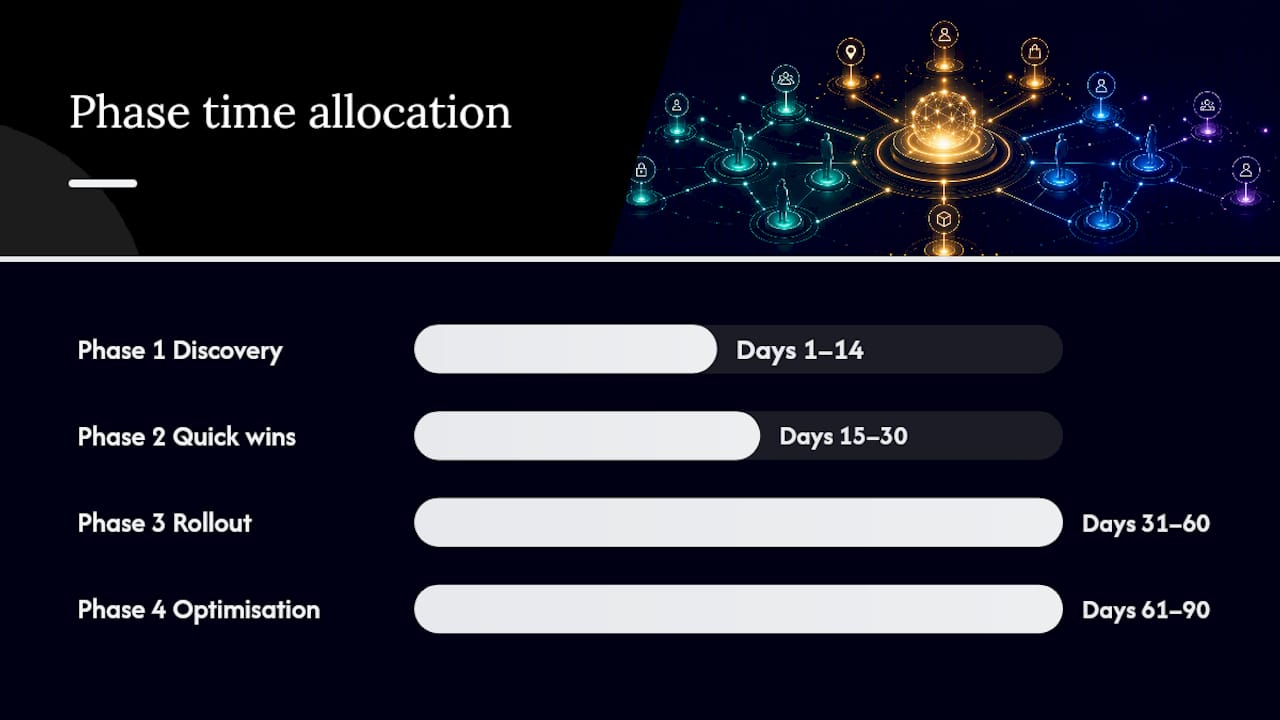
A 90-day sprint is long enough to produce measurable results and short enough to maintain focus. The following plan is structured for a mid-market B2B team with an account manager, a client success manager (CSM), and access to senior leadership.
Phase 1: Discovery (Days 1–14)
Roles: Account manager leads the audit. CSM owns the segmentation. Data analyst pulls the metrics.
Readiness check: You have a segmented client list, a journey map, and a ranked churn risk register before moving to Phase 2.
Phase 2: Quick wins (Days 15–30)
Roles: CSM runs the survey and QBR scheduling. Senior leadership confirms exec sponsor assignments.
QBRs booked for all Tier 1 accounts.
Phase 3: Rollout (Days 31–60)
Roles: Account managers own cadence delivery. CSM tracks adoption. Exec sponsors attend Tier 1 QBRs.
Phase 4: Optimisation (Days 61–90)
Roles: Full team review. Data analyst produces the engagement report. Leadership signs off on the next sprint plan.
The structural challenge in most engagement programmes is that insight and action sit in different places. Data lives in the CRM. Strategy lives in the account manager’s head. Execution happens in email threads. The result is inconsistency.
Viaductgen’s Growth Engine applies a five-phase methodology and cross-client intelligence from multiple engagements to deliver predictable, measurable outcomes. The practical difference is that patterns from across the client portfolio feed back into how individual engagements are structured and where interventions are timed.
How the model works in practice:
Takeaways you can apply regardless of scale:
Client engagement refers to the active, two-way participation between a client and a business throughout their relationship. It measures how invested a client is in the relationship, not simply whether they have been contacted.
Common examples include completing onboarding tasks on time, attending quarterly business reviews, responding to feedback surveys, adopting new features or services, and referring colleagues. Passive activities like receiving a newsletter do not qualify.
The closest equivalents are “client participation,” “account involvement,” or “relationship depth.” In customer success contexts, the term “client health” is often used to describe the same concept measured as a composite score.
A communications framework from Broadridge identifies consistency, continuity, and contextual relevance as core principles for client communications. Definitions of the full five Cs vary by source, so it is worth reviewing the framework directly rather than relying on a single summary.
Engaged clients are significantly cheaper to retain than new clients are to acquire, they expand their spend more readily, and they generate referrals that no paid channel can replicate. For UK businesses, strong engagement also supports GDPR-compliant data practices by grounding data collection in genuine, consensual relationship activity rather than speculative outreach.

