
AI-driven research is the use of artificial intelligence to automate and augment the full scientific workflow, from literature review and hypothesis generation through to data analysis, experimentation, and manuscript preparation. Rather than replacing individual tools, it reframes how research gets done at a systems level. The five-level autonomy spectrum (L0 through L4) describes this range precisely: L0 is pure human control with no AI involvement, while L4 represents near-full AI autonomy across all research phases. Most UK academic and professional settings currently operate somewhere between L1 and L3, where AI handles defined subtasks under human governance.
The scope is broader than most researchers initially expect:
The UK Research Integrity Office (UKRIO) frames this shift not as a threat to scientific rigour but as a governance challenge: the question is not whether to use AI, but how to use it accountably.
The tool landscape in 2026 covers the full research lifecycle, and the most useful ones do more than a single task. UK institutions have been particularly active in adopting tools that align with data protection requirements under UK GDPR and institutional ethics policies.
AI automation in UK research workflows follows a similar pattern to commercial sectors: the productivity gains are real, but they arrive with new quality-assurance responsibilities.
Pro Tip: Before adopting any AI research tool institutionally, check whether it stores your data on servers outside the UK. Several popular tools default to US-based infrastructure, which may conflict with your institution’s data governance policy.

The most useful way to understand AI-driven research methods is not as a list of tools but as a set of layered workflows. Each layer handles a different type of task, and effective AI-driven research relies on combining exploration, tool execution, and human verification rather than treating any single layer as sufficient on its own.

Iterative literature search and synthesis
AI agents run repeated search cycles, each pass informed by what the previous one found. This is retrieval-augmented generation in practice: the system queries multiple databases, extracts key claims, identifies contradictions, and produces a structured synthesis. The researcher’s role is to set the scope, evaluate the synthesis, and decide which threads to pursue.
Hypothesis generation and experimental design
Large language models can generate candidate hypotheses by identifying patterns across existing literature. The limitation here is real: LLMs tend to suggest a narrower methodological range than human researchers, which means relying on them uncritically risks methodological narrowing. Treating AI-generated hypotheses as a first draft rather than a final list is the practical fix.
Multimodal data integration and NLP analysis
Natural language processing now handles qualitative datasets at a scale that would be impractical manually. Adaptive research designs adjust their parameters in response to real-time data inputs, particularly useful in health and education research. Multimodal integration combines text, images, audio, and physiological signals into unified analytical frameworks, giving researchers a richer picture of complex phenomena.
Manuscript drafting and dissemination
AI systems can produce structured first drafts, generate abstracts, format references, and produce data visualisations. The human researcher remains responsible for scientific accuracy, interpretation, and the judgements that give a paper its intellectual contribution.
Pro Tip: Run your AI-generated methodology section through a structured checklist against your field’s reporting standards (CONSORT for trials, PRISMA for systematic reviews) before submission. AI drafts often miss field-specific disclosure requirements.
The dominant deployment model in credible UK research settings is what practitioners call “copilot mode”: human-governed collaboration where AI handles defined subtasks and a researcher retains decision authority at every critical junction. Full autonomy (L4) remains experimental and is not yet appropriate for published scientific work.
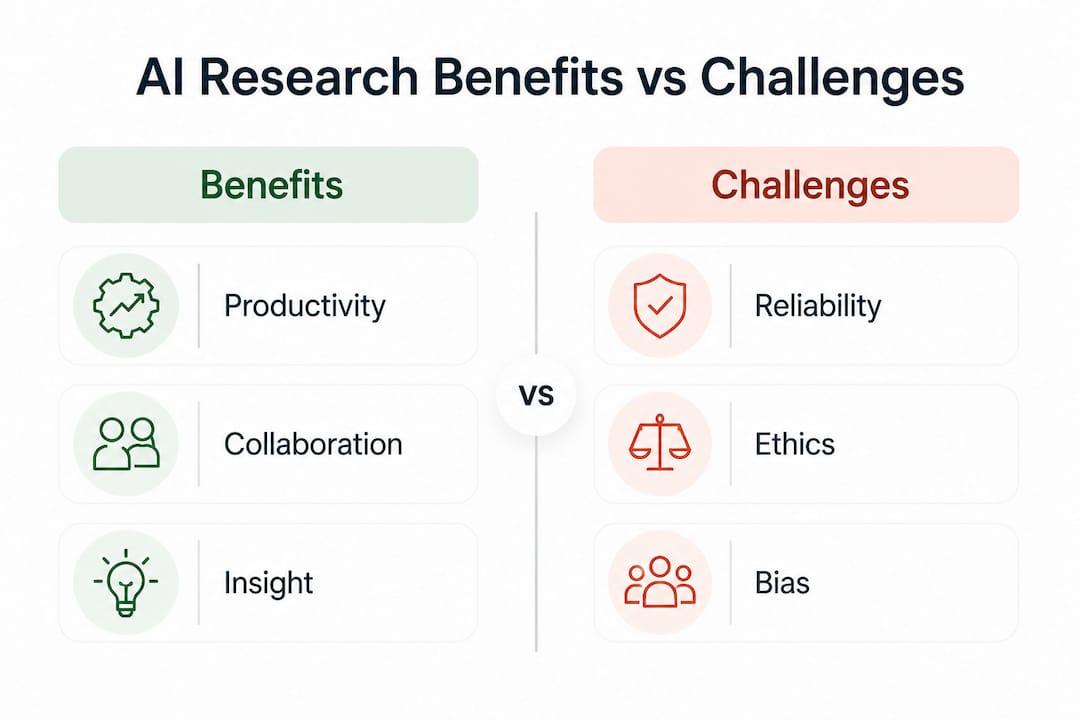
The productivity case for AI in research is strong. AI agents handling routine tasks free scientists to focus on the work that requires genuine insight: framing meaningful questions, interpreting ambiguous results, and making the creative leaps that move a field forward. Fully automated systems can generate research papers at costs as low as $15, which illustrates the scale of the efficiency shift, even if the quality of those outputs varies considerably.
The benefits researchers consistently report include:
The challenges are equally concrete. LLMs remain unreliable for novel hypothesis generation and scientific judgement, excelling at retrieval and tool-mediated tasks but struggling where creativity and domain intuition matter most. Hallucination is a persistent problem: AI systems can generate plausible-sounding citations, statistics, and methodological claims that do not exist. Verification is not optional.
There are structural risks too. Overreliance on AI for entry-level research tasks risks deskilling early-career researchers who never develop the foundational skills that make expert judgement possible. The symbiotic relationship between AI and science works in both directions: scientists provide the physical and conceptual insights that make AI more interpretable, and that contribution requires researchers who actually understand the domain deeply.
The UK Research Integrity Office has been clear that AI use in research does not transfer scientific accountability away from the researcher. Whatever a tool produces, the human author remains responsible for accuracy, attribution, and the integrity of the published record. That principle shapes every good-practice recommendation that follows.
Transparency and disclosure
Researchers should disclose AI use in methods sections, specifying which tools were used, for which tasks, and how outputs were verified. Vague statements like “AI was used to assist with writing” are insufficient. Reviewers and readers need enough detail to assess whether the AI involvement affected the reliability of the findings.
Verification protocols
Every AI-generated claim, citation, or statistical figure requires independent verification before it enters a manuscript. Designating an AI validator role within a research team, as recommended by published guidance on responsible AI agent use, gives one person explicit accountability for checking outputs.
Reproducibility and traceability
AI-driven research raises new reproducibility challenges. If a tool’s outputs change between versions, a study may be impossible to replicate exactly. Researchers should log the tool version, prompt structure, and date of use alongside their data and analysis files.
Bias and data quality
AI models trained on unrepresentative datasets produce biased outputs. This is particularly acute for researchers working on under-represented populations or non-English language contexts, where training data is thinner. Checking whether a tool’s training data reflects your study population is a basic due-diligence step.
Pro Tip: Treat AI-generated literature reviews the same way you would treat a research assistant’s first draft: useful as a map of the territory, but requiring your own critical reading of the primary sources before you cite them.
The five-validity principle adapted for AI evaluations covers transparency, repeatability, contamination risk, construct validity, and ecological validity. Applying it systematically to any AI-assisted component of a study gives researchers a structured way to document and defend their methodology.
The UK sits in a genuinely interesting position. It has strong institutional infrastructure for research integrity, active AI research communities across its universities, and a regulatory environment that takes data governance seriously. The tension between those strengths and the pace of AI development is where most of the interesting questions currently live.
UKRIO’s guidance on AI in research has become a reference point for UK institutions developing their own policies. The emphasis on human oversight, transparent disclosure, and reproducibility aligns with the broader direction of UK research funding bodies, including UK Research and Innovation (UKRI), which has published principles for responsible AI use in funded projects.
Active adoption areas within UK academia include:
The near-term outlook points towards more capable multimodal systems, better human-AI collaboration interfaces, and harder governance questions around peer review. AI-generated papers are already entering submission pipelines at major journals, and the publishing sector has not yet settled on consistent detection or disclosure standards. That gap is likely to close through a combination of journal policy and funder requirements rather than through any single regulatory intervention.
The deeper structural question is about the research workforce. If AI handles an increasing share of entry-level research tasks, the pipeline for developing expert scientific judgement needs rethinking. UK institutions that get ahead of that question now, by building AI literacy into doctoral training and postdoctoral development, will be better placed than those that treat it as a future problem.
Viaductgen applies the same principles in commercial research contexts: AI-powered intelligence works best when it sits inside a system where human judgement governs the decisions that matter. The research is faster, the coverage is broader, and the outputs are more reliable precisely because the human layer has not been removed.
AI-driven research automates and augments the full scientific workflow across literature review, hypothesis generation, experimentation, and reporting, but human oversight remains the critical factor separating reliable science from plausible-sounding noise.
| Point | Details |
|---|---|
| Five-level autonomy spectrum | AI-driven research spans L0 (full human control) to L4 (near-full AI autonomy); most UK settings operate at L1–L3. |
| Copilot mode is the credible standard | Human-governed collaboration, where AI handles subtasks and researchers retain decision authority, is the most reliable deployment model. |
| LLMs narrow methodology | AI language models suggest a narrower methodological range than human researchers, requiring active cross-checking to avoid methodological blind spots. |
| Verification is non-optional | AI systems can hallucinate citations and statistics; every AI-generated claim requires independent verification before entering a manuscript. |
| UKRIO sets the UK standard | The UK Research Integrity Office emphasises transparency, disclosure, and human accountability as the core principles for AI use in research. |

