
UGC ads outperform studio-shot brand creative on nearly every prospecting metric that matters, and the businesses winning cold social right now treat creative production as a testing pipeline, not a one-off shoot. The immediate move is simple: pick one product, run a hook-first test this week, and let performance data decide what scales. Everything else in this guide exists to make that first test count.
TL;DR:
- UGC ads deliver approximately four times higher click-through rates and around 50% lower costs per click than traditional brand creative, depending on the audience and vertical.
- Sourcing UGC is most cost-effective when obtained directly from customers post-purchase using incentives and clear shot guidance, while creator marketplaces and AI tools offer quicker options at higher costs.
- Legal licensing of UGC requires explicit, documented consent covering paid use, duration, exclusivity, and disclosure, with built-in rights capture to avoid compliance issues.
- Testing should focus on running 3-5 hook variations for 48-72 hours with small budgets, killing underperformers early, and scaling winners into dedicated campaigns for better learning.
- High-performing brands maintain disciplined, volume-based testing over reliance on single creative hypotheses, continuously launching new variations to beat tired or decayed ads.
User generated content advertising is paid creative built from footage that customers or creators shoot themselves, then run as an ad rather than left as an organic post or review. The point is that it looks like it belongs in the feed, not like it interrupted it.
A handful of formats do most of the heavy lifting for ecommerce brands:
Platform fit matters as much as format. TikTok rewards native, hook-first UGC that doesn’t look like an ad, Meta performs well with several UGC variants fed into Advantage+, and YouTube Shorts tends to reward genuine how-to and demo content over polished pitches.
The mechanics come down to trust and algorithmic reward feeding each other. A viewer’s brain processes a peer talking about a product very differently to a brand talking about itself, and platforms have built their delivery systems to notice that difference through engagement signals: watch time, comments, shares.
That engagement changes what an ad costs to run. Higher engagement tells the algorithm the creative deserves more reach, which pushes CPM and CPC down and lets the ad win more auctions at a lower price.
UGC ads deliver roughly 4x higher click-through rate and around 50% lower cost per click than standard brand creative, though the exact lift varies by vertical, audience temperature, and how native the creative actually looks.
Three factors drive the gap most consistently:
Three routes exist for getting usable UGC into your ad account, and most brands that scale well end up blending all three rather than picking one.
Customer-sourced UGC is the cheapest route by far. Request footage directly after purchase or delivery, offer a discount code or small credit as an incentive, and give explicit shot guidance (vertical, well-lit, one clear benefit per clip) so the raw footage is actually usable without a reshoot.
Creator marketplaces and direct outreach trade cost for reliability. Creator UGC typically runs $75 to $500 or more per deliverable, depending on usage rights and the creator’s following, and marketplaces speed up sourcing versus cold outreach on Instagram or TikTok. Influenna’s breakdown of current UGC rates is a useful reference before you negotiate a contract.
AI UGC tools now offer product-URL workflows where you paste a product page and get a native-looking ad in minutes, pulling images and copy automatically. Mintly’s product-URL approach is one example of how fast this loop has become.
The pragmatic split: use AI to test a dozen hook ideas cheaply before you know what works, then hand your validated winners to human creators to shoot as polished hero assets.
Organic permission does not transfer to paid use. A customer tagging your brand or leaving a comment on their own post is not consent to spend money putting their face in front of thousands of strangers, and copyright in that footage stays with the creator until rights are assigned or licensed in writing.
Before any UGC clip enters an ad account, confirm four things:
Pro Tip: Build rights capture into your submission form itself, a simple tick-box agreement at the point of upload, rather than chasing signatures after the fact. It is the difference between a five-minute process and a week of follow-up emails.
Store the signed agreement, the original file, and the platform it ran on for as long as the ad is active, plus a reasonable buffer afterwards.
Hooks account for most of the performance variance between winning and losing UGC ads, which is why testing methodology typically starts with the hook, then moves to creator or avatar testing, then CTA testing rather than testing everything at once.
A workable structure looks like this:
At real scale, brands running aggressive creative programmes target 15 to 25 new creatives per week across their top products, which sounds demanding until you remember AI tools have made the first testing pass nearly free.
One caveat worth building into your setup from day one: the platform’s own algorithm will starve a losing variant of spend almost immediately, which is good for efficiency but bad for learning. To get a genuinely diagnostic read on which hook wins, run dedicated creative tests with matched targeting and budget controls rather than trusting a single mixed campaign to tell you the truth.
Winners feed straight into retargeting and lookalike audiences once they prove themselves cold, giving you a second life for the same asset at a lower funnel stage.
The metrics that matter run in a specific order, and skipping straight to conversion rate without checking the earlier ones hides where a creative is actually failing.
Pairing UGC ads with verified reviews on the product page can lift conversion by around 15%, which means the ad’s job often isn’t to close the sale outright, it’s to get a sceptical cold viewer to a page that has already been built to convince them. Tracking that handoff properly usually means layering in proper attribution to connect ad spend to revenue rather than trusting last-click numbers inside the ads platform alone.
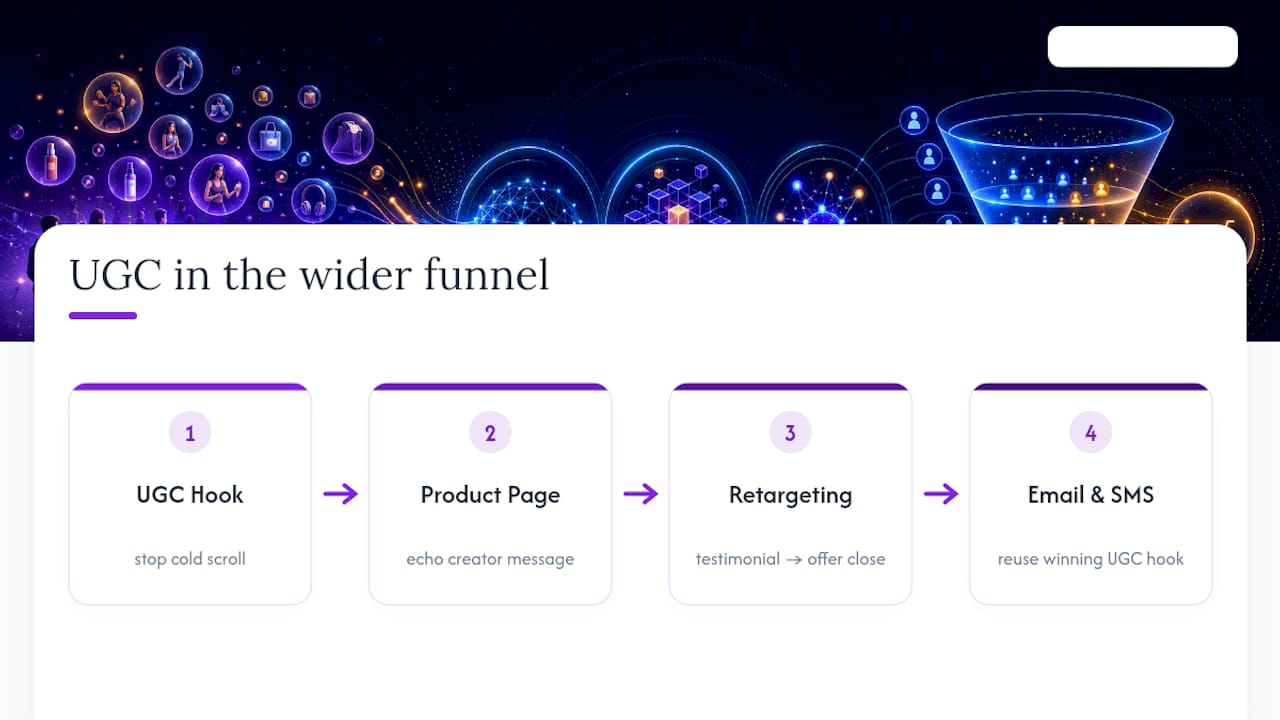
UGC ads earn their reputation at the top of the funnel, but treating them as a standalone tactic wastes most of their value. The clip that stops a cold scroll on TikTok should hand off to a product page that reinforces the same message the creator just made, not a generic collection page that forces the viewer to start their decision over.
Cross-channel consistency matters more than most brands assume. If your UGC ad shows a customer solving a specific problem, your email flows, your retargeting creative, and your product page copy should echo that same problem-solution framing rather than reverting to generic brand language once the click lands. Retargeting sequences work well when they escalate: a cold hook-first UGC clip, followed by a testimonial-format retarget, followed by an offer-led close for anyone who added to basket but didn’t buy.
Email and SMS flows benefit from the same source material. A welcome sequence that reuses the winning UGC hook from your ad account performs better than one written cold, because the subscriber has already been primed by the same message once. Loyalty and post-purchase flows can then ask happy customers to become the next round of UGC, closing the loop.
The businesses getting the most out of this treat UGC creative less like an ad account line item and more like a shared asset library that email, organic social, and paid all draw from, tested once in ads and reused wherever the same audience shows up next.
Most UGC programmes stall for predictable reasons, and nearly all of them are fixable once you spot the pattern.
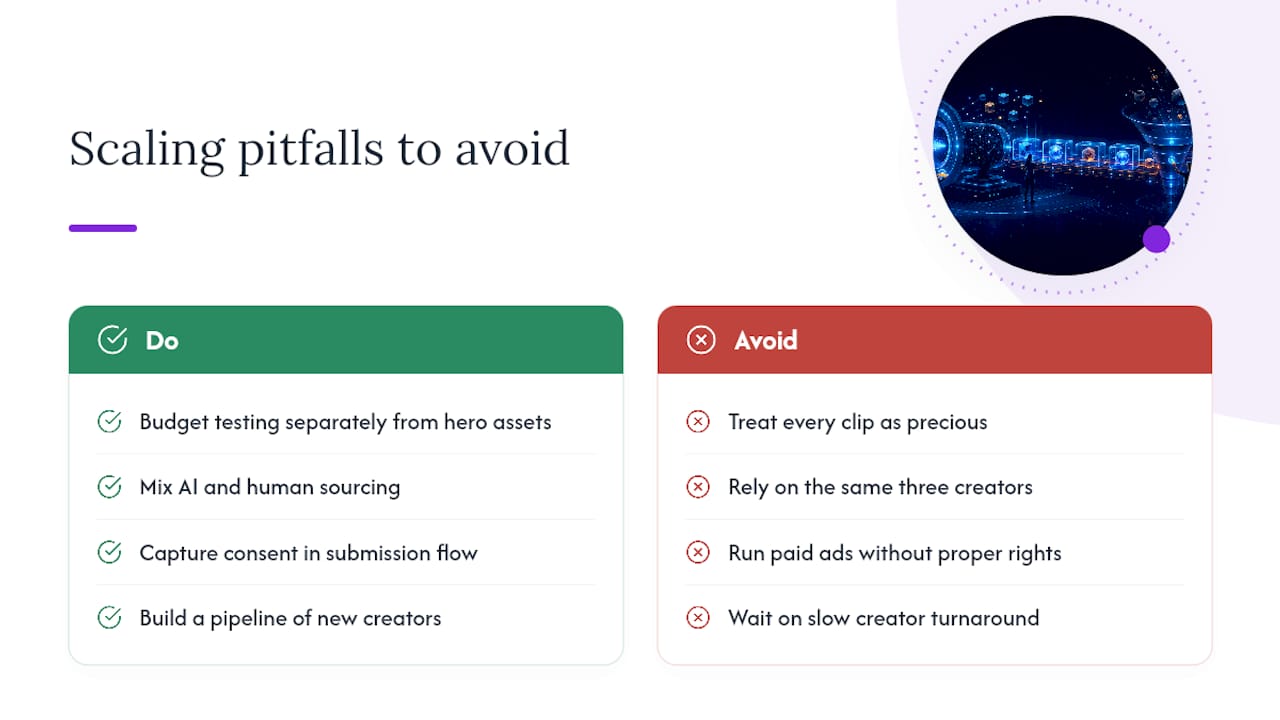
Treating every clip as precious is the most common trap. Teams that spend heavily on a handful of polished creator videos often refuse to kill underperformers because of the cost already sunk, when the entire value of UGC is volume and disposability. Fix this by budgeting for testing separately from budgeting for hero assets.
Sourcing bottlenecks show up once a brand tries to scale past its first few winning creatives. Waiting on creator turnaround times or chasing customers for footage slows the whole testing cadence down. A hybrid AI-and-human sourcing mix, discussed earlier, solves this directly.
Rights and disclosure gaps cause real legal exposure once a brand starts spending meaningfully behind a clip that was never properly licensed for paid use. This is almost always a process failure, not a malicious one, fixed permanently by building consent capture into the submission flow itself.
Fatigue from reusing the same three creators is subtler. Even winning UGC ads decay in performance after a few weeks of heavy spend, so a genuine pipeline of new faces and new hooks matters more than protecting a handful of proven performers indefinitely.
Misreading platform noise as creative failure rounds out the list. A test that ran during a bidding anomaly or against a temporarily saturated audience can look like a losing hook when it isn’t, which is exactly why matched, controlled testing setups matter more as spend increases.
The ecommerce brands getting consistent results from UGC ads share a few traits regardless of category. Beauty and skincare brands lean hard on before/after formats paired with a specific, believable timeframe, because the format does the persuading and the creator just needs to look credible rather than polished. Home and lifestyle brands tend to win with demo-style UGC that answers a practical doubt, “does this actually fit in a small kitchen”, rather than an emotional appeal.
Apparel and accessories brands that scale well typically run high creative volume rather than a handful of hero videos, treating each new colourway or drop as a fresh reason to shoot new hook variations rather than recycling last season’s winners. Supplement and wellness brands lean on testimonial format paired with the verified-review trust loop mentioned earlier, since the category faces more scepticism than most and needs the extra layer of social proof at the product page.
The common thread across all of these is discipline in testing, not creative genius. Brands that treat every new product launch as an excuse to run five to ten hook variations before committing spend consistently outperform brands that shoot one “definitive” ad and hope it works. The lesson repeated across every high-performing account is unglamorous: more shots on goal, judged quickly and honestly against a kill rule, beats one expensive bet almost every time.
Running a genuine hook-first testing programme at the cadence this playbook describes is demanding for an internal team already stretched across a dozen other channels, which is where a senior-led partner earns its place. A five-phase Growth Engine applies directly to UGC: AI-powered intelligence identifies which hooks and angles are already working in your category, a strategic blueprint sets the testing cadence and kill rules, AI-amplified execution produces test variants at volume, human-led optimisation reviews the data and decides what earns a hero-asset budget, and every cycle closes with measurable commercial outcomes tied to revenue rather than vanity engagement.
This is not a bolt-on service. Senior strategists sit inside the creative decisioning itself, deciding which winners deserve retargeting budget and which need retiring, backed by the same revenue attribution discipline that runs through every Viaductgen engagement. If your team wants to see how that AI-native production model actually works in practice, explore how we use AI in client work and get a sense of what a properly resourced testing pipeline looks like inside a 90-day sprint.
For deeper detail on the legal side, Traverse Legal’s breakdown of FTC influencer guidelines covers disclosure obligations in plain terms. Influenna’s current UGC creator rate benchmarks are worth checking before any contract negotiation. Semihuman’s guide to content compliance and rights capture workflows is a useful companion to the licensing checklist above, and Shopify’s own breakdown of UGC ad mechanics by platform is a solid reference for format and placement decisions.
Yes, provided the brand has explicit, documented consent from the creator covering paid use specifically, since organic permission or a tagged post does not automatically extend to paid advertising.
Creator-produced UGC typically runs $75 to $500 or more per deliverable depending on usage rights, while AI UGC tools can produce test variants for a fraction of that cost, making them well suited to early hook testing before committing to a paid creator.
For creators, yes: brands regularly pay per deliverable through marketplaces or direct outreach, with rates varying by follower count, niche, and the scope of usage rights granted.
UGC ads are paid placements built from footage shot by real customers or creators rather than a studio production, designed to look native to the platform feed rather than like a traditional advert, and they typically outperform brand creative on CTR and CPC.

