
A Google SERP (Search Engine Results Page) is the page Google returns after a query, combining paid ads, organic listings, and an expanding catalogue of SERP features including AI Overviews, People Also Ask boxes, local packs, and knowledge panels. Winning visibility in 2026 means appearing in those features, not only ranking in the top ten blue links.
The strategic shift is real and measurable. Google holds a dominant share of the global search market, which means the decisions Google makes about how to display results affect virtually every website owner and marketer in the UK. Since AI Overviews rolled out in May 2024, a material share of informational queries now return a synthesised answer above the organic listings, compressing the user journey before a single organic result is clicked. The practical consequence:
Backlinko identifies three building blocks in every Google SERP: paid ads, organic results, and SERP features. Understanding each one is the starting point for any serious SEO strategy.
Paid results appear at the top and sometimes the bottom of the page, labelled “Sponsored.” They are bought through Google Ads on a cost-per-click basis and can occupy the first four positions for commercial queries. Organic results sit below them, ranked algorithmically by relevance, authority, and a range of quality signals.
SERP features are everything else. They are dynamic, query-dependent, and increasingly dominant. The main ones to know:
A note on personalisation. Google tailors results by location, device, search history, and language settings. A query run in Manchester will produce a different local pack from the same query run in London. UK searchers also see UK-specific news sources and local business listings that would not appear in a US-based SERP. For accurate research, always test with geo-emulation set to your target location.
Statistic callout: StatCounter data shows Google commanding a dominant share of global desktop and mobile search. For UK-based SEOs, that concentration means Google SERP features are not optional reading — they are the primary arena.
Not every feature is worth pursuing for every query. The table below maps the major features against their visibility impact, the tactics that win them, and the tools to test with.
| Feature | Visibility impact | How to win | Tools to test | Where it appears |
|---|---|---|---|---|
| AI Overview | High: appears above organic; reduces clicks on informational queries | Answer-first content, clear entity signals, structured excerpts, citations | Viaductgen AI Visibility Checker, rank trackers with AI Overview detection | Informational / navigational queries |
| Featured snippet | High: position zero, strong CTR for definition and how-to queries | Short summary paragraph (40–60 words), direct question-answer format, H2/H3 headings | SERP simulators, snippet preview tools | Informational, definition, how-to |
| People Also Ask | Medium: expands visibility across related queries | FAQ-format content, concise answers under each question heading | Keyword research tools with PAA extraction | Broad informational queries |
| Knowledge panel | High for branded queries: dominates right-hand column | Google Business Profile, Wikipedia/Wikidata presence, consistent entity data | Google Search Console, entity checkers | Brand / entity navigational queries |
| Local pack | Very high for local intent: three listings above organic | Local Business schema, Google Business Profile completeness, citation consistency | Google Business Profile dashboard, local rank trackers | “Near me” / geo-modified queries |
| Shopping / product grid | High for transactional: visual, price-visible | Product schema (name, price, availability, aggregateRating), Google Merchant Centre feed | Google Merchant Centre diagnostics | Transactional product queries |
| Review stars | Medium: increases CTR on organic listings | aggregateRating schema, Review schema on product and service pages | Google’s Rich Results Test | Product, service, recipe pages |
| Top stories | Medium: time-sensitive visibility | News sitemap, fast load speed, E-E-A-T signals, structured article schema | Google Search Console, news rank trackers | Trending / news queries |
Pro Tip: To spot queries likely to trigger an AI Overview, look for informational intent combined with a question format (“how does X work”, “what is X”, “why does X happen”). Run those queries in an incognito window with your location set to the UK. If an AI Overview appears, treat that query as a feature-first target, not a standard organic ranking opportunity.
SEMrush’s analysis confirms that SERP composition varies significantly by query type and engine, which is why UK geo-testing matters before committing to a content format.
The old model was simple: rank higher, get more clicks. That relationship has weakened considerably. Ahrefs reports that AI Overviews now appear for a sizeable share of informational queries and materially reduce organic clicks where present. When a synthesised answer sits above position one, even a top-ranking page loses a portion of the traffic it would previously have received.

SERP analysis is the core diagnostic activity that replaces simple rank tracking. Moz’s professional SERP analysis guidance makes the point clearly: not all keywords are equal, and feature mapping determines the real opportunity. A keyword ranking at position three behind an AI Overview, a featured snippet, and a local pack is a very different commercial proposition from the same position on a clean SERP.
Specific features that re-route clicks:
Modern KPI set for SERP success:
| KPI | What it measures | Why it matters |
|---|---|---|
| Feature visibility rate | % of target queries where you appear in a SERP feature | Shows feature-level reach beyond organic position |
| Organic CTR by query type | Click-through rate segmented by informational / commercial / navigational | Reveals where features are cannibalising clicks |
| Revenue-attributed organic sessions | Organic sessions that convert to pipeline or revenue | Connects search activity to commercial outcomes |
| SERP volatility index | Frequency of feature changes for tracked queries | Flags when a query’s opportunity profile has shifted |
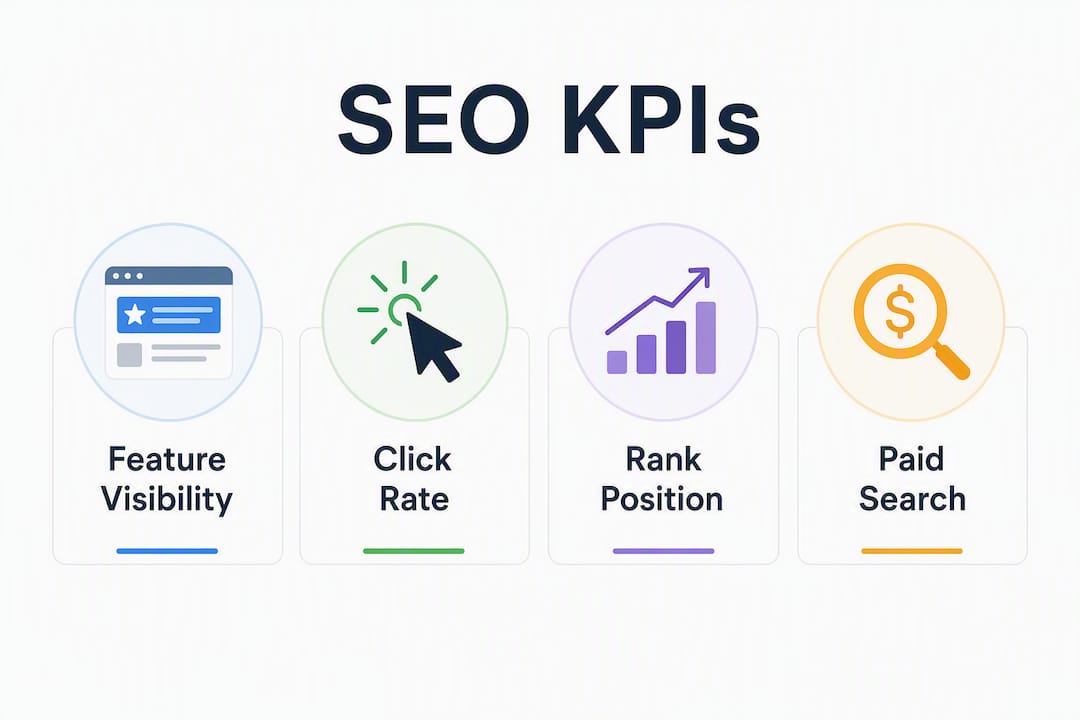
Paid search plays a compensatory role when features dominate. If an informational query is now answered entirely by an AI Overview, a paid ad above it may be the only reliable way to capture that click. Viaductgen’s revenue attribution approach treats paid and organic as complementary levers in the same commercial model, not separate budgets competing for credit.
For a deeper look at SEO reporting KPIs that connect to revenue, Viaductgen’s 2026 guide covers the measurement framework in full.
Run this checklist for every priority query before writing a single word of content.
SERP map template:
| Field | Example (informational) | Example (commercial) |
|---|---|---|
| Query | “how to set up Google Search Console” | “best CRM software UK” |
| Intent | Informational / how-to | Commercial investigation |
| Features present | AI Overview, PAA, featured snippet | Shopping grid, review stars, PAA |
| Top organic types | Long-form guides, official docs | Listicles, comparison pages |
| Suggested tactic | Structured how-to content, HowTo schema | Comparison page, aggregateRating schema |
Pro Tip: SERP composition changes. Schedule a recheck of your feature map every 60–90 days for high-priority queries, and immediately after any Google core update. A query that was a clean organic opportunity six months ago may now be feature-dominated. Build SERP volatility tracking into your reporting cadence, not just rank tracking.
The right tool depends on what you are trying to do. Here is how to think about the categories.
Live SERP inspection tools let you query Google from a specific location and device without affecting your personal search history. Browser extensions that emulate geo-location, or dedicated rank-checking tools with location parameters, are the standard approach. For UK-specific testing, always set the country to GB and the language to English (UK) to get accurate local pack and featured snippet data.
SERP simulators and snippet preview tools show you how your title tag and meta description will render in a Google result before you publish. Mangools’ SERP simulator is a widely used example: paste in your title and description, and it renders a preview at the correct character truncation point. This is useful for meta optimisation without needing to rank first.
Rank trackers with feature detection go beyond position reporting. The better platforms flag when a tracked keyword has an AI Overview, featured snippet, or local pack present, and some track whether your domain appears within those features. This is the minimum viable monitoring setup for 2026.
Viaductgen’s AI Visibility Checker is a practical starting point for assessing whether your pages are likely to be surfaced in AI-driven features, without requiring a full platform subscription.
APIs and licensed data sources are the production-grade option for teams building dashboards or automating SERP monitoring at scale. The AI search API market divides into independent indexes, licensed APIs (such as the Bing Web Search API), and SERP scraper services, each with a different risk and coverage profile. Licensed APIs are the most durable choice for anything running in production.
UK-specific considerations:
AI-driven search is reshaping how visibility is measured, and the tools you use need to reflect that shift rather than reporting only traditional rank positions.
Appearing in SERP features is not accidental. It follows from specific structural and content decisions.
Content and format:
Schema markup priorities:
HowTo structured data including name, text, and image fields.name, price, availability, and aggregateRating fields. The aggregateRating field is what triggers review stars in organic results.name, address (with addressCountry: GB), telephone, openingHours, and geo coordinates. Pair this with a complete and accurate Google Business Profile.datePublished, dateModified, author, and publisher fields to support Top Stories eligibility.Metadata:
Operational:
Pro Tip: Before committing to a full content overhaul for a feature-dominated query, run a small paid search test. Bid on the query, direct traffic to a landing page structured for answer-first content, and measure engagement and conversion. If the page performs well as a paid destination, the content format is validated before you invest in organic optimisation. This is especially useful for AI Overview-dominated queries where organic CTR data is unreliable.
For a broader view of search visibility strategies that connect to growth, Viaductgen’s tactical guide covers content format decisions by intent type.
The short answer: Google’s terms of service explicitly disallow automated querying at scale. Scraping works tactically for small-scale research, but it introduces structural and legal risk that grows with the scale of use.
Safer alternatives:
If you must automate at any scale, rate-limiting requests, using residential proxies, and obtaining legal review are risk mitigations, not legal guarantees. Relying on SERP scrapers for production AI systems creates a durability risk: Google can change markup or block access without notice, breaking any system built on scraped data.
This section provides general guidance only. For commercial-scale scraping projects, obtain independent legal advice before proceeding.
AI Overviews, first widely rolled out in May 2024, represent the most significant structural change to Google SERPs in years. They synthesise content from multiple sources into a single answer block, appearing above organic results for a material share of informational queries. The pages cited as sources gain a form of visibility, but the user may not click through at all.
The practical implication: content that provides concise, verifiable facts with clear entity signals and structured excerpts is more likely to be used as source material. Vague, padded content that buries its answer in the third paragraph is not.
Viaductgen’s AEO (Answer Engine Optimisation) playbook:
When a page is redesigned for answer-first structure, the most common outcome is not a dramatic ranking jump but a shift in how Google uses the content: it begins appearing as a cited source in AI Overviews for related queries, generating impressions and brand exposure even when the user does not click through. That visibility compounds over time as the page accumulates citations.
Viaductgen’s AI Overviews guide covers the practical mechanics of how Google selects source material, and the agency’s Growth Engine methodology applies AEO principles within a five-phase commercial framework that ties search visibility directly to revenue outcomes.
Google SERPs now reward feature-first optimisation: appearing in AI Overviews, featured snippets, and local packs requires structured content, schema markup, and answer-first writing, not only high organic rankings.
| Point | Details |
|---|---|
| Features intercept clicks | AI Overviews and featured snippets reduce organic CTR on informational queries; map features before setting traffic targets. |
| SERP analysis is the core skill | Run a feature map for every priority query: identify intent, features present, and winner-take-all risk before creating content. |
| Schema is non-negotiable | Implement FAQ, HowTo, Product, and LocalBusiness schema; test with Google’s Rich Results Test before publishing. |
| Measure beyond position | Track feature visibility rate, organic CTR by intent type, and revenue-attributed sessions, not rank alone. |
| Scraping carries structural risk | Use licensed APIs or commercial rank-tracking platforms for production monitoring; manual sampling for small-scale research. |
A curated list of authoritative resources for anyone building a serious SERP strategy.
A Google SERP is the page Google displays in response to a search query. It combines paid ads, organic listings ranked by algorithm, and SERP features such as AI Overviews, featured snippets, and local packs.
Google does not own the concept of a SERP, which is a generic term for any search engine’s results page. Google contrôle la conception, les fonctionnalités et la logique de classement de ses propres SERP, qui couvrent environ 90 % du trafic mondial de recherche (mi-2026).
SERP composition directly determines which content formats and tactics earn visibility. When features like AI Overviews or local packs dominate a query, organic ranking position becomes a weaker predictor of clicks, and feature-specific optimisation (schema, structured content, Google Business Profile) becomes the priority.
Google’s terms of service disallow automated querying at scale. For research purposes, licensed APIs (such as the Bing Web Search API) and commercial rank-tracking platforms are the legally safer alternatives; manual SERP inspection with geo-emulation covers small-scale needs without enforcement risk.

