
Search term mining is the practice of turning real search queries that triggered your ads into controlled keywords and negatives. The single highest-leverage habit here is running the search terms report for the last 30 days and applying a strict promote, block, or observe gate to every query before it touches your account structure. Do that weekly and waste falls, Quality Score signals improve, and your keyword list stops growing by accident.
Viaductgen
viaductgen.com
Turn PPC Data Into Growth
Viaductgen connects PPC with search, brand, and performance strategy through an AI-powered growth system focused on commercial outcomes.
A search term is what someone actually typed into Google. A keyword is what you told Google Ads to bid on. The gap between the two is often where most of your budget leaks or converts, depending on how closely you police it.
Keyword Planner gives you forecasts and volume estimates built from aggregated data across advertisers. Search terms give you something more valuable: proof. Every entry in the report already triggered your ad, generated an impression, and, often, produced a click and a cost. That is a higher-confidence signal than any planner suggestion, because it reflects your account’s actual auction behaviour rather than a generic estimate.
Mining well delivers three concrete gains:
Ignore this process and match type expansion quietly drifts your account away from the queries you actually want to win.
Treat every mined term as a candidate for one of three outcomes: promote, block, or observe. Skipping the third bucket is the most common reason accounts end up bloated with low-volume ad groups nobody can maintain.
Pro Tip: Before promoting a term, check whether an existing keyword elsewhere in the account already covers it. Promoting without auditing for duplicates is a common way to cannibalise your own ad groups and muddy conversion reporting.
Match type discipline matters here too. Broad match paired with Smart Bidding can act as a genuine discovery engine when conversion volume is strong, but below that signal threshold it will keep generating the same wasteful patterns you are trying to mine out.
The Google Ads search terms report is your primary source, but it is far from the only one. Microsoft Advertising runs its own equivalent report, and if you’re active on both networks, the overlap in query language is worth comparing.
Beyond the ad platforms themselves, several secondary sources routinely surface language paid search misses entirely:
A Search Engine Land roundup catalogues nineteen such tools and tactics, and the common thread across them is that discovery rarely comes from one channel alone.
For accounts with meaningful spend, n-gram analysis and scripts add a layer of automation: rather than reviewing individual queries, you group them by recurring one, two, or three-word patterns to spot systemic waste rather than isolated bad matches. AI prompts and third-party dashboards can accelerate the sorting stage, but they are aids to the workflow above, not replacements for the gate itself.

The report’s value depends entirely on which columns you actually watch and how you filter them. Six matter most: search term, matched keyword, match type, impressions, click-through rate, and conversions, alongside cost.
Filtering transforms a wall of data into a decision list. Useful filters include:
Match type context deserves particular attention. The report maps each search term back to the keyword and match type that triggered it, and Google’s own documentation on the search terms report explains how broad, phrase, and exact matches relate to what was actually typed. A close variant sitting one word away from your exact match keyword is usually safe to leave alone; a completely different intent triggered by a broad match keyword is a signal to act, not observe.
Performance Max and DSA queries deserve a caveat of their own: they surface useful themes but do not expose keywords in the conventional sense, so treat anything promising there as a hypothesis to validate inside a standard search campaign before you commit budget to it.
Negation should follow patterns, not incidents. A single irrelevant click rarely justifies a negative; a query type that recurs across weeks, or across multiple ad groups, does. Chasing every one-off wastes ops time and produces a negative list nobody can maintain.
Shared negative lists solve the maintenance problem at scale. Rather than negating the same waste pattern separately in ten ad groups, apply it once at the list level and attach that list to every relevant campaign. Change control matters too: log who added what and why, since an undocumented negative can silently block a legitimate query months later and nobody will know why performance dipped.
Negatives are also what make broad match discovery viable. Without a disciplined negative layer, broad match plus Smart Bidding will keep testing the same wasteful territory instead of expanding into genuinely new, relevant queries.
Pro Tip: Review your shared negative lists quarterly, not just when something breaks. Search behaviour shifts, and a negative that made sense a year ago can start blocking demand you now want.
Cadence should scale with spend, not follow a fixed calendar. Accounts spending under a few thousand pounds a month can mine every two to four weeks; higher-spend accounts generating conversions daily benefit from a weekly review, since waste and opportunity both compound faster.
Ownership works best when split rather than dumped on one person. An analyst pulls and filters the report; an account manager or strategist makes the promote, block, or observe calls against agreed thresholds; someone senior reviews aggregate trends monthly to catch drift the weekly view misses.
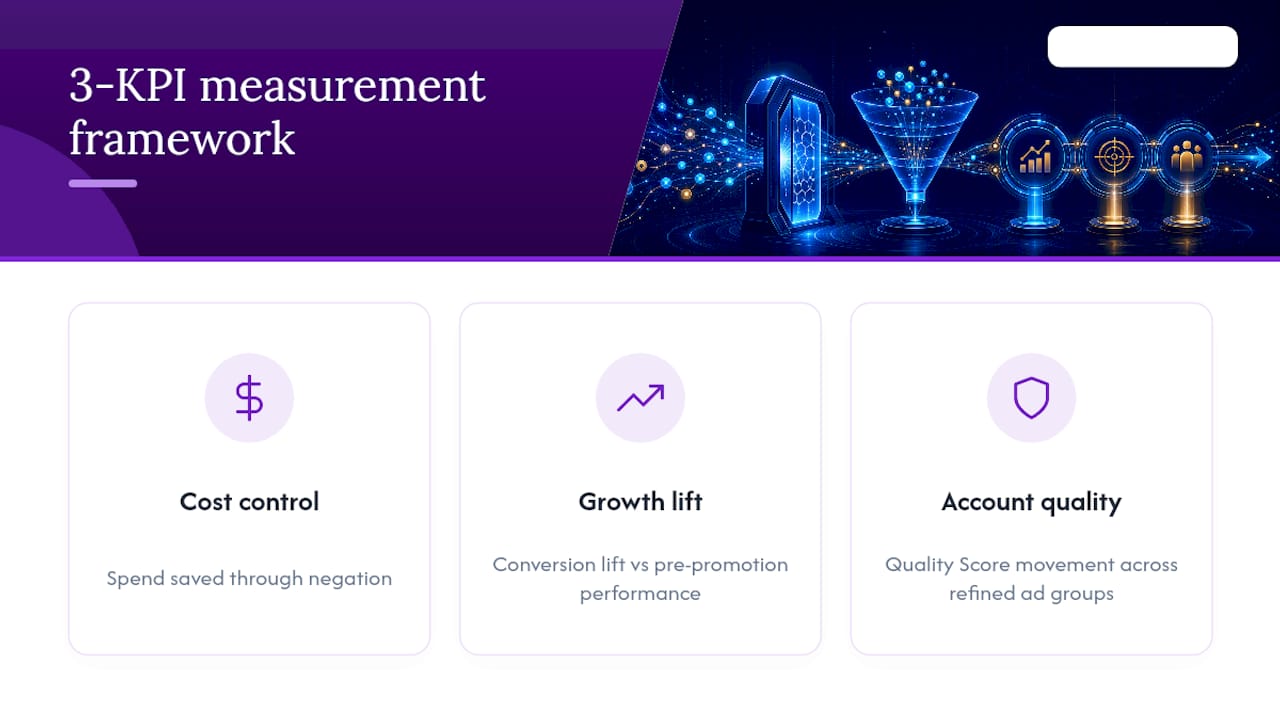
Three KPIs prove the workflow is working: spend saved through negation, conversion lift from promoted terms measured against their pre-promotion performance, and Quality Score movement across the ad groups you’ve refined. Track all three, not just one, or you risk optimising for cost-cutting at the expense of the growth mining is supposed to deliver.
Search term mining sits inside the third and fourth phases of our Growth Engine, AI-Amplified Execution and Human-Led Optimisation, where automated pattern detection flags gate candidates and a senior strategist makes the final promote, block, or observe call. AI handles the volume; judgement handles the risk.
As Co-founder & CEO, I’ve watched automated-only mining drift accounts toward technically clean but commercially irrelevant keyword lists. Pairing the two is what keeps the Growth Engine’s PPC work compounding rather than plateauing, as our People XCD case study illustrates.
Volume alone is a weak signal. A search term with 500 impressions and no conversions tells you far less than one with 40 impressions and three conversions at a strong cost per acquisition. Prioritise by commercial intent first, then by statistical confidence.
Start by grouping mined terms into intent tiers: transactional queries that include buying language (“buy”, “price”, “quote”, brand names), comparison queries that suggest late-stage research, and informational queries that rarely convert directly but may feed remarketing lists. Transactional terms clearing your gate deserve same-week promotion. Comparison terms are strong observe candidates, since they often need a few more cycles to prove consistency.
Within the transactional tier, rank by a blended score rather than a single metric. A term converting at your target cost per acquisition with modest volume usually outranks a high-volume term converting above target cost, because scaling the latter just scales your problem. Where two terms tie on performance, favour the one aligned with a landing page you already have, since promotion without a matching page rarely pays off even when the query itself is strong.
Revisit priorities every review cycle rather than treating a promotion decision as permanent. Search behaviour shifts with seasonality, competitor activity, and even algorithm updates to Smart Bidding, so yesterday’s low-priority observe term can become this month’s top promotion candidate without warning.
The most damaging mistake is promoting too eagerly. A term that clears a loose gate once, then never repeats, becomes a permanently underperforming keyword nobody remembers to prune, and enough of these creates the account sprawl practitioners warn against when gates aren’t enforced consistently.
A closely related error is treating every gate as fixed regardless of account size. Applying a one-conversion gate to a low-spend account with barely any conversion data guarantees you’ll either promote almost nothing or promote based on statistical noise. Adjust the gate to the account, not the other way round.
Negating too broadly causes the opposite problem. Blocking a phrase because one instance of it wasted spend can silently cut off a query pattern that would have converted well the following month. This is why pattern-based negation, not incident-based negation, matters so much.
Ignoring match type context is another frequent gap. Teams sometimes promote a search term without checking whether an existing keyword, under a different match type, already covers it, creating internal competition between keywords in the same auction rather than expanding real coverage.
Finally, many accounts mine sporadically rather than on a set cadence, which means waste accumulates for months between reviews. A missed cycle isn’t a rounding error. It’s several weeks of budget spent against queries nobody has actually checked.
The pattern across well-run accounts is consistency, not cleverness. A B2B services account running broad match with Smart Bidding, for example, benefits when mining is paired with tight conversion tracking and audience signals, since broad match only earns its keep when the bidding algorithm has clean data to learn from.
E-commerce accounts often see the clearest before-and-after story. A retailer running loosely matched phrase keywords typically finds that a handful of recurring irrelevant query patterns (wrong product category, price-sensitive modifiers like “free” or “cheap” that don’t match their positioning) account for a disproportionate share of wasted spend once isolated through n-gram review. Blocking those patterns at the shared-list level, rather than one keyword at a time, tends to free up budget that then gets reinvested into newly promoted, converting terms discovered the same cycle.
Lead generation accounts frequently uncover call-intent queries during mining that display-only tracking never catches. Phrasing that leans toward “call now” or “phone number” intent behaves differently to form-fill intent, and accounts using trackable, memorable phone numbers alongside their mining process can attribute those conversions properly rather than losing them to unassigned call traffic.
The common thread across every case is that mining only pays off when it’s paired with governance: someone reviewing the report on a set cadence, applying gates consistently, and feeding the resulting promotions and negatives back into a structure built to support them.
Running this workflow manually, week after week, is realistic for a single account. It gets considerably harder once you’re managing several campaigns across markets, or once conversion tracking needs to tie back to actual revenue rather than click volume alone. That’s the point where most in-house teams either hire, or bring in a partner to run the process at scale.
Viaduct Generation’s Performance PPC service builds exactly this kind of gate-driven mining into an ongoing account operating rhythm, backed by senior strategists rather than a junior account manager working from a template. Where mining reveals a landing page mismatch or a tracking gap, our Conversion Rate Optimisation work closes that loop, and where the opportunity is bigger than PPC alone, our Search Growth Blueprint maps mining into a wider acquisition strategy across search, brand, and performance.
If you’re spending meaningfully on Google Ads and want this workflow run properly rather than sporadically, start with a conversation about your account on Viaductgen.
PPC, or pay-per-click search, is an advertising model where advertisers bid to show ads against specific search queries and pay only when someone clicks. Search term mining is the process of reviewing those actual queries to refine which ones you target.
PPC involves paying for placement in search results, with results appearing and disappearing as budgets and bids change, while SEO earns organic placement through content and technical optimisation that compounds over time without a per-click cost. Many accounts run both together, since search term data from PPC often reveals language worth targeting organically too.
PPC is an advertising method where you pay a fee each time someone clicks your ad, most commonly run through platforms like Google Ads. Its effectiveness depends heavily on which search terms actually trigger your ads, which is exactly what search term mining is designed to control.
Google PPC refers to advertising run through Google Ads, where ads appear against search queries and other placements and advertisers pay per click rather than per impression. Viaduct Generation’s Performance PPC service manages this end to end, including the ongoing search term mining that keeps campaigns efficient.

