
Brand is not a cosmetic layer you apply after a deal closes. In mergers and acquisitions, it functions as a financial asset, a trust mechanism, and a signal to every stakeholder watching. Get it right and you accelerate value creation. Get it wrong and you erode customer loyalty, unsettle employees, and confuse investors before integration has even begun.
The case for treating brand as a core acquisition variable rests on hard numbers. Brand intangible assets account for roughly 92% of S&P 500 market value, with brands alone driving over 30% of stock market valuation. Companies with strong brands have outperformed the S&P 500 by +88% since 2006. These are not marketing metrics. They are shareholder return figures, and they belong in every deal room conversation.
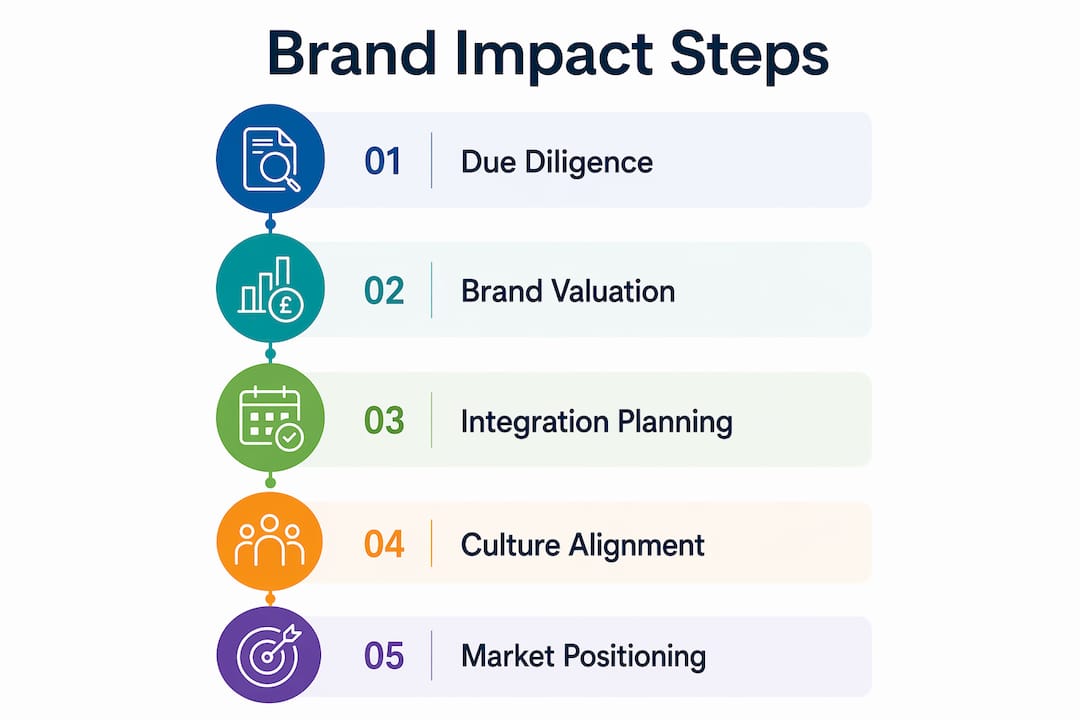
The role of brand in acquisition spans five distinct pressure points:
Valuation: Brand equity inflates or deflates the multiple a target commands.
Due diligence: Brand health signals customer retention risk and pricing power before close.
Integration planning: Brand architecture decisions made pre-close determine how cleanly two organisations merge.
Stakeholder signalling: Post-merger branding choices send immediate messages to customers, employees, and investors.
Long-term growth: A coherent brand platform unlocks cross-selling, pricing discipline, and market efficiency over time.
Brand equity in an acquisition context is not about recognition scores or logo recall. It is the accumulated trust that lets a company charge more, retain customers longer, and attract talent without competing purely on salary. When one business acquires another, it is buying that accumulated trust, and the way it handles the brand determines whether that trust transfers or evaporates.
Customer loyalty is the most direct expression of brand equity, and it has a measurable financial consequence. A 5-point increase in retention driven by brand loyalty can raise profit by 25–95%. That range is wide, but even the lower end is enough to shift a deal’s internal rate of return materially. Acquirers who treat brand as a retention mechanism, rather than a communications exercise, tend to protect that upside.
Culture is the harder problem. Brand is not just external positioning; it is the set of behaviours and expectations that employees internalise. When two organisations merge, their brand cultures collide, and 50–75% of integrations miss their objectives because of cultural clashes and brand misalignment. The companies that avoid this outcome treat cultural due diligence with the same rigour they apply to financial audits.
Reputation compounds the risk further. A target’s brand reputation affects how customers, regulators, and partners respond to the acquirer’s name appearing on the door. If the acquired brand carries negative associations, those associations transfer. If it carries genuine goodwill, careless integration destroys it. Neither outcome is neutral for the acquirer’s own brand equity.
Employee morale post-acquisition is often the first casualty of a poorly managed brand transition. Uncertainty about which brand “wins” creates anxiety, and anxiety drives attrition. The best performers, who have the most options, leave first. Retaining them requires a clear, credible narrative about what the combined organisation stands for, and that narrative is a brand decision.
The financial case for brand management in M&A is no longer theoretical. Research and market data now show that branding choices made around a deal directly affect stock market reactions, operating performance, and long-term value creation.

Three broad strategies dominate post-merger brand decisions: assimilation (one brand absorbs the other), fusion (a new combined identity), and business-as-usual (both brands continue independently). Each produces different financial outcomes.
| Branding strategy | Stock market reaction | Operating performance | Customer retention risk |
|---|---|---|---|
| Fusion | Most positive | Strongest post-merger | Lower: both audiences retained |
| Assimilation | Mixed | Moderate | Higher: acquired brand’s customers at risk |
| Business-as-usual | Least positive | Weakest | Highest: no integration signal |
Fusion branding yields more positive stock market responses than either assimilation or business-as-usual approaches, and it also produces stronger operating performance by maintaining elements of both brands. The mechanism is straightforward: customers of both organisations see their relationship acknowledged, which reduces churn. Investors read the combined identity as a signal of genuine integration rather than a holding pattern.
Business-as-usual branding, by contrast, is associated with market mispricing and weaker investor reception. It signals indecision, and markets price indecision accordingly.
Brand evaluation during due diligence is still underused, despite its predictive value for deal outcomes. A brand audit at this stage should assess net promoter scores, customer concentration risk, pricing premium sustainability, and the target’s share of voice in its category. These indicators reveal whether the brand’s equity is real or inflated by market conditions that will not survive a change of ownership.
“Post-merger branding acts as a strategic signal to customers, employees, and investors, influencing their responses and impacting share price.” — Research on corporate branding in mergers, published via SSRN
The financial value of brands in acquisitions depends heavily on resource fit: how well the acquirer’s existing capabilities can deploy the target’s brand assets. A strong brand acquired by a firm with weak marketing management capability often underperforms, not because the brand was overvalued, but because the acquirer lacked the infrastructure to extract its value.
Approximately 60–70% of private equity value creation in acquisitions derives from EBITDA and revenue growth, where a coherent brand platform is essential to unlock cross-selling, pricing power, and market efficiency. That figure reframes brand from a soft asset into a direct driver of the metrics PE firms track most closely.
The decision about what to do with two brands after a deal closes is one of the highest-stakes choices an executive team makes. It affects customer perception, employee identity, and investor confidence simultaneously, and it is rarely reversible without cost.
Assimilation works best when the acquirer’s brand is materially stronger and the target’s customer base is small or overlapping. The risk is losing the loyalty of customers who chose the acquired brand specifically because it was not the acquirer.
Fusion suits deals where both brands carry genuine equity and the combined entity needs a new identity to signal transformation. It requires investment in brand architecture and communications, but the research on merger outcomes consistently favours it for operating performance.
Business-as-usual is often chosen by default rather than design, particularly in private equity portfolio structures. It preserves optionality but delays the integration benefits that justify the deal premium.
Authenticity is not about keeping everything the same. It is about honouring the reasons customers chose the acquired brand and making those reasons visible in the combined organisation. The most common failure is renaming everything immediately, before the acquirer has earned the right to the relationship. Customers notice, and the ones with the highest lifetime value are usually the quickest to leave.
Practical tactics for preserving authenticity include retaining the acquired brand’s visual identity during a transition period, keeping key customer-facing staff visible and vocal, and communicating the rationale for the acquisition in terms that centre the customer’s benefit rather than the acquirer’s growth ambitions.
Neglecting brand identity post-close does not produce a neutral outcome. It produces a slow erosion of trust that shows up in churn data six to twelve months later, by which point the integration team has moved on and the connection to the brand decision is invisible.
Pro Tip: Plan your brand architecture before the deal closes, not after. The decisions made in the final weeks before completion, about naming, visual identity, and customer communications, set the trajectory for integration. Changing course after announcement costs more in customer confusion and internal disruption than getting it right the first time.
For organisations navigating cross-border M&A, brand integration carries additional complexity: regulatory naming requirements, cultural associations, and language nuances all affect which strategy is viable in each market.
Brand is most powerful when it enters the deal process at the beginning, not as an afterthought once legal and financial due diligence is complete. Treating it as critical infrastructure changes what you look for, what you pay, and how you integrate.
During due diligence, brand evaluation should sit alongside financial modelling. The questions worth asking are: How much of the target’s revenue depends on brand recognition rather than product switching costs? What is the net promoter score trend over the past three years? Does the target’s brand carry pricing power that will survive a change of ownership? These are not marketing questions. They are revenue quality questions.
“Brand is an underutilised lever of enterprise value; managing brand as a system builds trust and aligns teams, critical to M&A success.” — Ocean Tomo Intangible Asset Market Value Study
Acquirers who skip brand due diligence risk eroding customer trust and losing value before integration even begins. The damage is not always visible in the first quarter. It accumulates quietly in renewal rates, average order values, and net promoter scores until it becomes a revenue problem that no amount of post-close integration work can fully reverse.
Brand management has a multiplier effect on the metrics that determine enterprise value. Pricing power, which flows directly from brand equity, expands gross margins without requiring volume growth. Customer retention, driven by brand loyalty, reduces the cost of revenue and improves the predictability of cash flows. Both of these outcomes feed directly into EBITDA, which is the primary valuation driver in most M&A transactions.
The intangible asset data from Ocean Tomo makes the scale of this effect visible: when brands account for over 30% of stock market valuation, the difference between a well-managed and a neglected brand is not a rounding error on enterprise value. It is a material line item.
Brand strategy is one of the most effective tools for aligning two organisations after a deal closes. A clear, shared brand narrative gives employees from both sides a common reference point. It answers the question every employee asks after an acquisition: “What does this mean for me?” A brand that articulates the combined organisation’s purpose and values provides that answer faster than any internal communications campaign.

Delayed brand strategy formulation post-close results in misalignment and market confusion, affecting employee retention and customer perceptions negatively. The companies that move quickly, with a clear brand architecture and a credible narrative, tend to retain more of the talent and customer relationships that justified the deal premium.
For executives building digital brand strategy into their post-acquisition planning, the principles are the same whether the deal is domestic or cross-border: clarity, speed, and customer-centricity determine whether the brand transition accelerates or undermines the investment thesis.
Conduct a brand audit as part of pre-close due diligence, not as a post-close communications exercise.
Decide on the brand architecture strategy before announcement, so customer and employee communications are consistent from day one.
Retain the acquired brand’s customer-facing team during the transition period to maintain relationship continuity.
Measure brand health metrics, including net promoter score, share of voice, and customer retention, at 30, 90, and 180 days post-close.
Treat brand integration as a revenue protection exercise, not a marketing project.
Viaductgen’s brand strategy work applies these principles in practice, connecting brand architecture decisions to measurable commercial outcomes rather than treating identity as a standalone creative exercise.
Brand equity is the single most undervalued variable in M&A due diligence, directly shaping valuation multiples, integration success, and long-term shareholder returns.
| Point | Details |
|---|---|
| Brand drives enterprise value | Brand intangible assets account for roughly 92% of S&P 500 market value, with brands alone driving over 30% of stock market valuation. |
| Fusion branding outperforms | Fusion branding yields more positive stock market reactions and stronger operating performance than assimilation or business-as-usual approaches. |
| Retention has a profit multiplier | A 5-point increase in customer retention driven by brand loyalty can raise profit by 25–95%. |
| Cultural misalignment kills deals | Many integrations miss their objectives because of cultural clashes and brand misalignment. |
| Brand due diligence must come pre-close | Acquirers who skip brand evaluation during due diligence risk eroding customer trust before integration begins. |

