
Programmatic SEO is a system that generates large volumes of search-optimised pages from a single template and a structured dataset, rather than writing each page by hand. It works when two conditions are both true: you have structured, defensible data behind the pages, and the keywords you’re targeting follow a repeatable pattern (think “[product] for [use case]” or “[service] in [location]”). Without both, it produces thin pages that Google eventually stops indexing.
TL;DR:
- Programmatic SEO relies on proprietary, high-quality data to maintain rankings when scaled beyond initial indexing, avoiding thin or duplicate pages.
- Successful patterns include directory pages, calculators, and integration listings that answer genuine queries with regular data updates.
- Continuous maintenance and validation, including content uniqueness and schema checks, are crucial to prevent thin content and ensure sustained performance.
- Industries with dynamic, high-volume data such as ecommerce, travel, and real estate see the best results, unlike static, low-variance sectors.
- Scaling requires a strategic, disciplined approach with proven validation, monitoring, and measurement practices to maximize ROI and avoid deindexation risks.
Programmatic SEO, often shortened to pSEO, is the practice of combining a page template with a structured dataset to publish search-optimised pages at a scale no editorial team could match by hand. A directory with 40,000 city pages, a SaaS tool with 12,000 integration pages, and a comparison site with thousands of “X vs Y” pairings are all running the same underlying model: one design, one content skeleton, and a database that fills in the variables.
The mechanics rest on structured data (a clean spreadsheet, API feed, or database table) and templates (the HTML and copy scaffolding that wraps around it). Search Engine Land’s guide to programmatic SEO frames the discipline around three principles that separate durable projects from the ones Google quietly deindexes:
This differs from traditional editorial SEO in one important way: editorial content starts with a topic and researches the angle; programmatic content starts with a dataset and designs a template around it. The two aren’t rivals. Most mature sites run pSEO for transactional, long-tail capture (thousands of near-identical pages targeting specific variants) alongside editorial content for the harder, more strategic terms that need genuine expertise and narrative depth. One handles volume; the other handles authority.
The clearest way to judge whether a page pattern will work is to look at who’s already doing it well and why their pages don’t feel like filler. Three patterns recur across the strongest examples of programmatic content creation.
Directory and marketplace patterns dominate the space because they map naturally onto structured data. A property portal generating a page per postcode, a job board generating a page per role and city, or a review site generating a page per business location. These work because each page answers a genuinely distinct query, and the underlying dataset (listings, prices, reviews) changes often enough to keep the page fresh.
Calculator and converter pages are one of the most consistently profitable patterns in automated SEO strategies, because they solve a task rather than just deliver information. A currency converter, a mortgage repayment calculator, a unit converter, or a salary-to-take-home calculator generates its own long-tail keyword universe almost automatically, since users search “convert X to Y” in nearly infinite combinations. The template stays fixed; only the inputs and outputs change.
Integration and catalogue patterns power much of the pSEO built by software and ecommerce companies. A project management tool listing “[Tool] integrations with [App]” for every app in its ecosystem, or an ecommerce retailer generating a page for every combination of product attribute and use case, both rely on a many-to-many dataset that would be impractical to build manually.
What separates the successful versions from the graveyard of deindexed pSEO experiments is defensible data. Backlinko’s analysis of programmatic SEO makes the point directly: proprietary data such as an integration directory you maintain yourself or user reviews you’ve collected gives a project a structural advantage that a competitor scraping the same public dataset simply can’t replicate. Anyone can pull average rainfall figures from a government API. Almost nobody else has your customer review data, your pricing history, or your usage analytics. That asymmetry is what keeps the pages ranking after the initial indexation bump fades.
Not every site should run programmatic content. Before committing engineering time to a template, confirm three prerequisites are in place: structured data you can maintain (not a one-off export), a keyword pattern with genuine search volume across variants, and the operational capacity to monitor and prune pages after launch. Programmatic SEO without ongoing maintenance is how sites end up with tens of thousands of orphaned pages nobody’s looked at in two years.
Prioritise business outcomes over vanity indexation. A page pattern built around conversion intent (comparison pages, calculator tools, product-availability pages) will nearly always outperform a purely informational pattern built for traffic alone, because the visitor arriving already has commercial intent baked into the query.
Run your candidate project through this checklist before building anything:
Three or more “no” answers is a signal to redesign the pattern before writing a single line of template code.
The build process runs in five stages, and skipping the validation steps at the start is the single most common reason projects fail at scale.
Pro Tip: Build your conditional content rules into the schema itself, not the template. If a data field is empty (no reviews yet, no pricing data for that variant), the schema should trigger a fallback content block rather than publishing a page with a visible gap. That one rule prevents most of the “thin content” complaints that surface during a manual audit.
Thin and near-duplicate content is the single most common reason programmatic SEO projects collapse after an initial ranking spike. The fix isn’t more pages. It’s tighter gates before pages go live.
Set a measurable target for unique content per page. HubSpot’s guidance on programmatic SEO recommends aiming for roughly 30 to 40% unique content on every page, achieved through page-specific data points, localised detail, or tailored recommendations rather than boilerplate reworded slightly. Semrush’s framework for programmatic SEO adds a second threshold worth building into your template brief: at least 500 words of genuinely useful, page-specific copy, alongside schema markup and conditional logic that adapts to the data available for that particular variant.
Run every batch through three checks before it goes live:
30–40% is the rough unique-content threshold practitioners point to as the line between a defensible page and one at risk of being classed as near-duplicate content, according to HubSpot’s analysis.
Build sitemap segmentation into the architecture from day one, splitting programmatic pages into their own XML sitemap separate from your core site pages, so Search Console reporting shows you exactly which segment is underperforming. Pages that show zero impressions after eight to twelve weeks should be noindexed or merged into a stronger page, not left live indefinitely. Pruning is not a failure of the project. It’s routine maintenance.
Four metrics matter more than any others in the first three months: indexation rate (the percentage of published pages Google has actually indexed), impressions, click-through rate, and conversion rate segmented by page type. A batch with strong impressions but weak conversion tells you the pattern has demand but the wrong template; a batch with poor indexation tells you the quality gate failed before launch.
Treat every new template as an experiment, not a finished product. Test title tag formulas against each other on a subset of pages, test the position and format of your primary call to action, and only roll the winning variant out across the full page set once you have a statistically meaningful sample.
Frame the return on investment in unit economics, not vanity traffic totals:
A page pattern that costs pennies to produce but never converts is not a success story, regardless of how many thousands of pages sit in the sitemap. Scale the patterns that clear a positive return per page, and cut the ones that don’t, even if they’re driving respectable impression counts.
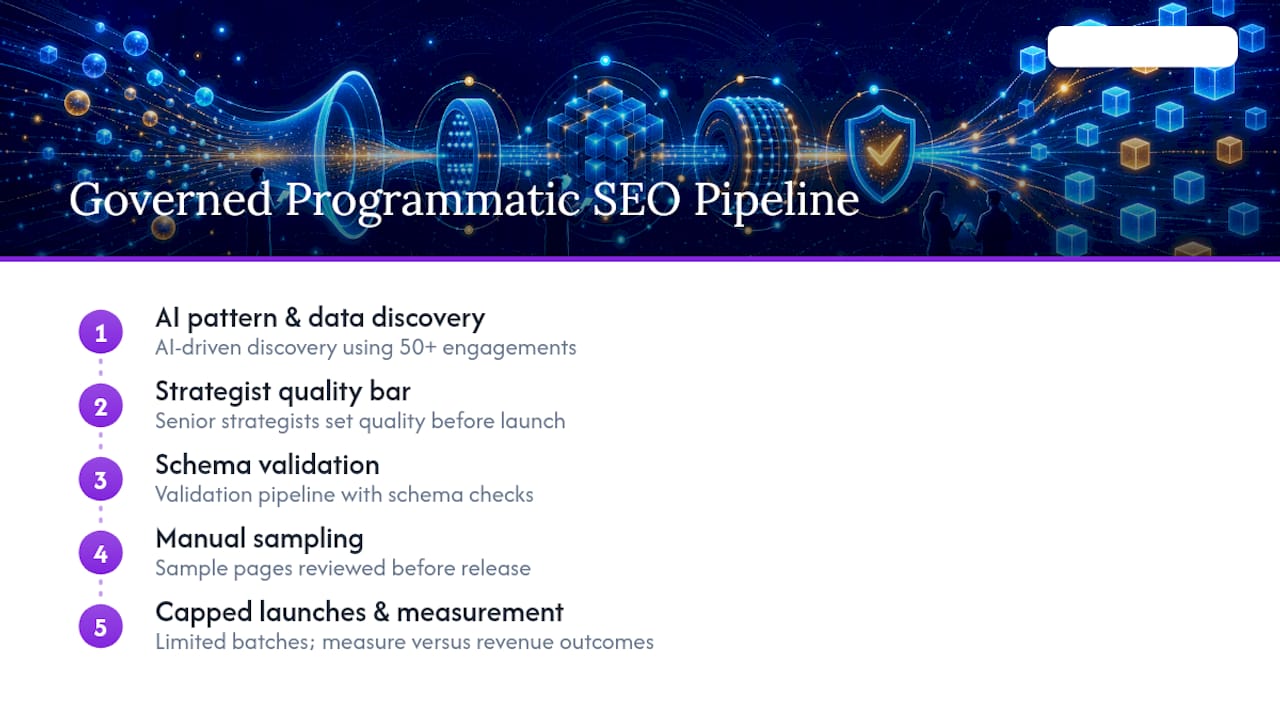
Viaductgen treats programmatic projects as a governance exercise as much as a technical one. Our Growth Engine pairs AI-driven pattern and data discovery with senior strategists who set the quality bar before a single page goes live, drawing on cross-client intelligence from more than 50 engagements to flag which keyword patterns and templates are likely to hold up. In practice, that means a validation pipeline with schema checks, manual sampling, and capped launch batches, and measurement tied to revenue outcomes rather than raw page counts or rankings alone.
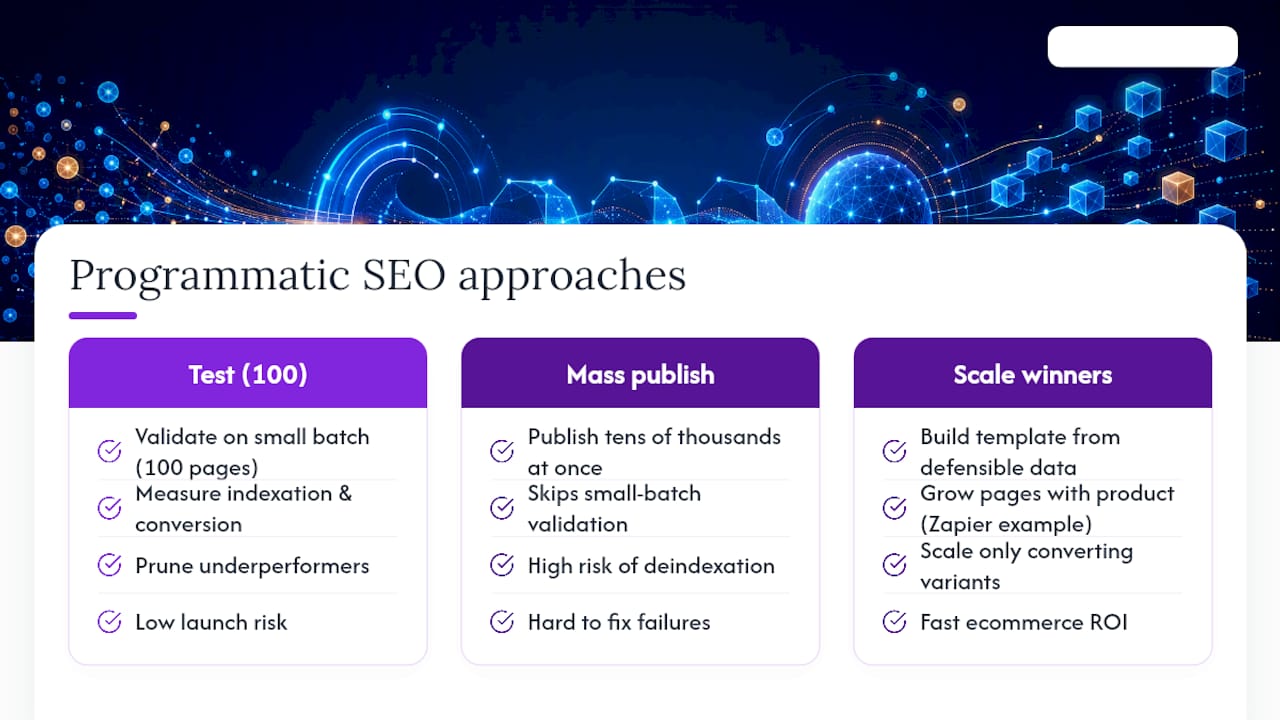
The pattern behind most publicly documented programmatic SEO successes is consistent: a company with defensible data builds a template around a keyword pattern with genuine volume, launches conservatively, and scales only the variants that convert. Zapier’s integration pages are the most frequently cited example in the industry precisely because the underlying dataset, thousands of app-to-app integrations, is proprietary and continually expanding, which means the page set grows in step with the product rather than needing constant manual refresh.
The lesson that transfers across industries isn’t the specific template. It’s the sequencing: validate the pattern on a small batch, measure indexation and conversion before scaling, and treat every underperforming segment as a candidate for pruning rather than a sunk cost to defend. Teams that skip the small-batch phase and publish tens of thousands of pages in a single push are the ones that show up in case studies about mass deindexation events, not organic growth. The teams that get cited for measurable ROI are almost always the ones that treated their first 100 pages as a test, not a launch.
Where this consistently pays off fastest is ecommerce: programmatic SEO for ecommerce businesses running product-by-attribute or product-by-use-case combinations tends to show conversion improvements within the first reporting quarter, because the searcher’s intent is already transactional by the time they reach the page. Informational pSEO projects, by contrast, often take two to three quarters longer to prove their commercial value, simply because the visitor is further from a buying decision.
Programmatic SEO sits inside Google’s guidelines when every page provides genuine value to the person who lands on it, and it breaches them when pages exist purely to capture search volume with no real utility behind them. Google’s own helpful content guidance doesn’t distinguish between a page written by a person and a page generated from a template. It asks the same question of both: would a reader consider this page worth landing on if they found it directly, without the search engine in the middle?
That’s a meaningfully different bar than “is this technically unique enough to avoid a duplicate content flag.” A calculator page that solves a real task passes both tests. A location page that swaps in a town name over an otherwise identical paragraph of generic advice might scrape past an automated duplicate check while still failing the genuine usefulness test, and Google’s helpful content systems are increasingly built to catch exactly that gap.
The ethical case for doing this well and the SEO case for doing this well are, encouragingly, the same case. Pages built on proprietary data, with conditional logic that adapts real information into each variant, serve the reader and satisfy the guidelines simultaneously. Pages built purely to multiply keyword coverage without adding anything a reader couldn’t get elsewhere are the ones that eventually get caught, whether by a Google update or simply by readers bouncing back to the results page within seconds. Treat every template brief as an honest answer to the question “why should this specific page exist”, and most of the compliance risk resolves itself before launch.
The stack splits into four functional layers, and most teams mix tools across them rather than buying a single platform that claims to do everything.
For data collection, teams typically combine internal databases or CRM exports with public sources like government open-data portals, and where public data alone isn’t defensible, custom scraping built on frameworks such as Scrapy. For templating and generation, no-code teams lean on Airtable as the structured data layer, feeding into a CMS like HubSpot Content Hub or a purpose-built WordPress plugin, while engineering-led teams build custom pipelines with a headless CMS and API-driven publishing. For validation, schema testing tools, automated similarity checkers, and SEO and AEO tools form the core of any serious quality gate. For ongoing monitoring, seo analytics tools tracking indexation rate, impressions, and page-level conversion are non-negotiable once a project passes a few hundred live pages, because manual spreadsheet tracking simply doesn’t hold up at that scale.
The tooling choice matters less than the discipline behind how it’s used. A team running Airtable and a WordPress plugin with a strict validation pipeline will consistently outperform a team running an expensive custom-built stack with no quality gate at all.
Ecommerce, software, travel, real estate, and financial services consistently produce the strongest programmatic SEO results, and the common thread across all five is structured, high-volume, naturally variable data.
Ecommerce retailers generate pages per product-attribute combination and per use-case variant, backed by genuine inventory and review data. Software companies build integration and comparison pages from data that grows automatically as their product ecosystem expands. Travel platforms generate destination and route pages from pricing and availability feeds that update in near real time. Real estate portals generate location and property-type pages from listings data that refreshes constantly by nature of the market. Financial services and affiliate programmatic strategies around comparison and calculator content work because the underlying rate and fee data changes often enough to justify continual freshness, and the search intent behind “best [product] for [situation]” queries is reliably high-volume and commercial.
Industries with static, low-variance data (a local service business with one location and one price list, for instance) rarely benefit from programmatic content creation, simply because there’s no genuine variable to build a template around. The pattern needs real variation to justify its own existence.
Getting programmatic SEO right at scale means running keyword validation, defensible data sourcing, schema-driven templates, and a launch and monitoring pipeline as one connected system rather than four disconnected projects. That’s precisely where a fixed-scope, 90-day sprint model earns its keep: AI-powered research and pattern discovery feeding a strategic blueprint, senior-led template and schema design, a governed launch, and measurement tied directly to indexation, traffic, and conversion outcomes rather than page counts alone.
Viaductgen’s search, AEO and GEO services are built around exactly this kind of programme delivery, backed by the Growth Engine methodology and the cross-client pattern intelligence that comes from running these builds repeatedly across different sectors. If your team has the structured data and the keyword pattern but not the in-house capacity to build and govern the pipeline properly, get in touch through our SEO services page to talk through what a 90-day sprint would look like for your dataset.
Programmatic SEO means generating large volumes of search-optimised pages by combining a fixed template with structured data, rather than writing each page individually.
Traditional editorial SEO starts with a topic and researches an angle for a single piece of content; programmatic SEO starts with a structured dataset and designs one template that scales across thousands of variants.
A software company generating a dedicated page for every integration in its ecosystem, or an ecommerce retailer generating a page for every product-attribute combination, are both classic programmatic SEO patterns.
SEO is evolving rather than declining. AI-driven search results and answer engines have changed how visibility gets earned, but structured, defensible, genuinely useful pages, whether built editorially or programmatically, still perform, which is why schema-driven approaches like Viaductgen’s Growth Engine focus on data quality and governance rather than volume alone.

