
To get the point means to understand the essential idea of what someone is saying. If a colleague explains why a project is over budget and you reply, “Yes, I get the point — we need to cut costs,” you are confirming that the core message has landed. The phrase is idiomatic, meaning it cannot be read literally: “getting” here refers to comprehension, not physical receipt. In everyday British English it sits comfortably in casual speech; in formal writing, alternatives such as “I understand your point” tend to feel more appropriate. The sections below cover the differences between similar-sounding phrases, grammar forms, common mistakes, and practical tips for making your own meaning clear.
These three phrases share a word but do very different jobs. Mixing them up is one of the most common errors among learners of British English, and the confusion is understandable — the distinction is subtle until you see them side by side.
| Phrase | Who it refers to | Core intent | Typical tone |
|---|---|---|---|
| Get the point | The listener | To understand the main idea | Neutral to casual |
| Get to the point | The speaker | To be direct; stop elaborating | Can sound impatient |
| Get the point across | The speaker | To communicate successfully | Neutral to positive |
A quick illustration. In a work meeting, your manager might say, “Has everyone got the point about the new sign-off process?” That is asking whether listeners have understood. If the same manager says, “Can we get to the point, please?” she is telling the room to stop digressing. And afterwards, she might reflect, “I’m not sure I got the point across clearly enough” — meaning she doubts her own communication succeeded.
The social weight of each phrase differs too. Telling someone to “get to the point” can come across as brusque in British professional culture, where indirectness is often preferred. Merriam-Webster frames “come/get to the point” as reaching the most important idea of something said or written — a neutral definition, but in practice the imperative form carries an edge.
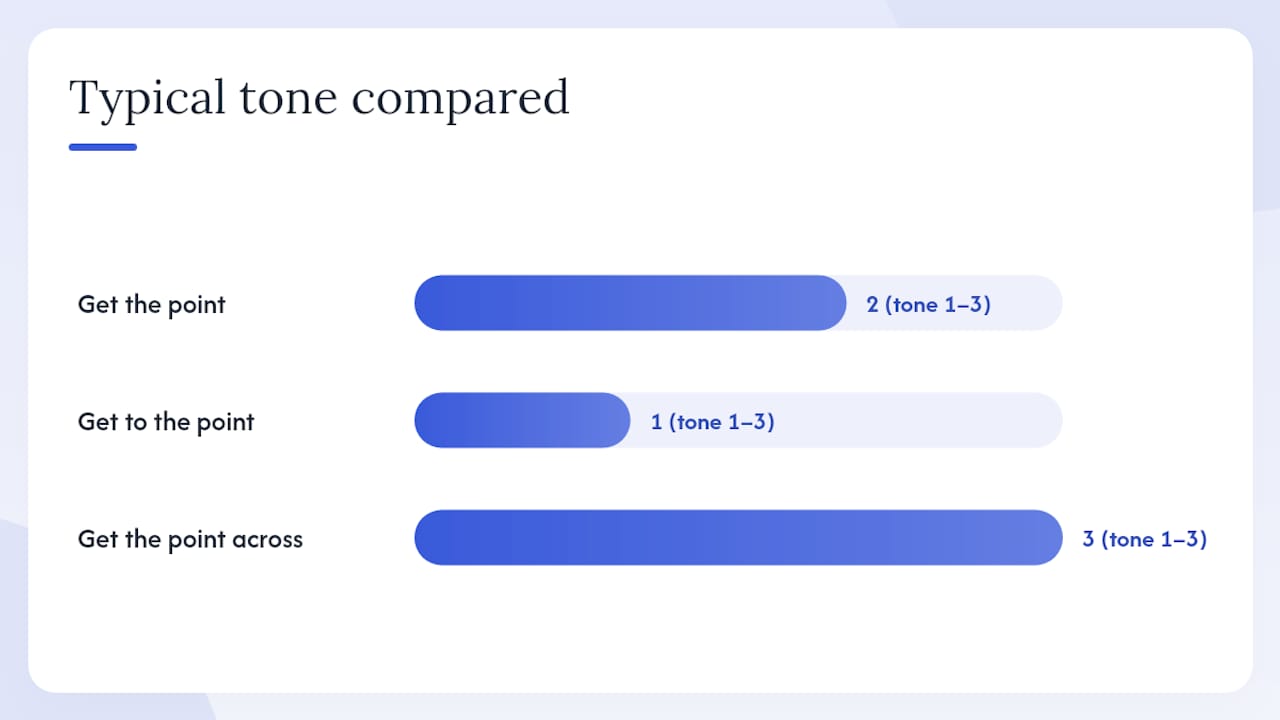
British English places a premium on indirectness, so how you use these phrases matters as much as which one you choose.
Do:
Don’t:
The cultural backdrop here matters. British communication tends towards understatement. Saying “I’m not sure everyone has fully grasped the main idea yet” is often preferred over the blunter “Nobody got the point.” The Longman Dictionary of Contemporary English notes collocations such as “point taken” and “miss the point” precisely because these softer forms do so much social work in everyday British speech.
The phrase follows standard English conjugation with one regional wrinkle worth knowing.
Present: “I get the point.” / “She gets the point.” Past simple: “He got the point immediately.” Present perfect: “We’ve got the point, thank you.” Negative: “I don’t get the point of this exercise.”
The regional variation sits in the past participle. In British English, “got” is standard: “Have you got the point?” American English favours “gotten”: “Have you gotten the point?” Both are grammatically correct, but “gotten” sounds distinctly American to British ears and can feel out of place in formal UK writing.
On pronunciation, the natural stress in speech falls on point: “I get the point.” In rapid conversation, “get the” often contracts to something close to “gerr-the,” but the stress pattern stays the same. When used as a discourse marker (“but you get the point”), the phrase is typically unstressed and said quickly, signalling that the speaker is wrapping up a line of reasoning rather than making a fresh claim.
The phrase works across registers. Here are varied examples, followed by two short dialogues.
Dialogue 1 — Work meeting
Priya: I’ve been through the Q3 figures three times now. The margin is shrinking because our supplier costs went up 12% and we haven’t adjusted pricing. Tom: Right, I get the point. We need to reprice before Q4. Priya: Exactly. Glad that’s clear.
Tom’s response confirms comprehension and moves the conversation forward. Notice he does not say “I get to the point” — that would make no grammatical sense here.
Dialogue 2 — Friendly chat
Jess: He turned up late, forgot the tickets, and then complained the whole evening. Dan: OK, OK — I get the point. You’re not seeing him again. Jess: Took you long enough!
Dan uses the phrase as a shortcut: he has understood the implication of Jess’s story without her having to state it directly. This is a common function in British casual speech, where usage examples show the phrase doing as much social work as informational work.
| Expression | Meaning | Typical context |
|---|---|---|
| See the point | Understand the purpose or logic | Slightly more formal than “get the point” |
| Take the point | Acknowledge someone’s argument | Polite; implies partial agreement |
| Miss the point | Fail to understand the main idea | Can be critical in tone |
| You’ve got a point | Concede that someone’s argument has merit | Conversational; signals agreement |
| Point taken | Accept a criticism or correction briefly | Very British; ends a minor dispute gracefully |
| Make the point | State or argue the main idea | Neutral; used by speakers, not listeners |
| Grasp the idea | Understand a concept | Slightly more formal; suits written English |
The distinction between “take the point” and “you’ve got a point” trips people up. “I take your point” means “I understand what you are arguing” — it does not commit you to agreeing. “You’ve got a point” means “your argument has merit.” One is about comprehension; the other is about conceding ground. In British professional settings, “I take your point” is the safer choice when you want to acknowledge without fully agreeing.
The word point in the sense of “the essential idea” likely traces back to metaphors of hitting a target, whether in archery or with a spear. The “point” of an argument, like the tip of an arrow, is the sharpest, most concentrated part. Etymology summaries propose this target metaphor as the probable origin, though the precise historical path is not definitively documented.
It is worth treating this as a plausible story rather than a proven fact. The Oxford Learner’s Dictionaries entry focuses on current usage rather than origin, which reflects the honest state of the evidence: the metaphor is illuminating as a teaching aid, but etymology here is inference, not certainty.
The most frequent mistake is taking the phrase literally. A learner who hears “did you get the point?” and thinks it refers to a physical object will be baffled. The phrase is entirely metaphorical: “the point” is an idea, not a thing.
A second common error is the phrase “get into the point.” This is not standard English. The correct forms are “get the point” (understand it) or “get to the point” (be direct). “Get into the point” sounds like a translation from another language and will confuse native speakers.
Here are the most frequent errors with corrections:
The third error above illustrates a structural trap: “get the point across” already contains the idea of successful communication, so adding “to understood” or “to be understood” is redundant. When you hear someone use the phrase, ask yourself: is the speaker describing their own comprehension, asking for brevity, or reflecting on whether they communicated well? That question will tell you which form fits.
Understanding the idiom is one thing; using it well in your own communication is another. These steps reliably improve clarity in both speech and writing.
Pro Tip: When you need someone to be more concise, avoid the direct imperative “get to the point.” Instead, try “Could we focus on the main issue?” or “What’s the core ask here?” Both achieve the same result without the social friction that the blunter phrase can create in British professional settings.
Before: “So, as I was saying, there are a number of factors that have contributed to the situation we find ourselves in, and I think it’s fair to say that, all things considered, the timeline has been affected.”
After: “The timeline has slipped by two weeks. The main cause is the delayed supplier approval.”
The second version takes four seconds to read. The first takes twelve, and the listener still has to extract the point themselves. For anyone working on B2B email communication or professional messaging, this front-loading habit is one of the highest-return changes you can make. AI tools are increasingly used to help surface the core insight from long documents — the Docupow AI data extraction guide covers how automated summarisation can help identify the point in dense material.
‘Getting the point’ means understanding the essential idea — and knowing which related phrase to use, and how to say it, is what separates clear communicators from confusing ones.
| Point | Details |
|---|---|
| Core definition | ‘Get the point’ means to understand the essential idea of what someone has said. |
| Three distinct phrases | ‘Get the point’ (listener understands), ‘get to the point’ (speaker is direct), ‘get the point across’ (speaker communicates successfully). |
| Register in UK English | ‘Point taken’ and ‘I take your point’ are the polite British alternatives to blunter forms. |
| Common mistake | ‘Get into the point’ is not standard English; use ‘get the point’ or ‘get to the point’. |
| Practical habit | State your main point first, then add context — never build to a conclusion the listener has to extract themselves. |
‘Get the point’ means to understand the essential or most important idea of what someone has said, as defined by the Oxford Learner’s Dictionaries. It is an idiomatic phrase used across British and other varieties of English.
‘Get the point’ describes a listener’s comprehension; ‘get to the point’ is a request or instruction for a speaker to be direct and stop elaborating, as noted by the Cambridge Dictionary.
‘Get the point across’ means to communicate a message successfully so that others understand it, shifting focus from the listener’s comprehension to the speaker’s success in conveying the meaning.
‘Get into the point’ is not standard English and is a common learner error. The correct phrases are ‘get the point’ (to understand) or ‘get to the point’ (to be direct).

