
“Get to the point” means state the main or most important idea without unnecessary preamble. Cambridge Dictionary and Merriam-Webster both treat it as a request for brevity. “Get to a point,” by contrast, usually means reach a particular stage or moment in a process. The two phrases look almost identical, but they do very different jobs.
Context shapes everything here. The same phrase can sound neutral in a meeting and quite sharp in a one-to-one conversation. Below are four typical UK English uses, labelled by setting and tone.
The variant “come to the point” is particularly common in British English, while “get to the point” is the dominant form in American English. Both are understood everywhere, and English Stack Exchange confirms native speakers treat them as functionally interchangeable, with the difference being regional and register-based rather than meaning-based.
Thesaurus.com lists dozens of alternatives. The table below covers the most useful ones for learners, with a register flag and a one-line note on when each works.
| Phrase | Register | Usage note |
|---|---|---|
| Cut to the chase | Informal | Casual speech and emails; implies skipping the build-up |
| Come to the point | Neutral | Slightly softer than “get to the point”; common in British English |
| Get straight to the point | Neutral | Adds emphasis; works well in professional writing |
| Get down to brass tacks | Informal | Idiomatic; signals a shift to practical detail |
| Get down to business | Neutral/formal | Suits meetings; focuses on action rather than brevity |
| To the point (adj.) | Complimentary | Used to praise concise writing, e.g. “Her answer was very to the point” |

The Cambridge Dictionary entry for “to the point” notes the adjectival use as meaning apt or suitable for the subject, which is a compliment rather than a command.
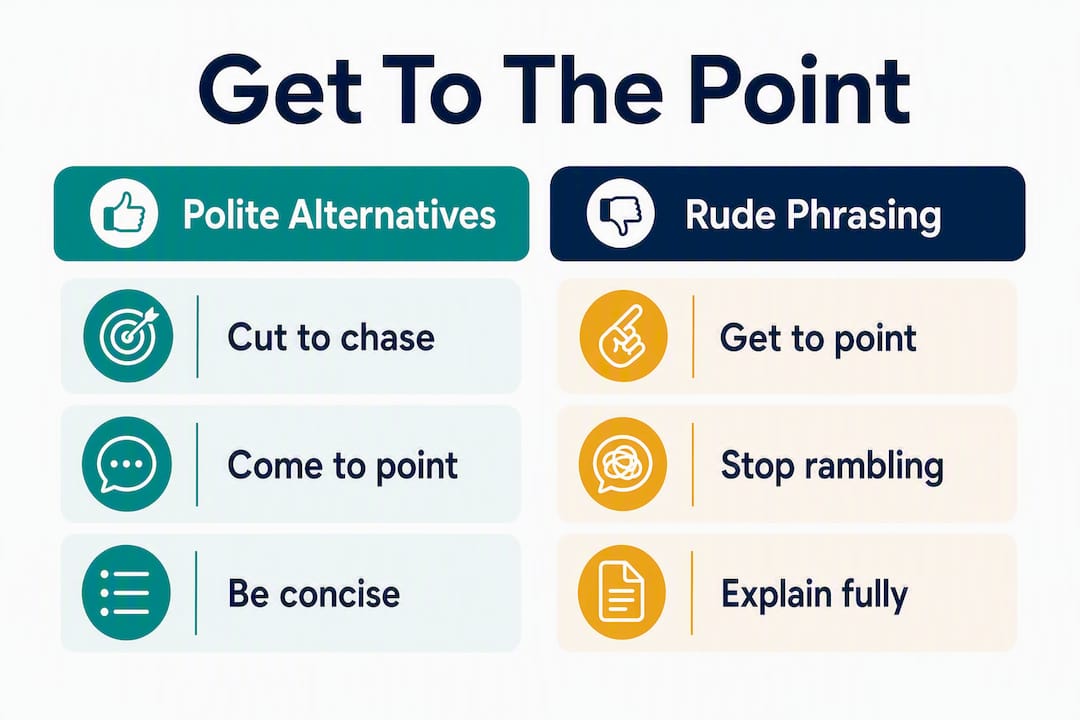
Antonyms include “go into detail,” “explain fully,” and “elaborate.” These are not flaws; a doctor explaining a diagnosis or a teacher introducing a new concept should elaborate. The antonym is only wrong when brevity is what the situation demands.

The phrase can land as impatient or dismissive, particularly when directed at a superior or during a sensitive conversation. Tone, timing, and phrasing determine whether it reads as efficient or unkind.
Avoid using it directly with a manager, a client, or anyone discussing something emotionally difficult. In those contexts, a reason-based softener works far better because it frames the request as practical rather than critical.
Dos and don’ts for learners:
Pro Tip: Lower your voice slightly and slow down when you say this phrase aloud. A calm, measured delivery signals efficiency rather than frustration, and the listener is far less likely to feel criticised.
The Longman Dictionary notes that “get to the point” often appears in contexts where someone has been speaking at length, which is exactly when the risk of sounding impatient is highest.
One article, one world of difference. The table makes the contrast clear.
| Phrase | Meaning | Example |
|---|---|---|
| Get to the point | State the main or most important idea | “Please get to the point — what do you need?” |
| Get to a point | Reach a stage or moment in a process | “We’ve got to a point where a decision is unavoidable.” |
“Get to a point” collocates naturally with progress language: “reached a point,” “arrived at a point,” “got to a point where.” “Get to the point” collocates with communication language: “come to the point,” “get straight to the point,” “make a point.”
Ready-made phrases save you from freezing mid-conversation. Here are templates at three levels of formality.
Asking for brevity:
Giving a concise reply (three-part structure): state your main point first, add one short supporting detail, then invite a follow-up. For example: “The launch is delayed by two weeks. The supplier confirmed a parts shortage. Happy to share the full timeline if useful.”
For written communication, practise reducing the first paragraph of an email to a single sentence that states the request or outcome. Viaductgen’s guide on writing clearly for UK business covers this in practical detail. CrossIdiomas also offers classroom role-play exercises where learners practise polite interruptions using time-based and outcome-based templates.
“Get to the point” means state the main idea; “get to a point” means reach a stage in a process — confusing the two is one of the most common learner errors with this phrase.
| Point | Details |
|---|---|
| Core definition | “Get to the point” means state the main or most important idea without unnecessary preamble. |
| Article vs the | “Get to a point” means reach a stage in a process, not a request for brevity. |
| Register risk | The bare imperative can sound impatient; soften it with a question form or a reason. |
| British preference | British English often favours “come to the point”; both forms are understood everywhere. |
| Concise reply structure | State the main point, add one supporting detail, then invite a follow-up question. |
The following resources were used to build this article. Each is worth bookmarking for further study.
It means state the main or most important idea directly, without unnecessary background. Cambridge Dictionary defines it as reaching the most important part of what you are saying.
“Get to a point” means reach a particular stage or moment in a process, for example: “We’ve got to a point where we need to decide.” It is not a request for brevity.
Common synonyms include “cut to the chase” (informal), “come to the point” (neutral, common in British English), and “get straight to the point” (neutral, slightly emphatic). Thesaurus.com lists many more alternatives with register notes.
Yes. It uses “point” figuratively to mean the essential idea rather than a physical location, which is what makes it an idiom rather than a literal instruction.

