
An email nurturing strategy is a planned sequence of emails designed to build relationships with leads and guide them toward a specific conversion, whether that is a purchase, a booked call, or a renewed contract. The engine underneath it is behavioural data: what a lead clicked, downloaded, ignored, or bought tells you far more about what to send next than their job title ever will. Done well, nurturing feels less like marketing and more like a well-timed conversation.
The core objectives are straightforward: keep leads engaged between touchpoints, build enough trust that a conversion feels natural, and move contacts through your funnel without burning them out. A nurturing programme integrates with your broader marketing activity rather than sitting in isolation. Think of it as the connective tissue between your paid acquisition, your content, and your sales team.
Every effective nurturing strategy shares the same building blocks:
A clearly defined audience, segmented by lifecycle stage and behaviour
Personalised content that reflects where each lead actually is in their decision
Triggered sequences that fire based on actions, not just calendar dates
A consistent content ratio weighted toward education over promotion
Measurable goals tied to real business outcomes, not vanity metrics
Full compliance with UK regulations, specifically GDPR and PECR
The ROI case for getting this right is strong. Lifecycle email flows generate approximately 41% of total email revenue from only 5.3% of sends. That ratio alone explains why the most commercially minded marketers treat nurturing as infrastructure, not a campaign.
The difference between a nurturing email and a broadcast is relevance at the individual level. Relevance comes from segmentation, and segmentation has moved well beyond “new subscriber” versus “existing customer.”
Hyper-segmentation combines recency, frequency, and product interest to create dynamic content personalisation that static segments cannot achieve. A lead who downloaded a pricing guide three days ago and visited your case studies page twice is in a fundamentally different mindset from someone who signed up six weeks ago and has not clicked anything since. Treating them identically wastes both their attention and your sending reputation.
Effective micro-segments typically combine:
Lifecycle stage: prospect, active lead, first-time buyer, lapsed customer
Behavioural signals: pages visited, content downloaded, emails clicked
Purchase or engagement recency: how recently they last interacted
Declared preferences: product categories, content topics, communication frequency
Real personalisation involves dynamic content blocks and timing adaptations tailored to a prospect’s behaviour, not just a name merge in the subject line. A lead who browsed your enterprise pricing page should receive different body copy, different social proof, and a different call to action than someone who only read a top-of-funnel blog post.
Personalising subject lines alone can lift open rates by 26%, and deep behavioural personalisation can boost revenue up to 5.7 times compared with generic campaigns. Those two figures sit at very different points of the personalisation spectrum, which tells you the biggest gains come from going further than most teams bother to go.

Educational content should make up at least 80% of your nurture sequence before you introduce sales messaging. The logic is simple: you earn the right to ask for a conversion by first demonstrating genuine value. Each email needs one clear call to action, placed where the eye naturally lands after reading the key message, typically after the first or second paragraph rather than buried at the bottom.
Sending too frequently accelerates unsubscribes; too infrequently and leads go cold. A common welcome cadence runs on days 0, 1, 3, 7, and 14, then drops to a weekly or fortnightly rhythm. Trust signals matter throughout: a named author with relevant credentials, consistent brand design, a visible unsubscribe link, and a clear statement of why the recipient is receiving the email all reduce friction and build credibility. Under UK law, PECR requires prior consent for marketing emails to individuals, and GDPR governs how you store and use the personal data that powers your personalisation. Both are non-negotiable.
The five automation flows that generate the most revenue from the fewest sends are well established. Here is how each one works in practice, and where the strategic decisions actually sit.
A welcome series runs across 4–6 emails in the first 14 days after sign-up. The first email delivers whatever was promised at sign-up, whether that is a lead magnet, a discount, or simply a warm introduction. Subsequent emails introduce your best content, set expectations about frequency, and ask for a first micro-conversion, such as following a social channel or completing a preference centre. For B2B contexts, the welcome series often ends with a soft invitation to book a call or explore a specific service page.
Drip sequences move leads from awareness to consideration by delivering progressively deeper content. A SaaS business might run a sequence that starts with a “how it works” overview, moves to a customer case study, then a feature comparison, and closes with a free trial offer. The key is that each email builds on the last rather than repeating the same pitch at different intervals.
Pro Tip: Design your drip sequence before you write a single email. Define the trigger, the goal, the step count (4–6 is typical), the timing cadence, and the exit criteria, such as a conversion or an unsubscribe. Sequences built without exit criteria keep sending to people who have already converted, which damages both your sender reputation and the customer relationship.

For e-commerce, abandoned cart flows are often the single highest-ROI automation in the entire programme. A three-email sequence works well: the first sends within an hour of abandonment and simply reminds the shopper what they left behind; the second, sent 24 hours later, addresses a likely objection such as returns policy or delivery time; the third, at 72 hours, may include a time-limited incentive. Browse abandonment flows follow a similar logic but fire on product page views without an add-to-cart action, making them useful for higher-consideration purchases.
A re-engagement sequence fires when a subscriber goes 60–90 days without a click. The goal is not to win back every inactive contact but to identify who is still worth sending to and sunset the rest. Keeping disengaged contacts on your list inflates your send volume, suppresses deliverability metrics, and skews your performance data. A two or three-email win-back sequence with a clear “stay or go” choice is cleaner than indefinitely mailing people who have stopped caring.
Post-purchase flows do more than confirm an order. They set delivery expectations, ask for a review at the right moment (typically after delivery, not immediately after purchase), and introduce complementary products based on what was bought. For B2B, the equivalent is an onboarding sequence that helps a new client get value quickly, reducing churn risk in the first 90 days.
For a detailed breakdown of the email types that drive growth in business-to-business contexts specifically, the B2B email types guide from Viaductgen covers the distinctions in depth.
Strategy before execution. The campaigns that underperform are almost always the ones where someone started writing emails before defining what success looks like.
Every nurture sequence needs a single primary goal: a first purchase, a demo booked, a subscription renewed, a referral made. Sequences with multiple competing goals tend to confuse recipients and produce ambiguous data. Once the goal is defined, work backwards to determine how many emails are needed, what content addresses the objections between the lead’s current state and the conversion, and what trigger starts the sequence.
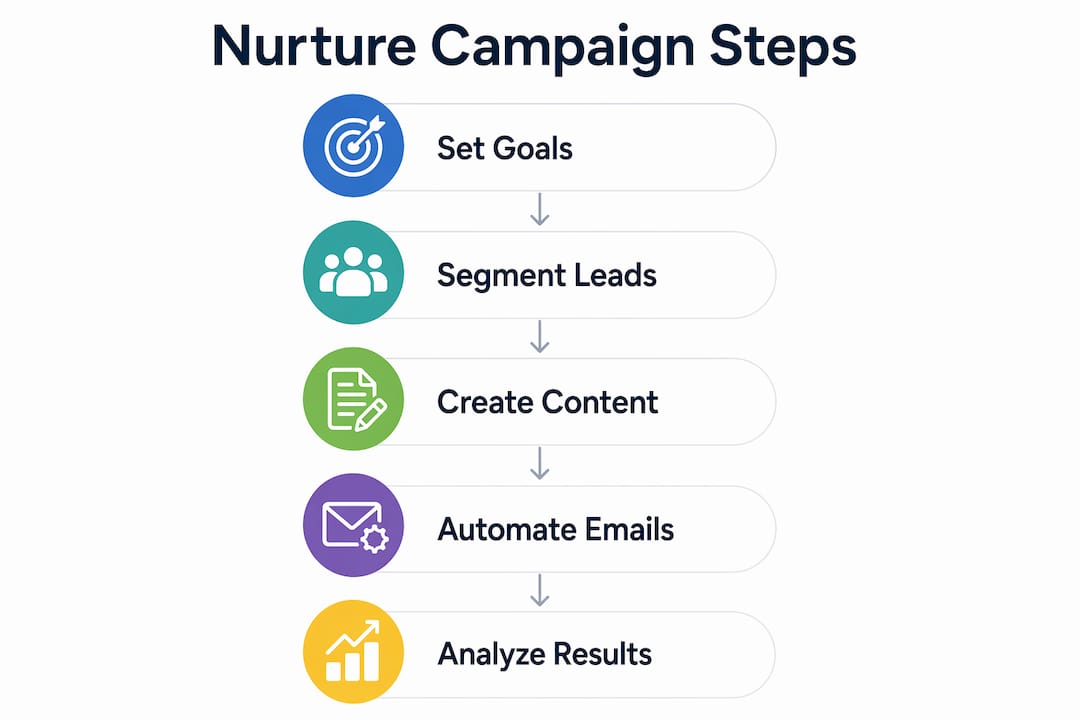
Behavioural automation applies triggers, conditions, and actions to send relevant sequences without manual intervention. A well-architected sequence looks like this:
Trigger: the specific action or lifecycle event that starts the flow
Goal: the single outcome the sequence drives
Step count: typically 4–6 emails; more steps rarely improve results
Timing: spaced to match the decision pace of your audience
Exit criteria: conversion, unsubscribe, or a manual tag that removes the contact
Dynamic content blocks let you serve different body copy, images, or offers to different segments within the same email send. A lead in the consideration stage sees a case study; a lead who has already visited your pricing page sees a comparison of your tiers. This is not technically complex in most modern email platforms, but it requires clean, well-structured data upstream. List hygiene, consistent tagging, and a reliable CRM integration are the unglamorous work that makes personalisation possible.
Pro Tip: Run A/B tests on one variable at a time: subject line, send time, call-to-action copy, or content format. Testing multiple variables simultaneously makes it impossible to know what drove the result. Build a testing calendar and treat each test as a permanent learning, not a one-off experiment.
At least 80% of your nurture content should educate, inform, or genuinely help the reader before you ask for anything. This ratio earns the trust and the right to request a conversion, and it prevents the subscriber fatigue that drives unsubscribes. Promotional emails land harder when they are surrounded by content that has already proven its value.
Email nurturing works best as part of a connected system. A lead who downloads a guide, receives a nurture sequence, and then sees a retargeting ad reinforcing the same message is far more likely to convert than one who only experiences the email. Aligning your email triggers with your paid social audiences, your SEO content calendar, and your sales team’s outreach cadence turns isolated channel activity into a coherent acquisition engine. Viaductgen’s email marketing service is built around exactly this kind of cross-channel integration.
Pairing your nurture programme with strong website content also pays dividends. The website content creation guide from Depeche Code covers how to align on-site content with lead nurturing flows to keep prospects engaged across both channels.
The data from 2026 reinforces two things: automation is where the leverage sits, and personalisation depth is what separates average programmes from exceptional ones.
The headline figure is the one already cited: lifecycle flows generate roughly 41% of total email revenue from just 5.3% of sends. That is not a marginal efficiency gain. It means a small number of well-designed automated sequences outperform the bulk of broadcast campaigns combined.
41% of email revenue comes from lifecycle flows that account for just 5.3% of total sends. Automation is not a convenience feature. It is where the commercial return actually lives.
On personalisation, the gap between surface-level and behavioural approaches is stark. Personalised subject lines lift open rates by 26%. But behavioural personalisation, where content, offers, and timing adapt to what a lead has actually done, can drive up to 5.7 times the revenue of a generic send. Most teams stop at the subject line. The 5.7x uplift is available to those who go further.
Open rates themselves are an increasingly unreliable metric. Privacy features in Apple Mail and other clients inflate reported open rates artificially, meaning a high open rate no longer confirms genuine engagement. The more reliable signal is clicks on goal-related links, specifically the primary action the email was designed to drive. A click on the “book a demo” button tells you something real. A reported open in a privacy-protected inbox does not.
The 80/20 content rule holds up in 2026 research as well. Sequences that lead with education and defer promotional asks consistently outperform those that pitch early. The mechanism is straightforward: trust accumulates with each genuinely useful email, and that accumulated trust converts when the ask finally arrives.
For marketers building or rebuilding their nurture infrastructure, the practical implication is clear. Invest first in your automation architecture and your data quality. Then layer in deeper personalisation. Measure by primary goal completions, not open rates. And treat the content ratio as a discipline, not a guideline. The step-by-step email marketing guide from Viaductgen walks through how to sequence these priorities in practice.
Effective email nurturing combines behavioural personalisation, well-structured automation, and an education-first content approach to generate disproportionate revenue from a small share of total sends.
| Point | Details |
|---|---|
| Automation drives outsized returns | Lifecycle flows generate 41% of email revenue from just 5.3% of sends. |
| Personalisation depth determines revenue | Behavioural personalisation can boost revenue up to 5.7 times compared with generic campaigns. |
| Subject line personalisation lifts opens | Personalised subject lines increase open rates by 26% versus non-personalised equivalents. |
| Education before promotion builds trust | At least 80% of nurture content should be educational before any sales ask is made. |
| Measure by goal completions, not opens | Open rates are unreliable; clicks on primary goal-related links are the meaningful engagement signal. |

