
A practical creative testing framework pairs a single goal KPI with a constraint KPI, a pre-defined action tree, and repeatable experiment designs so teams reliably convert creative learnings into incremental business outcomes. Marketers who adopt this structure see fewer wasted cycles and faster decisions, because every test is designed to change an action, not just satisfy curiosity. The immediate next step is straightforward: draft a hypothesis, define your action tree, and plan a short controlled test before you touch a single asset.
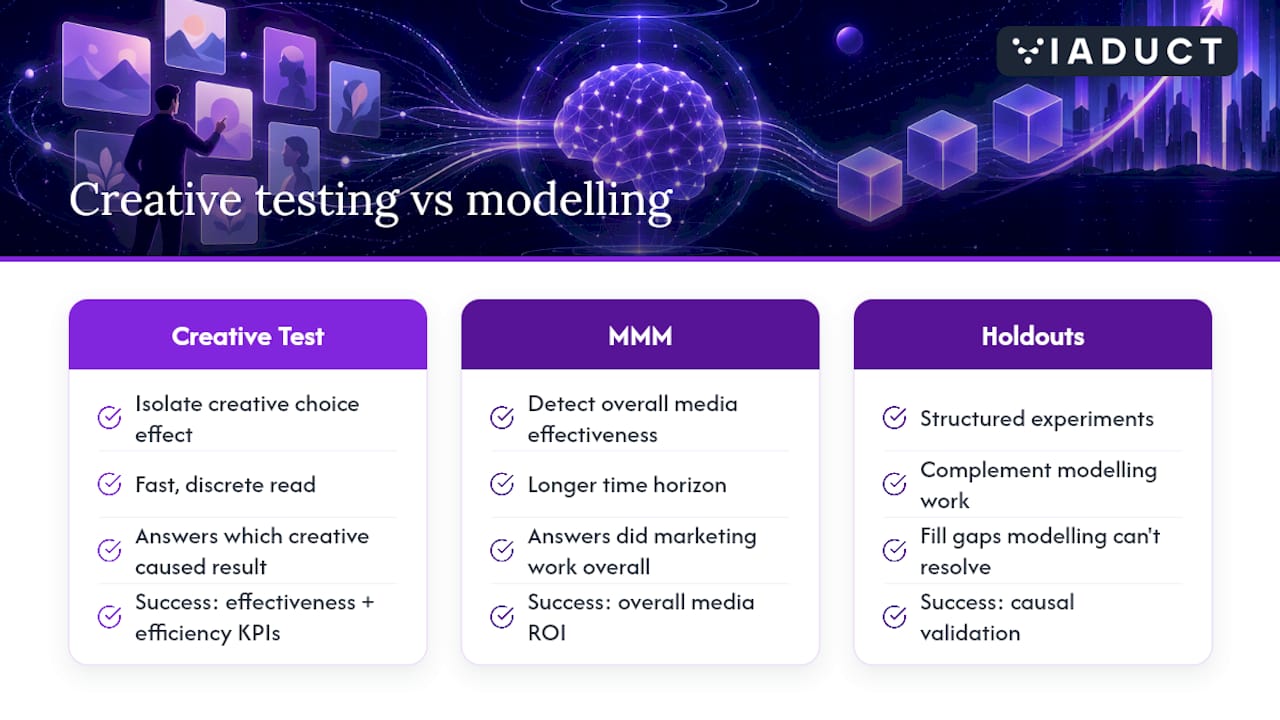
Creative testing is the controlled comparison of ad variants, hooks, formats or calls to action, designed to isolate which creative choices move a defined business metric. It sits inside a broader measurement portfolio alongside marketing mix modelling and attribution, but it answers a different question: not “did marketing work overall” but “which specific creative decision caused this result.” That distinction matters when deciding where to invest measurement budget.
Creative testing earns its place when you need a fast, causal read on a discrete creative variable, a new hook, a different length, a mobile-first cut, rather than a macro view of channel contribution. Broader marketing mix modelling remains the better tool for detecting overall media effectiveness across a longer time horizon; structured experiments and holdouts complement this work by filling gaps that modelling alone cannot resolve.
The clearest way to judge success is an effectiveness-efficiency pairing: one KPI captures the outcome you want more of, the other guards against winning that outcome at unacceptable cost. Without both, teams end up optimising creative that performs well on one metric while quietly damaging another.
A framework is only as good as its repeatable parts. Every test should start from a written hypothesis: what you believe, why you believe it, and what result would prove or disprove it. That hypothesis should link directly to an action tree, a simple map of what your team will do for each possible outcome, agreed before the test runs rather than argued over afterwards.
Beyond the hypothesis, a small set of artefacts keeps testing consistent across a team of any size.
Skipping any of these usually shows up later as a dispute about what the test actually proved.
Choosing a goal KPI works best when it is a metric your team can act on directly, rather than a vanity number that looks good in a report. Pair it with a constraint KPI that stops a “win” from masking a hidden cost, for example testing for incremental conversions while watching incremental return on ad spend so a cheaper conversion doesn’t quietly erode margin.
When conversion events are sparse, a waterfall of metrics moving from higher-funnel to lower-funnel signals often produces a decisive read where conversion-only analysis would sit stuck at “inconclusive.”
The discipline that separates useful tests from expensive guesswork is variable isolation. Change one thing per cell wherever the platform allows it: the hook, the call to action, the length or the format. Testing five variables at once might feel efficient, but it leaves you unable to say which change actually drove the result.
Mobile-first framing deserves particular weight, since most paid social and a growing share of Performance Max inventory serves on a phone screen first. Design for sound-off viewing, front-load the message in the first three seconds, and cut vertical versions before you cut horizontal ones as an afterthought.
Pro Tip: Build creative in modular segments so a losing hook can be swapped without reshooting the entire asset.
The right method depends on the question, the available volume and how much certainty you actually need. A simple A/B split works well when you have enough volume to reach a clean read within a few weeks and the two variants can run genuinely side by side. When you need to know whether the campaign as a whole is adding incremental value, rather than pulling forward demand that would have converted anyway, geo holdouts or incrementality tests give a more honest answer, at the cost of longer run times and more coordination.
Platform mechanics change the calculation further. Performance Max pools many asset combinations into a single auction, which means individual creative signals can take longer to separate from the noise of “reservoir learning,” where the system favours whichever combination gathered early signal rather than the one that would perform best at scale. Video-inclusive Performance Max campaigns tend to behave differently again: advertisers running at least one video asset in Performance Max observe incremental conversions on average, which argues for including video from the start rather than adding it later as an experiment.
Running one good test is easy. Running dozens without breaking live performance requires process. A simple intake to prioritise to schedule pipeline stops teams from testing whatever is loudest that week and instead tests what matters most against the current goal KPI.
A CRO testing calendar built around these principles applies the same governance logic to landing page and conversion experiments, and the two calendars are worth running in parallel rather than in isolation.
Reading results well starts before the test launches, with a power analysis: an honest estimate of the sample size or spend needed to detect the effect you actually care about. Google’s experiments guidance recommends redesigning a test rather than running it underpowered when the required sample size is unrealistic, whether that means pooling cells, targeting a bigger effect, or moving to a higher-funnel metric.
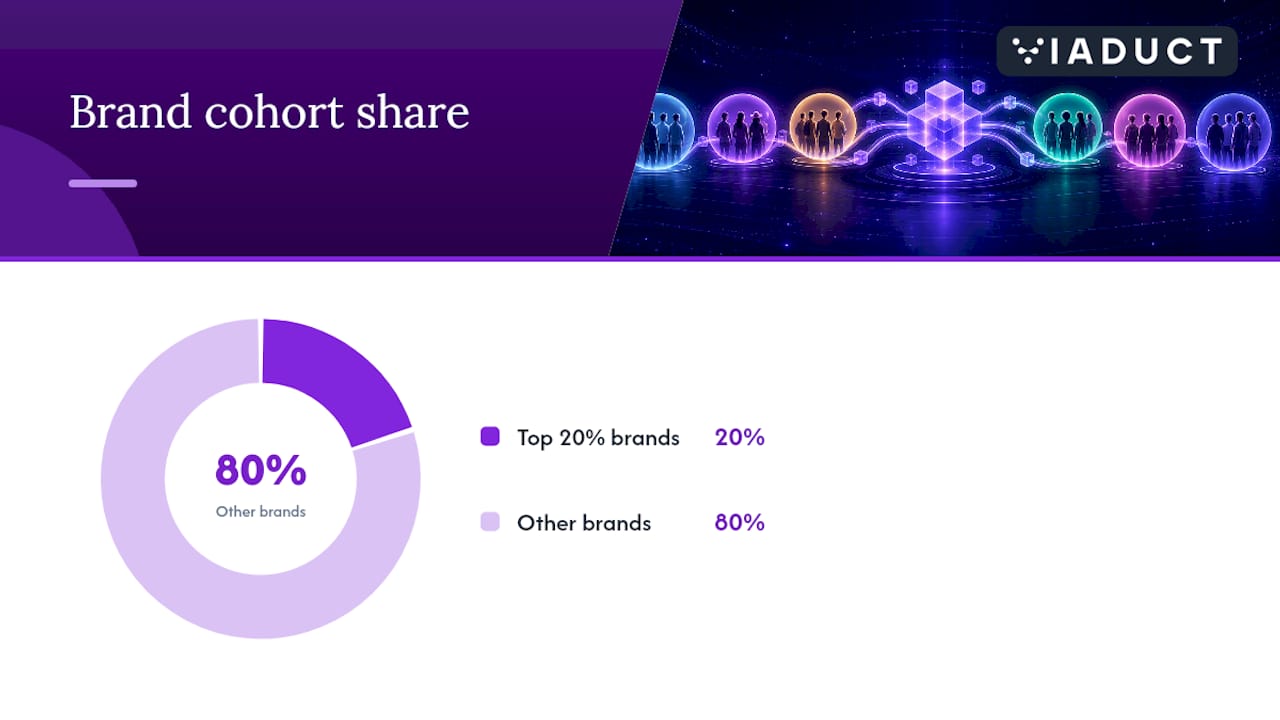
Statistic: Brands in the top 20% for Creative Consistency Score achieve roughly 28% greater business effects than less consistent peers, a reminder that a single winning test matters less than sustained consistency across a portfolio of tests.
When conversion volume is too thin to trust, fall back to the waterfall: read view-through rate, then click-through rate, then landing page engagement, then conversions, stopping at whichever level gives you a confident, actionable signal.
Timing errors are one of the most common ways teams misread a test. Google recommends allowing two to three weeks for a new ad group to leave the learning phase, and three to four weeks for Performance Max campaigns to stabilise before judging results or making further changes.
Any test that produces a claim you intend to publish, a statistic, a comparison, a performance promise, needs evidence behind it before it goes live, not after. The ASA requires objective claims in advertising to be backed by adequate documentary evidence under the CAP Code, and a failure to hold that evidence is treated as a breach in its own right, independent of whether the claim turns out to be true.
A single test rarely changes a business. A library of validated tests, reviewed and reused, does. Every completed test should feed a hypothesis library that records what was tested, what the action tree predicted, what happened, and what was decided, so the next brief starts from evidence rather than opinion.
This is where structured experimentation earns its place alongside modelling, since a playbook of validated creative decisions becomes an input that attribution and mix models can later confirm at scale.
We built our five-phase Growth Engine, AI-Powered Intelligence, Strategic Blueprint, AI-Amplified Execution, Human-Led Optimisation, and Measurable Commercial Outcomes, to make the discipline above operational rather than aspirational. Senior strategists define the hypothesis and action tree at the Strategic Blueprint phase, our AI infrastructure handles variant generation and monitoring during execution, and human-led optimisation reads the waterfall of metrics before any scaling decision is made.
Patterns drawn from more than fifty client engagements feed our systems with predictive benchmarks that shorten the time it takes to reach a confident read on a new creative variable, since we are rarely testing a hypothesis from zero. That cross-client intelligence, paired with senior oversight at every phase, is what lets a smaller team move at the pace of a much larger one.
Building the framework described above is one thing. Running it every quarter, across every campaign, without it quietly falling apart, is another. Our Campaign Strategy & Architecture, Creative Production & Testing, and A/B & Multivariate Testing services exist to carry that operational weight, alongside Conversion Rate Optimisation and Paid Media delivery that keep the constraint KPI honest while the goal KPI improves.
We deliver this through fixed-scope sprints with defined deliverables and commercial targets, rather than an open-ended retainer with no clear checkpoint. A typical sprint moves from hypothesis and action tree design, through variant production and live testing, to a documented playbook update, giving you a working testing programme rather than a one-off report. You can see how the 90-day sprint model works in practice, or explore our Paid Media services directly.
If you want a senior-led team to design and run this framework end to end, visit Viaductgen to see how the Growth Engine applies to your own campaigns.
Common examples include simple A/B split testing, geo-based holdout experiments, and platform-native tools such as Google’s experiments within Performance Max. Most robust frameworks combine one of these methods with a written hypothesis and a pre-agreed action tree, rather than relying on the method alone.
The 3 2 2 method refers to a specific creative structure of three headlines, two descriptions and two images or videos used within a single ad set on Meta platforms, intended to give the algorithm several combinations to test automatically. It is a production shortcut rather than a full testing framework, since it does not define a hypothesis, action tree or constraint KPI on its own.
Start with a written hypothesis, a goal KPI and a constraint KPI, then isolate one creative variable per test cell, such as the hook or the call to action. Run the test for the platform’s recommended learning period, two to three weeks for standard ad groups and three to four weeks for Performance Max, then apply the pre-agreed action tree to the result.
There is no single best framework, since the right choice depends on available volume, the platform, and whether you need a fast directional read or proof of incrementality. A framework built on a clear hypothesis, a goal and constraint KPI pair, and a pre-defined action tree tends to outperform ad hoc testing regardless of which specific method, A/B, holdout or incrementality test, sits inside it.
Standard ad groups typically need two to three weeks to exit the platform’s learning phase, while Performance Max and other automated campaigns need three to four weeks to stabilise before results are reliable. Judging a test earlier than this often produces a false read driven by the platform’s own learning curve rather than genuine creative performance.

