
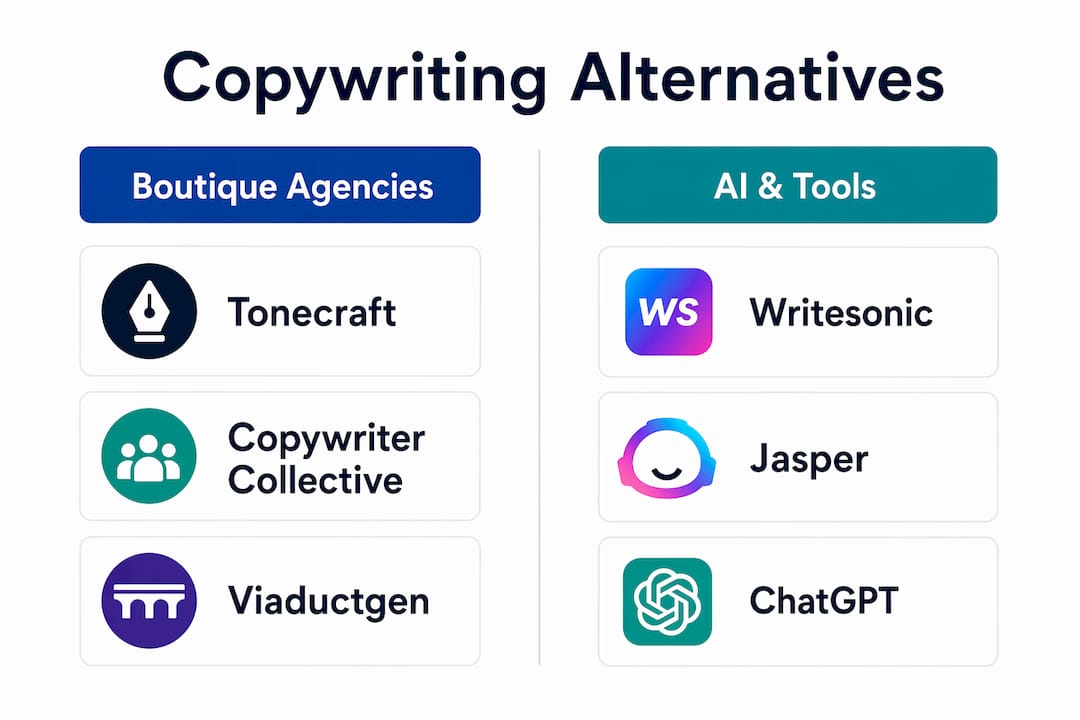
The strongest craftycopy.co.uk alternatives split into three clear categories: boutique UK agencies like Tonecraft for brand voice work, managed freelance networks like Copywriter Collective for flexible project briefs, and enterprise creative services like Superside for high-volume integrated campaigns. AI tools including Jasper, Writesonic, ChatGPT, Grammarly Business, and 1min.AI fill a fourth lane for businesses that need speed and scale over strategic depth. Crafty Copy itself focuses on messaging strategy and website copywriting for women founders and solopreneurs, so the gap you are filling depends entirely on whether you need that same strategic positioning work, pure copy output, or something bigger.
| Service | Type | Best for | Pricing model | Design integration |
|---|---|---|---|---|
| Tonecraft | Boutique agency | Brand voice and professional services positioning | Fixed-price bundles | Limited |
| Superside | Enterprise creative service | High-volume ad testing with copy and design aligned | Subscription retainer | Full, in-workflow |
| Copywriter Collective | Managed freelance network | Flexible specialist projects | Pay-per-project | Separate |
| Grammarly Business | AI writing software | Clarity, grammar, and style improvement | Subscription (per seat) | None |
| Writesonic | AI content generator | Social media and short-form marketing copy | Usage-based tiers | None |
| ChatGPT | AI language model | General copy drafting and ideation | Free and paid tiers | None |
| Jasper | AI content platform | Brand-consistent marketing content at scale | Subscription | Limited |
| 1min.AI | AI copywriting tool | Fast, concise marketing texts | Usage-based | None |
Tonecraft positions itself as a brand strategy partner rather than a word-count supplier. Its fixed-price packages cover tone of voice development, copywriting subscriptions, and creative campaigns, with transparent pricing that removes the budget uncertainty common with hourly freelancers. For professional services firms that need messaging to do real commercial work, that clarity is genuinely useful.

Superside operates at the opposite end of the scale. Its copy team works inside the same creative workflow as designers, motion specialists, and brand leads, so messaging and visuals ship together rather than in sequence. Enterprise marketing teams running continuous creative production find that integrated copy and design can reduce operational costs by up to 50% compared to traditional agency retainers. That is the model’s core argument.

Copywriter Collective sits between the two. It connects businesses with vetted UK copywriters across specialisms, from SEO content to technical writing, without locking clients into a long-term contract. The trade-off is that campaign-level integration still requires a separate design handoff.
Pricing structures across these options vary more than most buyers expect, and the model you choose shapes the working relationship as much as the cost.
Boutique agency (Tonecraft)
Managed freelance network (Copywriter Collective)
Enterprise service (Superside)
AI tools (Jasper, Writesonic, ChatGPT, Grammarly Business, 1min.AI)
| Option | Pricing approach | Typical turnaround | Client support channel |
|---|---|---|---|
| Tonecraft | Fixed bundles | Project-defined | Direct with copywriter |
| Superside | Subscription retainer | Fast within subscription | Dedicated team |
| Copywriter Collective | Pay-per-project | Variable | Account management |
| Jasper | Monthly subscription | Instant draft | Self-serve and chat |
| Writesonic | Usage-based tiers | Instant draft | Self-serve and chat |
| ChatGPT | Free and paid tiers | Instant draft | Self-serve |
| Grammarly Business | Per-seat subscription | Real-time suggestions | Self-serve and chat |
| 1min.AI | Usage-based | Instant draft | Self-serve |
Freelance copywriters excel at discrete, standalone projects but can struggle when a brief requires copy, design, and campaign logic to move together. If your bottleneck is a single web page or a batch of product descriptions, pay-per-project works well. If you are running a product launch across paid social, email, and landing pages simultaneously, a managed or enterprise model removes a lot of coordination friction.
The most common mistake is selecting a service before identifying the actual bottleneck. Successful marketers identify their content constraint first, whether that is volume, brand strategy, or e-commerce scale, and then match the service to it.
Key questions to ask before committing:
Pro Tip: Before briefing any service, write down the single outcome you need in one sentence. If you cannot do that, the brief is not ready, and no copywriter or AI tool will fix an unclear objective.
Brands achieve better conversion rates when copywriting develops in step with design teams. If your chosen service keeps copy and design in separate silos, build the handoff process into your project plan from day one, not as an afterthought.
AI tools are genuinely useful for specific tasks. The mistake is treating them as a like-for-like replacement for human-led strategy. AI tools efficiently generate bulk product descriptions and social media content but lack the strategic brand insight a human copywriter provides.
| Tool | Best for | Standout feature | Free option |
|---|---|---|---|
| Writesonic | Social media and short-form copy | High-quality template library across platforms | Yes, limited |
| ChatGPT | General drafting and ideation | Wide adaptability for varied content types | Yes |
| Jasper | Brand-consistent marketing content | Brand voice training and workflow tools | Trial only |
| Grammarly Business | Editing and clarity improvement | Real-time grammar and style suggestions | Yes, basic |
| 1min.AI | Fast, concise marketing texts | Speed for quick turnaround needs | Yes, limited |
Writesonic is the strongest pick for social media managers. Its template library covers X threads, LinkedIn posts, Instagram captions, and Facebook ads, and the short-form output typically needs minimal editing. Jasper suits marketing teams that need consistent brand voice across a high volume of assets; its brand voice training feature means the tool adapts to your tone rather than producing generic copy. ChatGPT is the most flexible of the group and the cheapest entry point, but it requires more editorial judgement to get output that is genuinely on-brand. Grammarly Business does not generate copy from scratch; it polishes and corrects existing drafts, which makes it a complement to other tools rather than a standalone solution. 1min.AI prioritises speed for short pieces, useful when you need a batch of ad headlines or social captions turned around quickly.
The honest limitation of every AI option here is the same one: they cannot identify what makes your business genuinely different from competitors. That gap is where human-led services earn their fee.
The UK copywriting market in 2026 is moving away from siloed word-count services towards integrated creative models where copy, design, and strategy are developed together from the brief stage. This shift is driven by performance marketing teams who have learned that misaligned copy and visuals consistently underperform, regardless of how good each element is in isolation.
Three service typologies now dominate the market:
Professional copywriters deliver strategic brand objectivity that drives superior ROI compared to generic writing services. The distinction between a copywriter and a messaging strategist is one that more UK buyers are starting to make explicitly, particularly in professional services, legal marketing, and B2B sectors where specialist brand positioning directly affects client acquisition.
Verification matters because the quality gap between providers is wide and not always visible from a website. The most reliable signals are independent user reviews on platforms like Trustpilot, Google, and Clutch, where clients describe actual project outcomes rather than curated case studies. For managed freelance networks, look for disclosed vetting criteria: how writers are assessed, what quality assurance process exists, and whether the network publishes sample work from named writers.
For AI tools, independent review sites like G2 and Capterra publish verified user ratings with use-case breakdowns. These are more useful than vendor-published testimonials because reviewers describe specific tasks, not general satisfaction.
Sponsored profiles and paid placements exist across most comparison platforms. A transparent provider will disclose whether a listing is paid or organic. When evaluating any service, check whether the reviews are independently verified, whether the reviewer is named, and whether the feedback describes a specific outcome. Generic five-star reviews with no detail are a weak signal regardless of volume.
The service scope varies considerably across these options, and it is worth mapping each against your actual brief before committing.
Tonecraft covers tone of voice development, website copywriting, copywriting subscriptions, and creative campaign copy. Its focus is brand voice and strategic messaging for professional services clients.
Superside offers paid and social ad copy, web and landing page copy, email and lifecycle campaigns, product marketing, long-form content, and brand messaging frameworks. It is built for continuous production rather than one-off projects.
Copywriter Collective provides access to vetted freelancers across SEO copywriting, technical writing, email marketing, product descriptions, and content strategy. The breadth depends on which writers are available for a given brief.
Grammarly Business covers grammar correction, style improvement, tone detection, and clarity suggestions. It does not write copy from scratch.
Writesonic generates blog posts, social media content, ad copy, landing page text, and email subject lines via templates.
ChatGPT produces drafts across virtually any content type, from email sequences to product descriptions, with quality dependent on the prompt quality.
Jasper covers blog content, social media posts, ad copy, email campaigns, and long-form content, with brand voice adaptation built into the workflow.
1min.AI focuses on short-form content: ad headlines, social captions, product descriptions, and email subject lines.
Tonecraft publishes case studies on its website showing tone of voice frameworks and website copy developed for professional services clients. The work demonstrates how brand voice guidelines translate into actual page copy, which is useful for evaluating whether the agency’s output matches your sector.
Superside’s portfolio covers enterprise-level ad campaigns, landing pages, and brand identity work. Because copy and design ship together, the case studies show finished creative assets rather than copy in isolation, which gives a clearer picture of how the service performs in practice.
Copywriter Collective does not publish a centralised portfolio in the same way, since output depends on the individual writer matched to a brief. Reviewing sample work from the specific writer assigned to your project is the practical approach here.
For AI tools, the most useful evaluation method is running a test prompt against your own brief. Jasper and Writesonic both offer trial access, and the output quality on a real brief tells you more than any published example. ChatGPT is free to test immediately. The gap that typically shows up in AI-generated work is specificity: the copy is grammatically correct and structurally sound, but it rarely captures the particular angle that makes a brand’s offer distinct.
If the providers above cover copywriting as a standalone service, Viaductgen takes a different route. Rather than producing copy in isolation, Viaductgen builds AI-powered growth systems where search, brand messaging, and performance work as a single connected engine. Copy is one component of that system, developed alongside SEO, paid media, and conversion strategy rather than handed off separately.
For mid-market and scale-up businesses that have outgrown one-off copywriting briefs and need messaging that compounds across channels, that integration is where Viaductgen’s brand strategy and identity work earns its place. It is a different kind of engagement from hiring a copywriter or subscribing to an AI tool, and it suits a different stage of growth.
The strongest craftycopy.co.uk alternatives are defined by operational model and integration depth, not word count or price alone.
| Point | Details |
|---|---|
| Match service to bottleneck | Identify whether your gap is brand voice, volume, or campaign integration before choosing a provider. |
| Boutique vs enterprise | Tonecraft suits brand positioning projects; Superside suits continuous high-volume production with design aligned. |
| AI tools have a ceiling | AI generates drafts efficiently but cannot replicate the strategic brand objectivity a human copywriter provides. |
| Integration drives performance | Brands achieve better conversion when copy and design develop together from the brief stage. |
| Viaductgen as a growth system | Viaductgen connects copy, search, and performance into one acquisition engine for businesses beyond one-off briefs. |

