
Clean room marketing: a practical selection guide

Fabio Embaló

Co-founder & CEO, Viaduct Generation

Published

August 19, 2026

A data clean room lets two or more organisations analyse combined data sets without either party seeing the other’s raw, identifiable records. For marketers, that means running attribution, audience overlap and enrichment work with retailers, publishers and platforms while staying inside GDPR and UK GDPR boundaries. The IAB State of Data report found that a large proportion of companies using privacy-preserving technologies rely on clean rooms specifically for secure data sharing, and standards from the IAB Tech Lab, including ADMaP and PAIR, now give the category a common technical vocabulary.

Three uses dominate how marketing teams actually deploy them:

  • Closed-loop measurement: matching ad exposure to sales or conversions without exporting customer lists to either side.
  • Audience collaboration: finding overlap between a brand’s first-party data and a retailer’s or platform’s audience, with no raw data changing hands.
  • Enrichment and activation: building richer segments from combined signals, then pushing them back out to a media platform for targeting.

Key takeaways

Clean room marketing works when identity resolution is solid upstream, the use case matches the technology’s match-rate requirements, and outputs feed directly into existing measurement systems rather than sitting isolated.

Point Details
Fix identity first Resolve and clean first-party data before any clean room project starts; match rate drives every downstream result.
Match the type to the goal Use retailer clean rooms for closed-loop sales attribution, neutral vendors for cross-platform reach.
Budget beyond licence fees Plan for data preparation, connector fees and per-query compute, not just a headline subscription cost.
Check PETs, not marketing copy Confirm hashing, MPC, differential privacy and configurable aggregation thresholds directly in vendor documentation.
Pilot before scaling Validate one partner and one measurement question over roughly three months before adding partners.

Table of Contents

What is clean room marketing?

Clean room marketing is the practice of using these secure, privacy-controlled environments to run joint analysis and targeting work with data partners. The IAB Tech Lab defines a data clean room as a controlled environment where multiple parties can contribute data for joint analysis under agreed technical and legal rules, without any party gaining direct access to the others’ underlying records.

That distinction matters because clean rooms get lumped in with tools that do something quite different.

  • A customer data platform (CDP) unifies your own first-party data into single profiles. It doesn’t broker secure collaboration with an outside partner.
  • A data management platform (DMP), largely built for the cookie era, pools third-party audience segments for targeting, typically with far looser controls over what any party can see.
  • Simple secure file transfer moves data from A to B. A clean room never moves the raw data at all; it lets queries run against it in place.

A properly configured clean room outputs only aggregated, anonymised results, subject to minimum audience thresholds, so no individual can be re-identified from what either party takes away.

How does a data clean room actually work?

The mechanics are consistent across vendors, even though the interfaces differ enormously.

  1. Ingestion: each party uploads or connects its data set (customer lists, exposure logs, transaction records) into the environment, retaining ownership throughout.
  2. Protection and matching: identifiers get hashed before matching, so the system can find overlapping customers without either party seeing the other’s plain-text emails or phone numbers.
  3. Protected compute: queries run inside the secure environment itself. Neither party can pull raw records out; they can only run pre-approved analysis.
  4. Output controls and activation: results are aggregated, thresholds are applied to prevent small-group re-identification, and approved segments can be pushed to a media platform for activation.

A few terms worth knowing before you sit through a vendor demo:

  • Hashing: converting identifiers like emails into irreversible codes for matching without exposing the original data.
  • Multi-party computation (MPC): a cryptographic technique letting multiple parties compute a joint result without any of them seeing each other’s inputs.
  • Differential privacy: adding statistical noise to outputs so no individual record can be reverse-engineered from the results.
  • Aggregation thresholds: minimum group sizes (commonly 25 to 100 users) below which the system will not return a result at all.

Pro Tip: Match rate is the single biggest lever on clean room value, and it’s decided before the project even starts. Data Axle’s guidance for marketers stresses that clean, well-resolved identity data upstream determines how much signal you actually get back. Sort out your identity resolution first; everything downstream depends on it.

What are the main types of clean rooms?

Four broad models cover most deployments, and they solve different problems.

  • Walled-garden (platform-owned): run by a single media platform, offering deep measurement inside that ecosystem. Strong for in-platform optimisation, weak for cross-platform comparison. Best for teams heavily concentrated on one platform’s spend.
  • Retailer or merchant clean rooms: built by retail media networks around their transaction and loyalty data. Excellent for closing the loop between ad exposure and actual purchase. Best for brands running significant retail media budgets.
  • Independent or third-party clean rooms: neutral vendors that connect multiple platforms and retailers in one environment. More interoperable but require separate integrations with each partner. Best for advertisers working across many walled gardens at once.
  • In-house clean rooms: built and hosted on a brand’s own cloud infrastructure. Maximum control and flexibility, but the heaviest technical lift. Best for large advertisers with dedicated data engineering teams.

Walled-garden environments trade portability for depth; neutral providers trade some of that depth for reach across partners.

What marketing use cases actually benefit from clean rooms?

The practical applications cluster around a handful of jobs marketers already recognise, just done with better privacy guarantees than the cookie-based tools they replace.

  • Closed-loop attribution: matching campaign exposure directly to conversion or sales data with a retailer or publisher.
  • Incrementality testing: measuring the lift a campaign actually generated rather than relying on last-click credit.
  • Audience building: identifying overlap segments between a brand’s CRM data and a platform’s audience for lookalike targeting.
  • Retail media measurement: connecting ad spend on a retailer’s network to that retailer’s own sales data.
  • Profile enrichment: combining transaction, loyalty and media exposure data to build richer segments for future campaigns.

Emarketer reports that a majority of organisations now use clean rooms in some capacity, with retail media cited as the strongest driver of that adoption.

Attribution and incrementality work demands high match rates to be reliable. Broad audience enrichment can still deliver useful direction even with lower coverage, which makes it a sensible starting use case for teams still building their identity infrastructure.

Where do clean rooms deliver, and where do they fall short?

The privacy case is genuinely strong. You get collaborative measurement and audience insight without ever exposing raw customer records to a partner, and you keep ownership of your own data throughout, which matters as third-party cookies and mobile identifiers keep eroding.

The operational case is more mixed, and partnering with analytics and client reporting software providers can help operationalise clean-room outputs effectively for agencies and consultancies.

  • Cost: licence fees, per-query compute charges, and data preparation work add up quickly, and the IAB Tech Lab’s cost guidance flags this as a real barrier for smaller organisations.
  • Technical skill: most environments require SQL competence and some data engineering support, which not every in-house marketing team has readily available.
  • Interoperability: connecting a neutral clean room to every walled garden and retailer you work with means separate integrations, not a single plug-and-play connection.
  • Actionability: getting a result is not the same as acting on it. A meaningful share of teams report struggling to turn clean room outputs into actual campaign decisions.

Clean rooms are the wrong tool for real-time bid optimisation or genuinely small audience segments; aggregation thresholds will simply suppress results below a certain group size, and query-based analysis isn’t built for millisecond decisioning.

What privacy and compliance checks matter most?

Privacy-enhancing technologies (PETs) are the actual mechanism preventing re-identification, not a marketing claim on a vendor’s homepage. Hashing obscures identifiers before matching. MPC lets two parties compute a shared result without either seeing the other’s inputs. Differential privacy adds statistical noise so individual records can’t be isolated from an output, even a small one.

Two IAB Tech Lab standards are worth checking for by name in any vendor’s documentation. ADMaP standardises attribution measurement protocols across environments, and PAIR governs privacy-safe audience activation so activation doesn’t quietly reintroduce raw identifiers through the back door.

Before legal sign-off, get clear answers on:

  • What aggregation thresholds are enforced, and are they configurable?
  • Who has access rights inside the environment, and how is that governed?
  • Is every query and output logged for audit purposes?
  • What contractual restrictions apply to how each party can use combined outputs?

Pro Tip: Ask for an independent audit report of the vendor’s PET implementation, not just a compliance whitepaper. A logged, auditable trail of every query run is what actually protects you if a regulator or partner later asks how a result was produced.

How do you choose the right clean room partner?

Score any shortlist against these dimensions before you sign anything.

  1. Privacy features and PETs supported (hashing, MPC, differential privacy, configurable thresholds).
  2. Identity layer strength and expected match rate against your own data.
  3. Connector coverage across the retailers, platforms and DSPs you actually use.
  4. Cloud compatibility with your existing infrastructure (Snowflake, AWS, Google Cloud, Azure).
  5. Pricing model: licence, per-query, or storage-based, and how costs scale with volume.
  6. Built-in analytics and activation capability versus a query-only environment.
  7. Technical support and onboarding resource available from the vendor.
  8. Contractual flexibility around data-use restrictions and exit terms.

Ten questions worth putting directly to any vendor on a discovery call:

  • What identity resolution method do you use, and what match rates do comparable clients typically see?
  • Which retailers, platforms and DSPs do you already connect to natively?
  • What’s your default aggregation threshold, and can we adjust it?
  • How is pricing structured, and what triggers additional charges?
  • Can outputs activate directly back into a media platform, or do we need a separate step?
  • What cloud environments do you support or require?
  • How is access governed and logged inside the environment?
  • What SQL or engineering skill does our team need to run queries independently?
  • Do you support MMM or incrementality testing use cases specifically?
  • What does a typical pilot timeline look like from contract to first insight?

Red flags include vague answers on match rate, no mention of audit logging, and pricing that only becomes clear after the contract is signed.
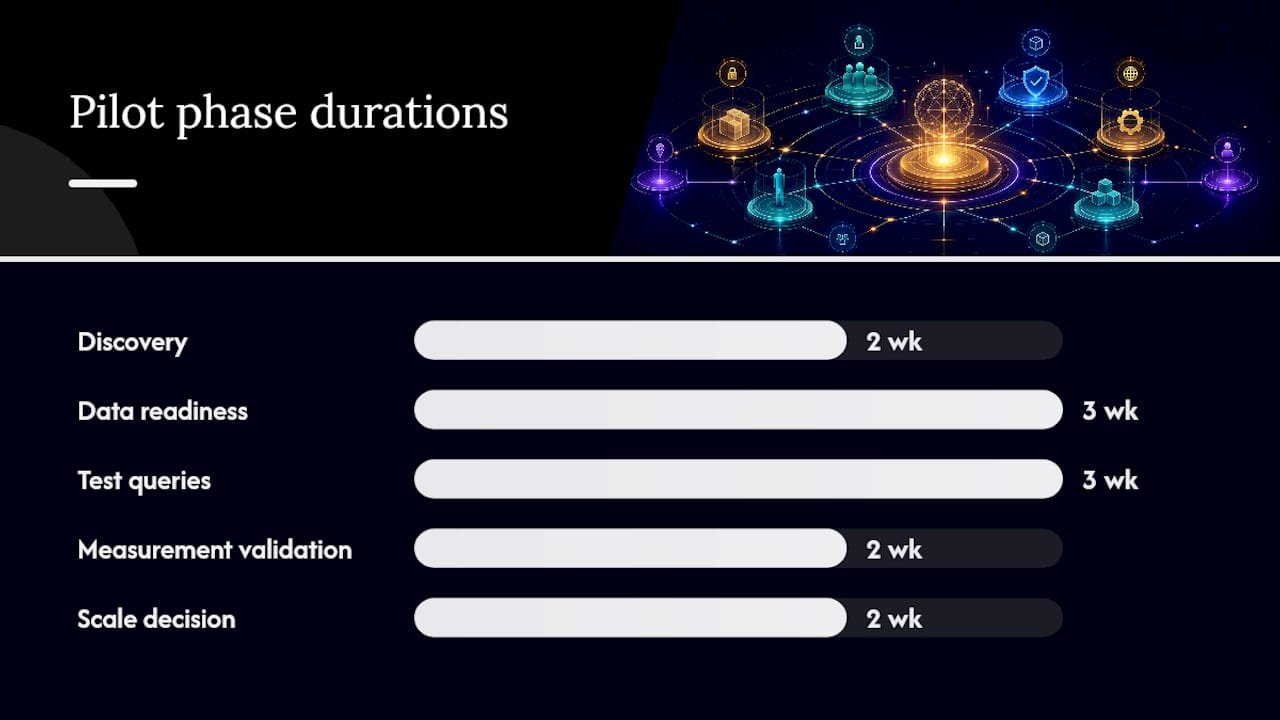
What does a clean room implementation actually cost?

What does a clean room implementation actually cost? — overview diagram

Budget across several cost lines rather than a single licence fee. Expect charges for platform licence or usage, data preparation and identity resolution work, connector fees per partner, storage, per-query compute, and professional services for setup. The IAB Tech Lab’s own cost breakdown lists these same components and notes they scale with both query volume and the number of partners connected.

A realistic pilot runs across three months:

  1. Discovery (weeks 1 to 2): define the measurement question and confirm partner willingness.
  2. Data readiness (weeks 3 to 5): clean and resolve identity data before ingestion.
  3. Test queries (weeks 6 to 8): run initial matching and measurement queries at small scale.
  4. Measurement validation (weeks 9 to 10): sense-check outputs against known campaign results.
  5. Scale decision (weeks 11 to 12): decide whether to expand partners or use cases.

Ongoing costs rise mainly with query frequency and the number of active partner connections, not with a flat annual fee, so a growing programme needs a growing budget line, not a one-off purchase.

Which clean room vendors should marketers know?

Six names come up repeatedly in vendor shortlists, each solving a slightly different problem.

  • Google Ads Data Hub: platform-bound to Google’s ecosystem, strong for measurement and audience work tied directly to Google Ads and YouTube spend.
  • Amazon Marketing Cloud: Amazon’s own clean room for advertisers running retail media on its platform, tightly coupled to Amazon’s ad and sales data.
  • Snowflake: a cloud data platform offering clean room functionality (Snowflake Data Clean Rooms) for teams already storing data in its warehouse, strong on flexibility for technically capable teams.
  • LiveRamp: a neutral identity and clean room provider with wide connector coverage across platforms and retailers, suited to advertisers working across many partners.
  • InfoSum: an independent clean room vendor focused on decentralised matching, popular for retail and publisher collaborations that need to keep data physically separate.
  • Decentriq: a neutral, confidential-computing clean room provider aimed at technically sophisticated teams needing strong cryptographic guarantees.

Platform-bound options (Google Ads Data Hub, Amazon Marketing Cloud) offer deep measurement but no activation outside their own ecosystem. Neutral vendors need separate connector work per partner but give broader reach. UK and EU advertisers should confirm data residency and hosting location explicitly with any vendor, since retailer coverage and cloud region availability still vary by market.

How would an agency run a clean room programme?

A structured rollout looks like this in practice:

  1. Discovery: map existing data assets, partners and the specific measurement question worth answering first.
  2. Identity readiness: clean and resolve first-party data before any matching begins, since poor upstream hygiene produces weak match rates regardless of vendor quality.
  3. Pilot measurement: run one publisher or retailer partnership against one clear question, validating results before expanding.
  4. Scale: add partners and use cases once the pilot proves out.
  5. Industrialise: feed validated outputs into broader multi-touch attribution and MMM models.

Track match rate, incremental lift versus a holdout group, ROAS delta pre and post activation, and time-to-insight per query cycle. The most common pitfall Viaductgen sees isn’t vendor selection, it’s teams skipping identity readiness and then blaming weak results on the platform itself.

Sources

Ready to turn clean room outputs into measurable revenue rather than isolated dashboards? Viaductgen’s AI-native approach to client work connects identity readiness, pilot measurement and attribution into a single 90-day sprint, so the insight a clean room produces actually changes what your campaigns do next.

FAQ

What is a clean room in marketing?

A clean room in marketing is a secure environment where two organisations, such as a brand and a retailer, jointly analyse combined data without either side accessing the other’s raw customer records.

What is clean room advertising?

Clean room advertising uses these secure environments to measure campaign performance, build audience segments, or activate targeting based on combined first-party and partner data, all under privacy-preserving controls.

What does “clean room” mean in business generally?

Outside marketing, a clean room typically refers to an isolated process where a team works from limited, sanitised information to avoid contaminating a separate project with restricted knowledge, most commonly seen in reverse-engineering and intellectual property contexts.

What is a clean room in M&A?

In mergers and acquisitions, a clean room is a controlled setting where sensitive commercial data from both companies can be reviewed by a limited group of advisers ahead of a deal closing, without breaching competition rules on information sharing between rival firms.

How is a data clean room different from a CDP?

A customer data platform unifies a company’s own first-party data into single customer profiles, while a data clean room enables secure joint analysis between two or more separate organisations without either exposing raw data to the other.

What match rate do I need for reliable measurement?

There’s no fixed universal threshold, but attribution and incrementality use cases need meaningfully higher match rates than broad audience enrichment work, which is why identity resolution quality should be addressed before selecting a vendor.

About the Author

Fabio Embaló

Co-founder & CEO, Viaduct Generation

Fabio co-founded Viaduct Generation in 2020 with a belief that the gap between agency output and business impact was structural, not incidental. He leads the agency's strategic direction, client partnerships, and the development of the Growth Engine methodology. With a background spanning organic search, content strategy, and digital transformation, he has spent his career building systems that connect digital activity to commercial outcomes.

AI Strategy Growth Architecture SEO & AEO Client Partnerships