
Effective B2B website messaging names a buyer’s specific problem and the measurable outcome you deliver, then proves it with evidence a stakeholder can forward to a colleague. Start this week with a short voice-of-customer sweep, pull three exact phrases your buyers use to describe their pain, and put them in your headline and subhead before you touch anything else. UK and Ireland buyers now complete the majority of their research before they ever speak to a salesperson, which makes your homepage the pitch, not the preamble.
Buyer behaviour has changed the sequence of a B2B sale. In 2025, UK and Ireland buyers controlled 57% of their journey before making contact with a vendor, which means your website carries the weight of a conversation that used to happen face to face. If your messaging cannot answer “why you, why now” without a salesperson in the room, you have already lost ground to a competitor whose homepage does that job unassisted.
The shift runs deeper than self-service research. Roughly half of B2B buyers now use AI tools regularly to research vendors, with adoption skewing higher among senior executives, the people who often hold budget authority. These tools summarise, compare, and recommend based on how clearly a site states its problem, outcome, and proof. Vague copy does not just underperform with humans; it can cause an AI system to skip your business entirely when a prospect asks it to shortlist vendors.
Unclear messaging creates specific, measurable damage rather than a vague drag on performance:
Buyers are not evaluating your product in isolation. They are gathering evidence to defend a decision to colleagues who never spoke to you directly, and your website messaging either equips them for that internal sale or leaves them under-armed.
Most messaging projects fail because teams jump straight to headline writing without doing the groundwork. Copy without research is guesswork dressed up in confident fonts. The framework below moves in a fixed order because each step depends on the output of the one before it, and skipping ahead is the single most common reason messaging projects stall at the “it sounds fine but nothing changed” stage.
Before you write a word of copy, collect language directly from the people who buy from you. You need three sources at minimum: recent customer interviews, a sample of sales call transcripts or notes, and support ticket themes. Twenty to thirty data points is usually enough to spot repeating phrases; fewer than ten and you risk building messaging around an outlier.
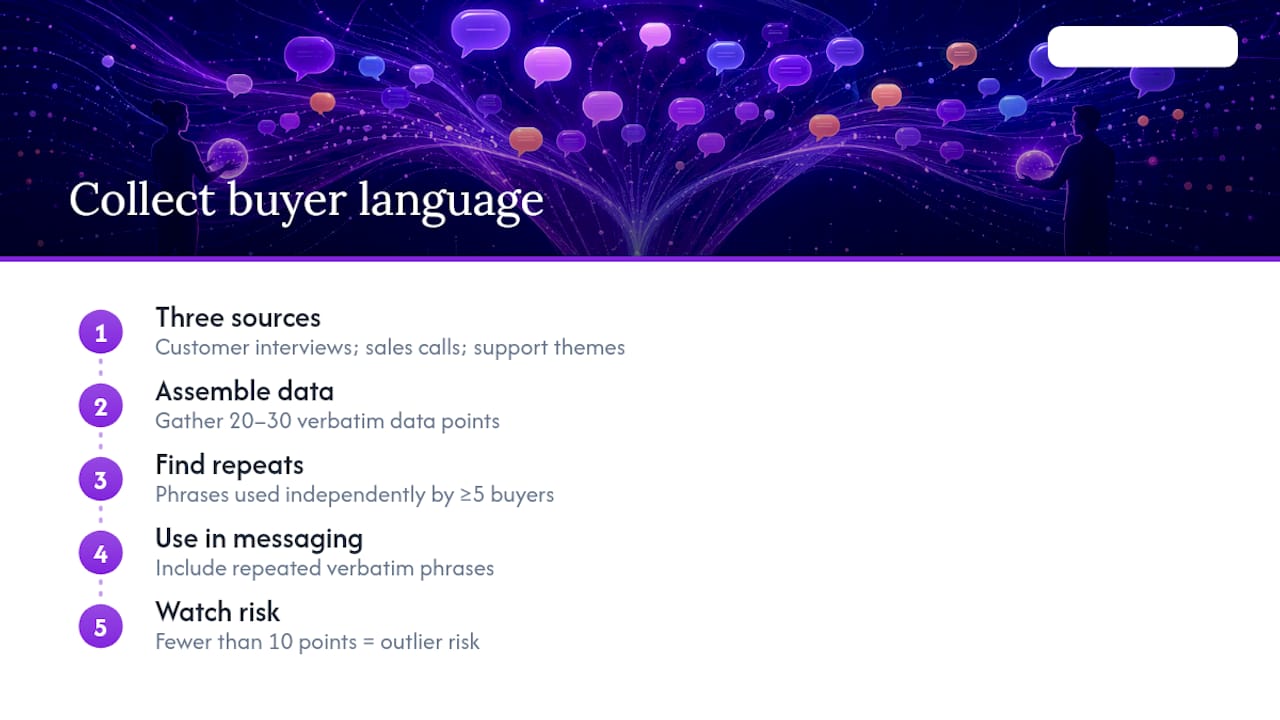
The output you want is not a summary. It is a list of verbatim phrases, the exact words buyers use to describe their problem, their fear, and the outcome they are chasing. If five different prospects independently describe the same frustration using similar language, that phrase belongs in your messaging hierarchy, not a paraphrased version your marketing team thinks sounds more polished.
Your value proposition should connect three things in a single sentence: the buyer’s problem, the outcome you deliver, and a piece of evidence that makes the claim credible. A workable structure looks like this: “[Audience] struggling with [specific problem] achieve [measurable outcome] through [mechanism], proven by [evidence].”
This is harder than it sounds because most teams write value propositions around what they do rather than what changes for the buyer. “We provide cloud infrastructure monitoring” describes an activity. “Engineering teams cut incident response time by identifying failures before customers notice” describes an outcome. Buying committees remember outcomes; they forget activities.
Once your one-line value proposition exists, it needs to cascade through a consistent structure across every page:
Every page should follow this order without exception. Consistency here is what lets a buyer skim your site in ninety seconds and still walk away with an accurate mental model of what you do.
A single message rarely persuades an entire buying committee, because a finance director, a technical evaluator, and a procurement lead are reading for entirely different signals. Segment your proof and framing accordingly:
You do not need three separate websites. You need modular sections, tabs, or downloadable assets that let each stakeholder self-select the depth of detail relevant to their decision.
Different proof formats carry different weight depending on where a buyer sits in their evaluation. Case studies work well early, when a prospect is validating that you understand their industry. Benchmarks and comparative data work better mid-funnel, when a champion needs ammunition to convince sceptical colleagues. ROI calculators work best late-stage, when the conversation has shifted from “can this work” to “can I justify the spend.” Buyers consistently rank original research and transparent methodology as the content that earns the most trust, ahead of polished but unverifiable claims.
Pro Tip: Publish the methodology behind any statistic you cite on your own site, even a two-sentence note. Buyers who see how you calculated a number trust the number itself far more than they trust the number alone.
Messaging is not a one-off project; it is an operating rhythm. For each test, define a hypothesis (“changing the hero headline from feature-led to outcome-led will increase demo requests”), a single primary metric, a minimum detectable effect you consider worth acting on, and a fixed review cadence, typically every four to six weeks for a mid-traffic B2B site. Testing less frequently than that means you are reacting to seasonal noise rather than genuine signal; testing more frequently rarely gives you enough data to draw a confident conclusion.
You do not need a formal research department to get usable voice-of-customer data. Five techniques deliver strong signal within a week, and none require specialist tools:
Converting raw verbatims into usable copy takes a filtering step most teams skip. Not every phrase deserves headline placement. A phrase becomes hero copy when it appears independently across multiple sources, when it captures an outcome rather than a feature, and when it is specific enough to be memorable rather than generic enough to apply to any competitor. Everything else, the secondary frustrations, the nice-to-have benefits, belongs in supporting bullets, FAQ answers, or deeper page content, not competing for space in your hero section.
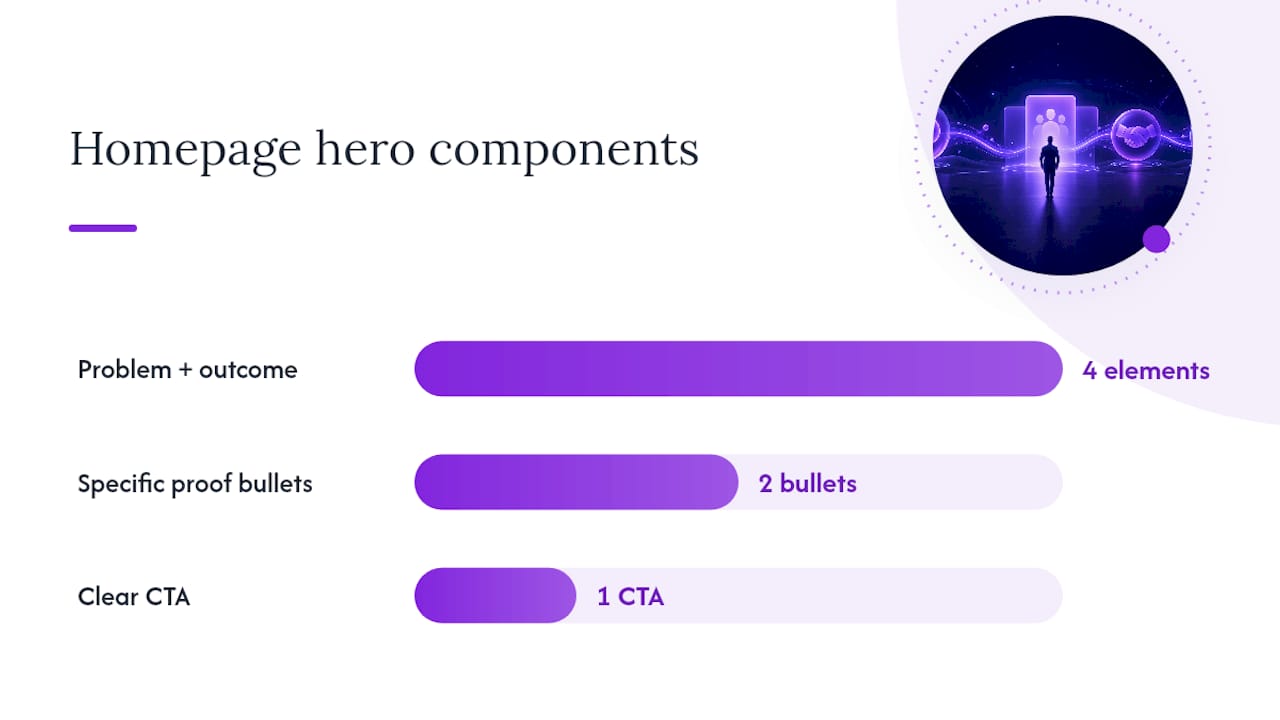
A homepage hero needs four elements in a fixed order: a problem line that names the buyer’s pain without softening it, an outcome line stating what changes when they solve it, two specific proof bullets, and one clear call to action. A workable template: “Struggling with [specific problem]? [Audience] achieve [measurable outcome] with [mechanism].” Followed by two proof bullets such as a customer result and a credibility marker, then a CTA that matches buyer intent, “See how it works” for early-stage visitors, “Book a call” for those ready to talk.
Product and solution pages follow a different logic. Lead with the outcome, not the feature list. Then map each feature explicitly to the outcome it produces, because buyers rarely care what a feature does in isolation; they care what changes for them because it exists. Close each feature-to-outcome pairing with a proof artefact, a stat, a mini case study, a screenshot with an annotation, so the claim doesn’t rest on your word alone.
Microcopy discipline matters more than most teams realise. A few rules worth enforcing across every page:
Pro Tip: Read every headline aloud to someone outside your industry. If they cannot repeat back what problem you solve within five seconds, the headline still has work to do.
Buyers want benefits and proof stated plainly, not buried under design flourishes, and the B2B Digital Shift Report found that many B2B sites still prioritise visual polish over the clarity buyers are actually looking for.
Not all proof carries equal weight, and understanding the hierarchy saves you from burying your strongest evidence under weaker claims. Independent third-party data tends to persuade sceptical buyers most, because it removes any suspicion of self-interested marketing. Customer benchmarks, showing how a specific metric moved for a named or anonymised customer, rank close behind. Detailed case studies come next, valuable but less persuasive than raw data because readers know you selected the story. ROI calculators and interactive tools help buyers personalise the case internally, and technical documentation matters almost exclusively to evaluators who need implementation detail, not persuasion.
Disclosing your methodology, even briefly, protects credibility rather than undermining it. A single sentence, “based on a survey of 200 mid-market buyers conducted in March,” does more to build trust than the statistic itself, because it signals you have nothing to hide in how the number was produced.
Where you place proof matters as much as which proof you choose. Early-stage visitors on your homepage need broad credibility markers, logos, review scores, a headline statistic. Mid-funnel visitors on product or solution pages need specific, comparable data relevant to their exact use case. Late-stage visitors, often deep in a buying committee’s internal debate, need downloadable assets: a comparison sheet, an ROI calculator, a technical whitepaper, something a champion can share without you in the room. This mirrors what Redpoint’s research found about mid-funnel content that supports internal selling: the formats that get shared internally are the ones that close deals, not the ones that merely look impressive on a first visit.
Four mistakes recur across almost every messaging audit we run, and each has a direct fix.
Process-led copy. “We use a proprietary five-step methodology” tells a buyer nothing about their outcome. Fix: rewrite around the result. “Our clients cut time-to-market by weeks” replaces process description with a claim buyers actually care about.
Jargon that excludes non-specialists. Technical language impresses your technical evaluator and alienates the finance director who also has a vote. Fix: write the headline for the least technical person in the room, then let subheads and deeper pages carry the specialist detail.
Inconsistent signals between sales and marketing. If your website promises one thing and your sales deck promises another, buyers notice, and it damages trust at exactly the moment they are deciding whether to believe you. Fix: build a single shared messaging document that both teams draft and approve together, then audit quarterly.
Absent or weak proof. Claims without evidence read as marketing noise. Fix: attach a specific number, case study, or third-party reference to every major claim on the page, no exceptions.
The organisational fix that prevents recurrence matters more than any individual rewrite. Teams that treat messaging as a one-off project watch it drift out of alignment within months. Building a recurring alignment ritual, a monthly thirty-minute sync between sales and marketing to review new voice-of-customer phrases, keeps messaging consistent as your product and market evolve, rather than letting it calcify around language that stopped being true two product releases ago.
Run this checklist against your homepage and top product page before you plan a full rewrite:
Homepage pass/fail check:
Product page pass/fail check:
Two templates you can use today:
Three A/B tests worth scheduling this quarter:
I’m Fabio, and this framework reflects how we think about messaging at Viaductgen, not as a copywriting exercise but as infrastructure for a buying committee’s internal case. Founded in 2020, Viaductgen built its five-phase Growth Engine, AI-driven research through to measurable commercial outcomes, specifically because messaging that isn’t tied to research and testing tends to drift into opinion rather than evidence.
A few principles guide how we apply this in client work:
Our FMIS case study and CWorkshop case study show this approach applied to businesses with genuinely different buying committees and sales cycles, and both illustrate the same underlying discipline: messaging built from research, tested rather than assumed, and carried consistently from the website into the sales conversation.
Most in-house teams know their messaging needs work; the harder problem is finding the time to run proper voice-of-customer research, test hypotheses, and rebuild a hierarchy across every page without pulling resource off other priorities for months. Viaductgen’s Search Growth Blueprint exists for exactly that gap: a defined 90-day engagement that combines AI-driven research with senior strategic input to rebuild messaging, test it, and connect it to measurable commercial outcomes rather than a subjective sense that the new copy “feels stronger.”
A briefing call is the natural next step if this framework has surfaced gaps you don’t have the internal bandwidth to close alone. Expect a direct conversation about your current buyer research, where your messaging is losing shortlist position, and what a structured sprint would prioritise first. The agency operates as a partner-led team, meaning senior strategists work the engagement themselves rather than handing it to a junior account team once the contract is signed. If you want to see the full method behind this, the Growth Engine page walks through how research, strategy, execution, and optimisation connect across a single engagement. Explore our full services or get in touch to scope what a messaging-focused sprint would look like for your business.
The framework in this guide draws on a handful of primary reports worth reading directly if you want the full data behind the claims.
If your business works with specialist service providers who need to translate technical detail into buyer-friendly language, firms like e-accounts offer a useful reference point for how sector-specific messaging can still stay plain and outcome-led.
The rule of multiple exposures holds that a buyer typically needs several opportunities to see your message before they take action, spanning your website, sales conversations, email, and social channels. In practice, this means your website messaging needs to stay consistent with what a buyer sees everywhere else, because contradictory signals reset the count and slow the decision down.
A B2B website is a site built to sell products or services to other businesses rather than individual consumers, which changes its job significantly. Instead of triggering an emotional impulse purchase, it needs to equip a buying committee, often several stakeholders with different priorities, with enough evidence to justify a considered decision internally.
B2B stands for business-to-business, describing any transaction where one company sells to another rather than to an individual consumer. The term shows up constantly in marketing, sales, and messaging discussions because B2B buying decisions typically involve longer cycles, multiple stakeholders, and higher scrutiny than consumer purchases.
Strong B2B messaging names a specific buyer problem and states a measurable outcome, backed by proof, rather than describing a product’s features in isolation. A homepage headline like “Cut reporting time by three hours a week” outperforms a generic line like “Powerful reporting software” because it gives a buyer something concrete to evaluate and repeat to a colleague.
If your sales team regularly has to re-explain what your website already claims to say, or if your bounce rate on key landing pages sits noticeably above your industry norm, your messaging likely needs attention. Running the homepage and product page checklist covered earlier in this guide is the fastest way to find out exactly where it’s falling short.

