
A B2B Google Ads strategy succeeds only when it is judged on pipeline value, meaning qualified leads and closed-won revenue, rather than click volume or cost per lead in isolation. That means building three things in sequence: measurement that connects clicks to CRM outcomes, targeting that filters for buying intent, and a post-click experience that qualifies rather than just captures. Expect three months minimum before the account has enough offline conversion data to bid on anything more sophisticated than early funnel signals.
TL;DR:
- Building offline conversion tracking and CRM integration requires at least three months to gather enough data for reliable optimization.
- Campaigns should follow a strict sequence, proving bottom-of-funnel success before expanding to middle and top-of-funnel efforts.
- Exact and phrase match keywords with intent modifiers outperform broad match and need regular negative keyword management to prevent wasted spend.
- Limit account structure to five core campaign types, focusing on high-intent search, branded terms, remarketing, Performance Max, and competitor bids, with tightly themed ad groups.
- Rely on pipeline value and closed-won revenue as primary KPIs, with at least three months needed to accurately attribute success and inform strategic decisions.
Four pillars hold up every B2B Google Ads programme that survives contact with a real sales cycle. Get these wrong and no amount of budget or creative testing fixes it later.
None of this works as a one-off setup. It needs a weekly and monthly rhythm: search-term reports reviewed weekly to catch wasted spend before it compounds, CRM syncs run at least weekly so Google Ads sees closed-won data on a predictable schedule, and optimisation sprints (budget, bidding, creative) run monthly against pipeline data rather than surface-level CPL. Someone on the marketing team, not sales operations, needs to own the definition of each conversion event and be accountable for making sure the CRM upload actually runs. Ambiguity over who owns that handoff is the single most common reason offline conversion tracking quietly breaks after the second or third month.
Campaign types and offers only make sense once you have decided which funnel stage you’re actually trying to move someone through. Google’s own B2B guidance recommends mapping campaign types and offers to funnel stage explicitly, rather than running one generic “get leads” campaign against everyone.
Budget sequencing matters more than most marketers admit. Prove BOFU first. If branded and high-intent search campaigns aren’t converting into SQLs at an acceptable cost, expanding into MOFU or TOFU spend just multiplies the waste. Once BOFU campaigns hold a stable cost per SQL over several weeks, reallocate a modest slice of budget upward into MOFU content promotion, then TOFU awareness, and let the CRM data tell you whether that spend is actually feeding the bottom of the funnel weeks or months later. Practitioner guides on lead generation sequencing consistently back this “prove it small, then expand” order over launching all three stages simultaneously.
Pro Tip: Set a hard rule before you launch: no MOFU or TOFU budget increase until BOFU campaigns have produced at least 20 to 30 SQLs at a stable cost. Otherwise you’ll be optimising three funnels blind at once.
Match type discipline separates B2B accounts that scale profitably from ones that bleed budget on irrelevant traffic. Exact and phrase match should form the foundation of any B2B search campaign, because they let you control which precise query triggers spend. Broad match earns a place only once you have several months of negative keyword data and a Smart Bidding strategy with enough conversion volume to interpret signal quickly, and even then it belongs in its own campaign with a capped budget so it can’t quietly cannibalise your proven exact match terms.
Negative keywords need a standing cadence, not a one-time setup. Review search terms weekly for the first two months of any new campaign, then fortnightly once patterns stabilise. B2B accounts consistently waste spend on:
Intent modifiers deserve priority in your keyword list because they filter for buyers rather than researchers. Terms combining a category with “pricing,” “demo,” “vendor,” “software,” “solutions,” or “for [industry/role]” consistently outperform the plain category term alone on cost per SQL, because they signal someone comparing options rather than learning what the category even is. A pattern like “[category] software for finance teams” or “[category] pricing” will nearly always beat “[category]” on its own for lead quality, even though it draws a smaller volume of clicks.
The practical workflow is simple to describe and easy to neglect: pull the search terms report, flag anything with zero conversions and meaningful spend, add it as a negative at the right level (ad group or campaign), then check whether your exact match list is missing any high-performing query variants worth adding directly. Do this on a fixed day each week, not “when there’s time,” because irregular reviews are how wasted spend accumulates unnoticed for months.
A pragmatic B2B account rarely needs more than five campaign types to cover the funnel properly, and piling on more than that usually just fragments budget and data without adding control.
Inside each search campaign, build tightly themed ad groups of three to five closely related keywords rather than chasing the old single-keyword ad group model. SKAGs gave granular control at the cost of enormous management overhead, and modern Smart Bidding needs conversion volume concentrated enough per ad group to learn quickly. Five well-matched keywords sharing one clear intent will usually out-perform five separate single-keyword ad groups competing for the same limited conversion data.
Performance Max deserves guardrails, not blind trust. It can pull in genuinely incremental conversions, but without clear audience signals and placement exclusions it will happily spend on display inventory that has nothing to do with your buyer. Google’s own placement guidance recommends feeding it first party audience signals (customer lists, website visitors) and reviewing placement reports regularly rather than treating it as fully hands-off. Set a firm conversion value threshold before it launches, and review its channel breakdown at least monthly to confirm it isn’t simply cannibalising branded search.
Nothing in this article matters if Google Ads never learns what a real customer looks like, and that learning depends entirely on getting CRM outcomes back into the platform. Two mechanics do the heavy lifting here.
Offline conversion upload joins each ad click to its outcome using the gclid parameter, the unique identifier Google attaches to every click. When a lead closes in your CRM weeks or months later, you upload that gclid back to Google Ads with the outcome attached, and the algorithm learns which clicks actually became revenue rather than just form fills, following best practices from Google Business Profile optimisation for small businesses.
Enhanced Conversions for Leads works alongside this by matching hashed first-party data (typically email address) to strengthen that connection, particularly useful when a gclid record has gaps or when a lead converts across devices. Both mechanics matter for the same underlying reason: Google Ads cannot optimise for outcomes it never sees.
Build a conversion hierarchy with values attached rather than treating every form fill as equal:
The bidding roadmap should follow signal maturity, not ambition. Start on Maximise Conversions while you gather volume, move to target CPA once you have enough SQL data to set a realistic target, and only move to target ROAS or full value-based bidding once closed-won data is flowing reliably from the CRM. Jumping straight to value-based bidding on day one, before Google Ads has seen a single real outcome, is one of the most common ways B2B accounts stall.
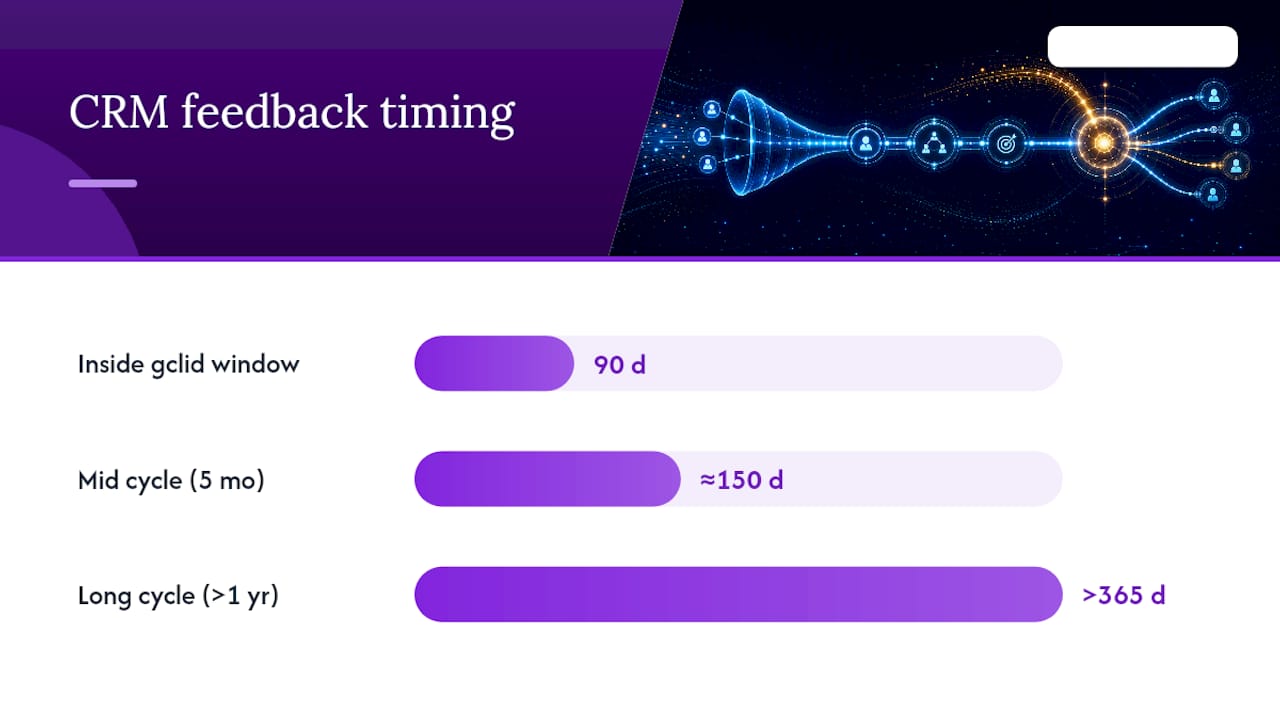
The gclid window is the operational trap almost nobody plans for. Google’s offline conversion window is 90 days, and many B2B sales cycles run considerably longer than that, sometimes well over a year. If your only conversion event is closed-won, deals that take five months to close will simply fall outside the window and teach the algorithm nothing. Fire intermediate events, SQL status changes especially, inside that 90-day window so Smart Bidding has something to learn from long before the deal actually closes. When you first switch on offline uploads, backfill historical closed-won records where the gclid was preserved; this shortens the learning curve considerably compared with starting from zero.
The click is cheap. The sales team’s time reviewing an unqualified lead is not. Landing pages built for B2B lead quality need to do more than convert; they need to filter.
The most common failure is a mismatch between what the ad promises and what the page delivers. An ad promoting “enterprise inventory management” that lands on a generic homepage forces the visitor to hunt for relevance, and most simply leave. Landing page best practice is consistent on this point: relevance between ad copy and page content is one of the strongest levers on both conversion rate and lead quality, because it keeps unqualified visitors from converting on curiosity alone.
Form design deserves particular care in B2B, where a five-field form asking for budget and timeline upfront can feel presumptuous for a TOFU offer but entirely appropriate for a demo request. Progressive profiling, asking for name and email on the first interaction and reserving firmographic questions for a second touch, works well for earlier-funnel offers; BOFU forms can and should ask more upfront, because genuine buyers expect to answer qualifying questions before a sales conversation.
Pro Tip: Add one field your sales team actually uses to prioritise follow-up, such as “current tool” or “team size,” even if it costs you a few percentage points of form completion. A shorter form that produces unusable leads is a worse trade than a slightly longer one that lets sales triage in seconds.
Most B2B buying committees research quietly for weeks before anyone fills in a form, which means the accounts worth chasing are often visible in your traffic data long before they convert. Company-identification tools paired with CRM lists let you spot which accounts are engaging with your site and prioritise outreach or bidding accordingly, addressing what Leadfeeder describes as a genuine blind spot in standard Google Ads reporting, which sees clicks but not company-level buying signals.
A structured remarketing sequence over 30 to 90 days keeps your brand in front of an account as it moves through evaluation, without repeating the same generic ad indefinitely:
Layer search keywords with these audience signals rather than running them independently. A high-intent keyword combined with a “known engaged account” audience list justifies a higher bid; the same keyword against a cold, unidentified visitor probably doesn’t. This layering protects budget by concentrating spend where intent and fit both exist simultaneously, rather than treating every click on a good keyword as equally valuable. For teams building this signal-based approach further, AI-assisted audience modelling can help synthesise these overlapping signals faster than manual review allows.
Smart Bidding needs a minimum volume of conversion data before it can make reliable decisions, and B2B accounts routinely fall short of that threshold, especially on high-value, low-volume campaigns. As a working rule, don’t hand full control to automated bidding on a campaign generating fewer than roughly 15 to 20 conversions a month; below that, manual CPC or Maximise Conversions with a conservative budget cap gives you more predictable, reviewable outcomes.
Automation still needs commercial guardrails even once volume justifies it. Directive’s analysis of B2B Google Ads performance points to exclusion lists, properly weighted conversion values, and regular monitoring of impression share and search terms as the difference between automation that compounds results and automation that quietly drifts off target.
When automated bidding changes conflict with pipeline data, for example, cost per click rising while cost per SQL improves, trust the pipeline metric. Smart Bidding optimises for the conversion event you gave it, and if that event is well chosen, short-term CPC volatility is often the algorithm finding better buyers, not losing control.
Reporting that stops at cost per click or cost per lead tells you almost nothing useful about whether a B2B Google Ads strategy is working. The primary KPIs that matter are cost per SQL, pipeline value generated per pound spent, and closed-won ROAS once enough deals have closed to calculate it meaningfully.
Roughly three months is the practical minimum before pipeline attribution data is reliable enough to guide major bidding or budget decisions, given how long B2B sales cycles typically run. Reporting earlier than that on closed-won figures alone will mislead you into either cutting a campaign that’s actually working or scaling one that hasn’t proven anything yet.
The right attribution approach for B2B blends two views rather than picking one. Multi-touch or assisted-conversion reporting inside Google Ads shows which campaigns and keywords contributed across a longer buying journey, useful for understanding influence. CRM-sourced closed-won revenue, tied back through the same offline conversion mechanism discussed earlier, remains the final word on what actually generated revenue. Use assisted data to understand the journey; use CRM revenue to make the budget decision.
Getting from a standing start to a pipeline-driven bidding strategy follows a fairly predictable sequence, and skipping steps almost always costs more time later than it saves now.
Every step assumes the previous one is actually working before you move forward. An account that starts value-based bidding before offline uploads are running reliably, or expands to Performance Max before high-intent search has a proven cost per SQL, is building on a foundation that isn’t there yet.
Everything above works better when it’s built inside a system rather than assembled campaign by campaign. A five-phase Growth Engine approach, AI-powered intelligence through to measurable commercial outcomes, treats CRM-connected bidding as the default, not an add-on bolted on after launch.
Fabio, Viaductgen’s Co-founder & CEO, built the agency’s approach around one conviction: an agency that measures success in rankings and clicks alone is measuring the wrong thing. Clients working within this model consistently report a clearer line between ad spend and sales pipeline within their first full sprint. If your team needs that structure applied to your own account, that’s exactly what a Growth Engine engagement is built for.
Most agencies still report on clicks and cost per lead because that’s what’s easy to measure quickly. Building the CRM connection first ensures every campaign decision, from bidding strategy to budget sequencing, is judged against pipeline value and closed-won revenue rather than surface-level metrics that look good in a monthly deck but say nothing about sales outcomes.
That approach sits inside Viaductgen’s AI-native way of working, where signal modelling and account prioritisation are built into the research phase rather than added after launch. If your current Google Ads reporting stops at leads rather than SQLs and pipeline value, a Growth and Strategy Planning engagement is the practical next step. Get in touch to see how the Growth Engine would apply to your account.
For technical implementation, start with Google’s official guidance on offline conversion tracking and Enhanced Conversions, which covers the gclid mechanics referenced throughout this article. Leadfeeder’s analysis of the B2B measurement gap and Unbounce’s landing page guidance are worth bookmarking for ongoing reference.
The rule of multiple touchpoints holds that a buyer typically needs several meaningful interactions with your brand before they’re ready to convert, which is why a single remarketing ad or one search click rarely closes a B2B deal on its own. It’s the reasoning behind building a 30 to 90 day remarketing sequence rather than relying on one-off ad exposure.
£20 a day is usually too low to generate reliable conversion data for most B2B categories, where cost per click on competitive terms can exceed that figure many times over in a single day. It can work for a narrow, low-competition niche keyword, but most B2B accounts need considerably more budget to reach the conversion volume Smart Bidding needs to learn effectively.
The strategies that consistently work combine funnel-mapped campaigns with CRM-connected measurement, tightly segmented intent-based keywords, and landing pages built to qualify rather than just capture leads. Pipeline value, not lead volume, should be the metric that decides whether any of it is actually working.
Definitions vary across sources, but a common version covers company (understanding the buying organisation’s structure), customer (the specific decision-maker or committee involved), cost (total value delivered relative to price, not just price alone), and communication (message tailored to buying-committee roles rather than a single generic pitch).
Expect a minimum of three months before pipeline attribution data is reliable enough to inform major bidding or budget decisions, given how long typical B2B sales cycles run. Earlier reporting can guide tactical adjustments, but shouldn’t be used to judge whether the overall strategy is working.

