
AI PPC bidding, commonly called Smart Bidding, uses machine learning to set your bid at the moment of each auction rather than relying on a fixed rule you set manually. It works best once your account has clean conversion tracking and enough monthly conversions to give the model something to learn from, typically in the range Google and independent practitioners both point to. Get those two conditions right and Smart Bidding will usually outperform manual bidding on scale and consistency. Get them wrong and it will confidently optimise towards the wrong outcome.
TL;DR:
- Smart Bidding requires at least 30 to 50 conversions per month per campaign to learn reliably and outperform manual bidding.
- The effectiveness of Smart Bidding depends heavily on clean conversion tracking, accurate conversion values, and stable data inputs.
- Common causes of underperformance include duplicated conversions, frequent target changes, and low account volume, which should be diagnosed carefully.
- Integrations like enhanced conversions, CRM data, and offline imports significantly improve bid accuracy by providing cleaner signals.
- Implementing AI bidding should follow a cautious, phased approach, with a focus on measurement stability and avoiding premature adjustments during the learning phase.
Smart Bidding is the subset of automated bidding built specifically around conversion goals, using auction-time signals to set a bespoke bid for every single auction rather than a static bid you configure once and forget. Wider automated bidding includes strategies like Target Impression Share, which chases visibility rather than conversions, so it sits outside the Smart Bidding family even though it shares the same machine learning infrastructure.
The strategies you will actually deploy break down cleanly:
Understanding tROAS vs tCPA in practice matters more than the definitions suggest. Target CPA treats every conversion as equal, which suits lead-gen accounts where a form fill is a form fill. Target ROAS demands accurate revenue data per conversion, which makes it the natural fit for e-commerce and any account where deal size varies wildly.
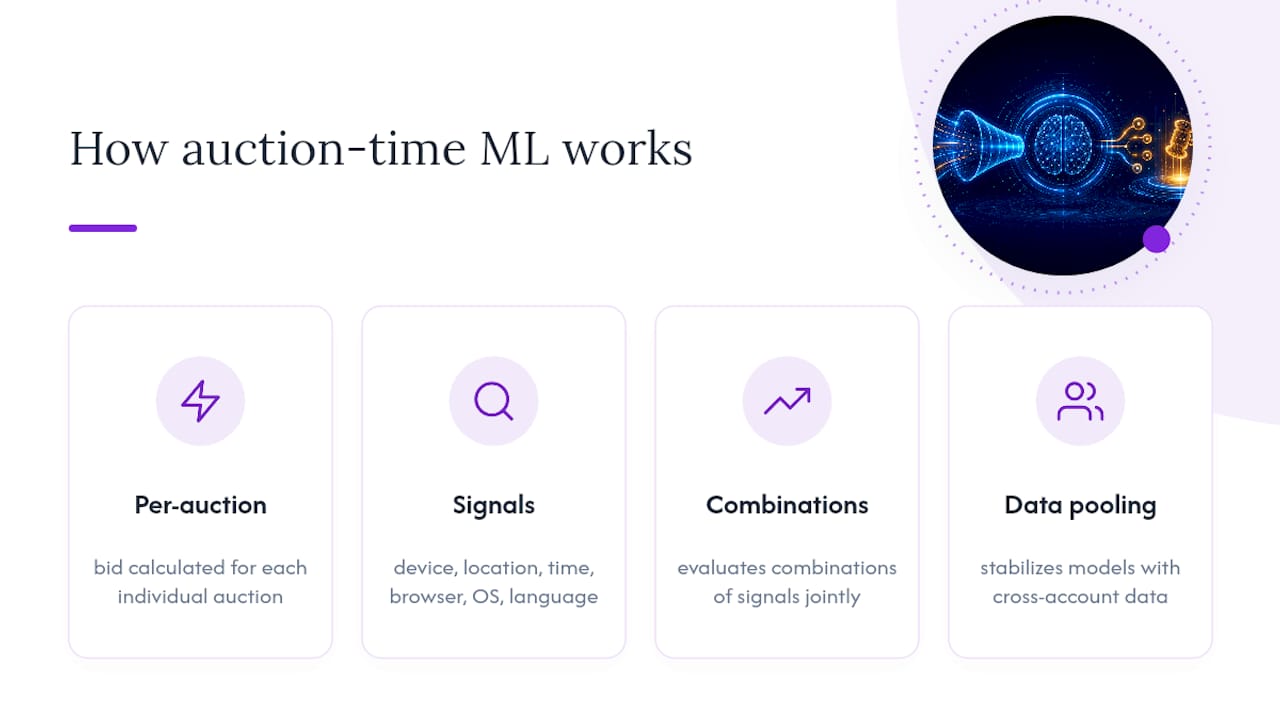
Every time your ad is eligible to show, Smart Bidding evaluates a fresh set of signals and calculates a bid specific to that exact auction, not a generic bid pulled from a table. The signals feeding that decision include device type, geographic location, time of day, browser, operating system, language, audience membership, and even which creative variant is being served. Google’s own documentation confirms Smart Bidding factors in signals like remarketing lists, operating system and browser to arrive at what it calls the optimal bid for each individual auction.
What makes this genuinely different from rule-based bid adjustments is the modelling depth. The system does not treat these signals in isolation. It evaluates combinations, so a mobile user in a specific city searching at 9pm on a particular browser gets modelled as a distinct pattern, not three separate adjustments stacked on top of each other. Query-level performance data and, where available, cross-account data help stabilise these models faster than a single low-volume account could manage alone.
Google states plainly that Smart Bidding uses machine learning to set bids at auction time, drawing on contextual signals including device, location, time of day, browser, operating system and language, a level of per-auction granularity no human bidder could replicate manually across thousands of daily auctions.
Conversion volume is the decision rule that matters most, and it is worth being specific about it. Industry guidance commonly points to roughly 30 to 50 conversions per month per campaign as the practical threshold before Smart Bidding has enough signal to learn reliably. Below that, the algorithm is essentially guessing with insufficient data, and performance tends to swing erratically rather than converge.
Manual bidding, or simpler automated strategies, remains the safer choice in several specific situations:
The sensible migration path is sequential, not a single switch. Gather at least four to six weeks of clean conversion data, pilot Smart Bidding on your highest-volume campaign first, then graduate other campaigns once you have confidence in the tracking underneath them.
Rolling out an automated PPC strategy without a sequence invites the exact volatility you are trying to avoid. Follow this order:
Pro Tip: Resist the urge to check performance daily during the first fortnight. Smart Bidding needs a stability window to build a reliable model, and reacting to day-three noise is the single most common reason pilots get abandoned prematurely.
Digital marketing institute guidance on AI in PPC advertising reinforces this: results depend on clean tracking and correct conversion values far more than on which specific strategy you select. A CRM-connected bidding approach that ties Google Ads data to actual pipeline outcomes tends to outperform accounts optimising on surface-level conversions alone.
Most Smart Bidding disappointments trace back to one of four causes, and the fix is usually diagnostic rather than dramatic.
Pro Tip: If a CRM mismatch appears, check timing before anything else. Offline conversion imports often lag by 24 to 48 hours, which can look like a tracking fault when it is simply a delay.
Smart Bidding is only as good as the data feeding it, and several integrations materially change what the algorithm can optimise towards. Enhanced conversions, server-side tagging, and offline conversion imports close the gap between what Google Ads sees and what actually happens after a click.
Conversion tracking practices that map value correctly across email and paid channels tend to compound this benefit, because the algorithm starts optimising towards genuine business value rather than a proxy metric.
Most agencies bolt Smart Bidding onto an account and hope the platform does the rest. Viaductgen’s Growth Engine treats bidding as one output of a connected system, starting with AI-Powered Intelligence to establish where your account’s true conversion signal sits, moving through a Strategic Blueprint that defines which strategy and targets fit your commercial goals, then AI-Amplified Execution to configure tracking, CRM imports, and bid strategy correctly from day one.
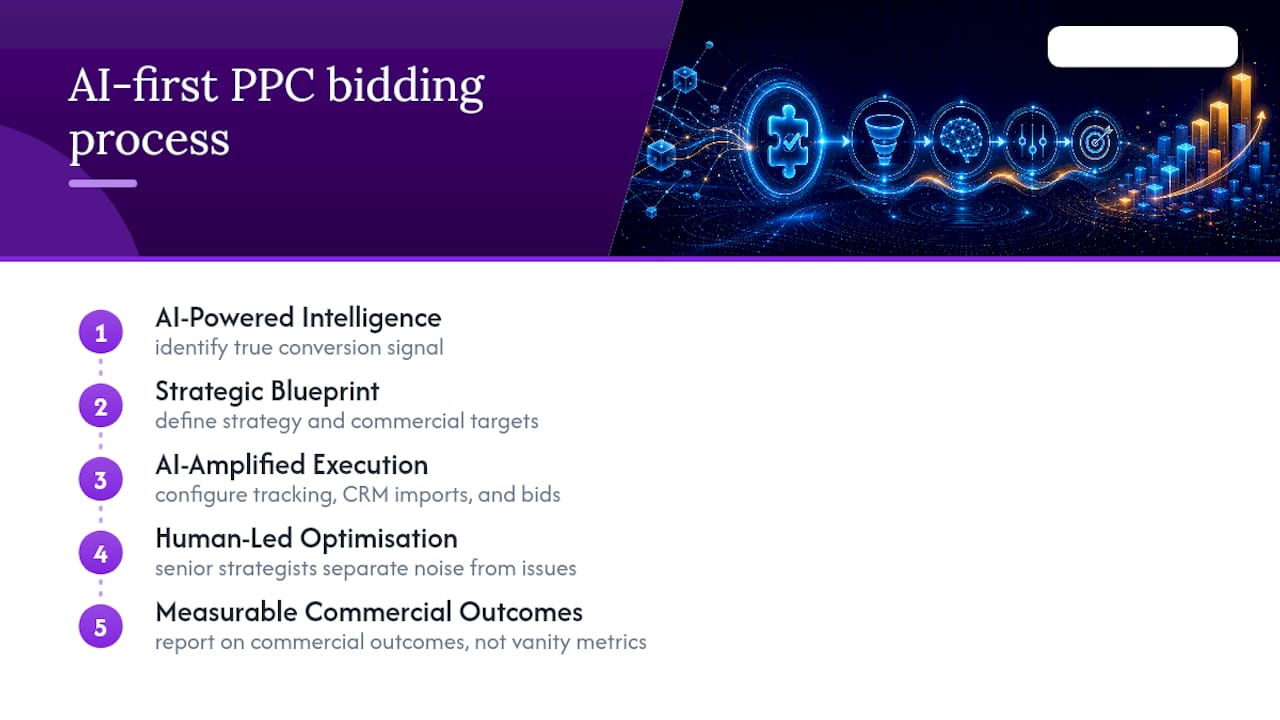
Human-Led Optimisation is where senior strategists intervene during the stability window, distinguishing genuine underperformance from expected learning-phase noise, before reporting against Measurable Commercial Outcomes rather than vanity metrics. That combination of proprietary AI infrastructure and senior judgement is what closes the gap between a Smart Bidding pilot that stalls and one that scales cleanly across an account.
If your tracking, CRM integration, or bidding setup needs a structural audit before you commit further budget to automation, explore Viaductgen’s Performance PPC service or start with a Search Growth Blueprint to map the right sequence for your account.
AI PPC bidding, or Smart Bidding, uses machine learning to set a unique bid for every auction based on contextual signals like device, location and time of day. Google describes this as auction-time optimisation rather than a fixed, manually set bid.
Most practitioners recommend roughly 30 to 50 conversions per month per campaign before Smart Bidding has enough data to learn reliably. Below that volume, manual bidding or a simpler automated strategy is usually the safer option.
Target CPA optimises for a fixed average cost per conversion, treating every conversion as equal value. Target ROAS optimises for revenue return and needs accurate conversion value data, making it better suited to accounts with variable deal sizes.
Give any new strategy or target change a stability window of several weeks without daily adjustments, since frequent changes reset the algorithm’s learning phase. Two to three consecutive weeks of consistent output is a reasonable signal before scaling further.
Yes, Viaductgen’s Performance PPC service covers tracking audits, CRM integration, bidding strategy setup and ongoing optimisation as part of its Growth Engine methodology. Pricing is available on request through the site.

