
An AI marketing operating model is the agreed design for how people, AI agents, data and approvals share marketing work, from the first request to measured results. It is not a tool stack. The teams that gain from AI are the ones that decide, task by task, what AI drafts, what a rule checks, what a person approves and how the outcome changes the next decision. Viaduct Generation builds growth systems on exactly this principle, with AI as the operating layer and senior strategists accountable for the judgement calls.
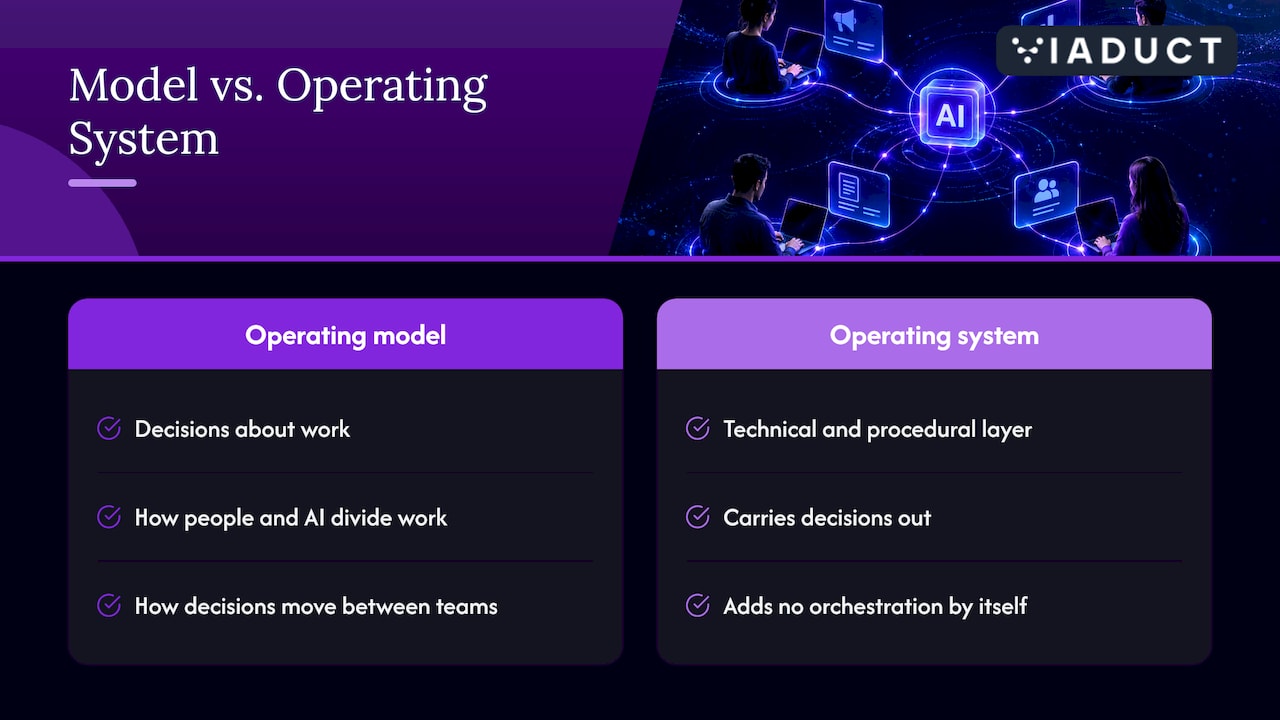
The phrase “AI marketing OS” (operating system) is now applied to very different things. Forrester’s October 2026 analysis notes that platforms for creative, customer experience, content and enterprise activation all use the label, and it warns that adding another technology layer does not solve orchestration. Marketers must also redesign how people and AI agents divide work, how decisions move between teams and how connected workflows are governed.
That is the useful definition for a mid-market or scale-up business. The operating model is the set of decisions about work. The operating system is the technical and procedural layer that carries those decisions out. If you buy the second without designing the first, you have more software and the same bottlenecks.
A practical test follows from this: trace one deliverable, such as a landing page, a paid social campaign or a supporter appeal, from request to accepted use. Every point where someone interprets an objective, chooses a source, makes a claim, approves an audience or authorises distribution is a design decision. Those points are where your model either holds or fails.
Frameworks differ in naming, but they converge. Martech.org’s seven-layer description covers workflow, data, content and assets, governance, agents, activation, and measurement and learning. Reduced to what a commercial team must have in place, the list becomes five working layers:
Martech.org’s own commentary calls orchestration the key idea: automation completes a task, whereas orchestration knows what is requested, which data and assets are needed, which brand rules apply, who must approve and how learning feeds the next decision. Cross-industry examples exist too: an AI-powered CRM platform for insurance agencies shows how prebuilt workflows tie intake, outreach, quoting and follow-up into a single flow, which is the same logic a marketing team applies from brief to deployment.
The most dependable pattern assigns AI a narrow, testable task inside a controlled sequence. Will Tisdall’s operating model for regulated UK organisations describes eight stages: trigger, approved inputs, AI task, deterministic checks, human review, final output, measurement and a review cycle. Deterministic checks protect requirements that must never vary, such as legal wording, pricing or product specifications. Human review resolves ambiguity and owns the decision. Output is released through the normal channel, never directly from the model.
In practice, we divide work along three lines:
A senior person must remain accountable for every external release. We set out why in our piece on why human sign-off is non-negotiable in AI production, and our wider position is on the page describing how we use AI in client work.
One further design rule matters: state what happens when the responsible approver is unavailable. The work can wait, return to a manual queue or be declined. It should never proceed on an invented approval.
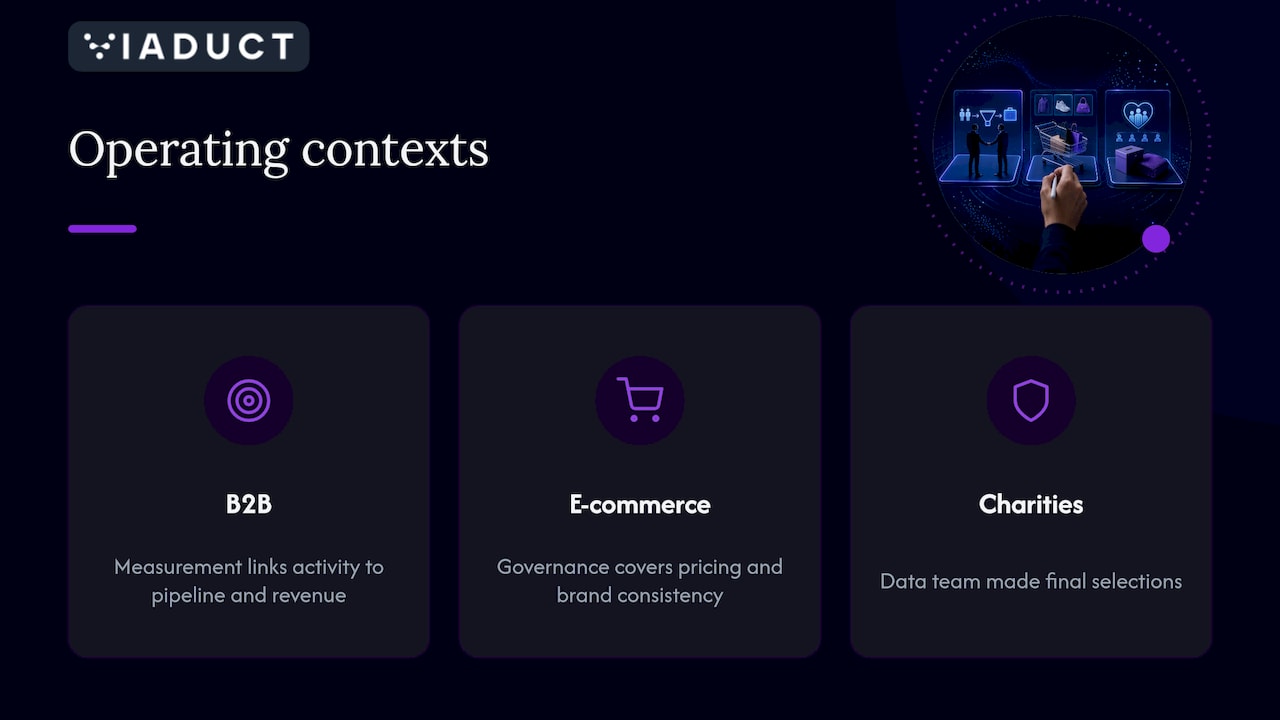
The layers are constant, but the emphasis shifts with the commercial model.
B2B businesses. Sales cycles are long and buying committees are large, so the foundation layer carries most weight: precise ideal customer profiles, a library of buyer objections and agreed claims. Measurement must connect search, paid and brand activity to pipeline and revenue, not to leads alone. Our view of AI-native marketing for leadership teams covers this in more depth.
E-commerce businesses. Volume and speed dominate. Memory and measurement layers pay back quickly because there are many tests: product feeds, creative variants, email flows and on-site conversion experiments. Governance concentrates on pricing, promotional claims and brand consistency across thousands of assets. Behavioural email is a clear example, as covered in our note on AI segmentation replacing batch-and-blast email.
Charities. Trust and data protection come first. The Parkinson’s UK case, reported by Civil Society, shows the right division of labour: machine-learning supporter predictions helped lift a September 2020 cash appeal by over £15,000 while the list and costs shrank, yet the in-house data team still made the final selections. The charity also built its own ChatGPT-style tool on Microsoft Azure OpenAI to keep sensitive information inside its own system. For charity boards, the lesson is that AI use in communications should be visible to trustees and recorded in governance decisions.
For any UK organisation, the governance layer must reflect data protection law, not just brand rules. A charity privacy policy published by Sherwood Forest Hospitals Charity in October 2026 gives a clear working example of the standards a UK charity applies:
Build these as gates in the workflow itself: a data-classification check before any prompt, a named owner for lawful basis, and a disclosure rule for AI-assisted content. If your marketing involves personal data in a regulated context, your data protection officer or legal adviser should sign off the design.
Time saved is not growth. Gartner’s agentic AI operating-model playbook, Time Saved Is Not Growth, argues that agentic systems should be judged on outcome-focused metrics rather than output-focused ones, and that a growth and learning system should continuously measure and adapt to real-time signals.
For a commercial team, that means two tiers of measurement:
The review stage closes the loop. Each cycle asks whether the workflow, source material, model or control needs to change, so that the method becomes a durable capability rather than a one-off document.
Resist the temptation to automate everything at once. A sequence that works:
The discipline is to treat AI as one option among several. Sometimes a deterministic automation or a manual judgement is the better answer for a given task, and the model should say so explicitly.
Viaduct Generation is an AI-native growth partner for mid-market and scale-up B2B businesses, e-commerce companies and charities. We deliver through fixed-scope 90-day sprints with defined deliverables and commercial targets, with senior strategists involved throughout and proprietary AI infrastructure doing the research, monitoring and production work. The model connects search (SEO, AEO and GEO), paid media, conversion optimisation, email, branding and web development in one system, described on our Growth Engine page. If you want to see which services your first sprint could draw on, start with our full services overview, or explore the Viaduct Generation homepage.
The operating model is the design: who or what does each task, who decides, on what evidence, and how results feed back. The OS is the connected technical layer that runs that design, covering data, agents, workflows and governance. A tool without a model usually adds activity but not outcomes.
They need the same logic at a lighter depth. Start with one workflow, one named approver and one measure of commercial outcome. Add layers as exposure and volume grow, aiming for reliable accountability rather than heavy documentation.
External publication, claims about products or results, audience approval, budget allocation and any use of personal data in decisions about individuals. AI can inform each of these, but a named person with the right authority should own the decision.
That depends on the starting point and the workflow chosen. A bounded first workflow measured against a manual baseline gives an early read, and our engagements are structured in 90-day sprints with commercial targets agreed at the outset.

