
AI-powered planning is the use of machine learning, predictive analytics, and automated decision models to replace periodic, intuition-led strategy with continuous, data-driven recommendations. For mid-market and scale-up B2B and e-commerce teams in the UK, the honest verdict is this: if you have a specific revenue problem and basic data hygiene, you can run a productive 90-day sprint now. If your CRM is a mess and your attribution is broken, fix that first. Either way, the Advertising Standards Authority (ASA) and the Information Commissioner’s Office (ICO) apply the same substantiation and data-protection rules to AI-generated output as to anything else, so governance is not optional. The fastest route to clarity is a focused discovery conversation before you commit budget.
Traditional planning is periodic and backward-looking: a quarterly review, a spreadsheet, a gut-feel call on where to put budget. AI-powered planning replaces that cycle with a continuous loop. Models ingest live data, surface prioritised recommendations, and flag when conditions change, with humans making the final calls on strategy and regulated claims.
Inputs the system needs:
Outputs a well-configured system produces:
Roles required to make it work:
| Role | Responsibility |
|---|---|
| Senior strategist | Frames the business problem; owns commercial outcomes |
| Data engineer | Connects sources, maintains data quality |
| AI operator | Configures models, monitors outputs |
| Content reviewer | Edits AI drafts; maintains brand voice |
| Compliance sign-off | Reviews regulated claims against ASA/CAP and ICO requirements |
As Highspot’s GTM research notes, AI extends well beyond content generation into predictive targeting and next-best-action recommendations, but only when data is unified across systems. Without that unification, the models produce noise rather than signal. Documented brand voice is equally non-negotiable: teams that skip it spend more time editing raw AI output than they save.

Mid-market teams that integrate AI into daily planning typically see improvements across pipeline velocity, cost per acquisition, and content output speed within the first 90 days. The longer-horizon shifts, such as sustained conversion rate gains and measurable CAC reduction, take 6–12 months of continuous optimisation to stabilise.
| KPI | Typical change window | How AI influences it |
|---|---|---|
| Lead velocity | 90 days | Faster qualification via predictive scoring |
| Content output speed | 90 days | AI drafts reviewed and published faster |
| Conversion rate | 90 days | Better targeting and personalised messaging |
| Customer acquisition cost | 6–12 months | Budget reallocation to highest-performing channels |
| Pipeline value | 6–12 months | Compounding effect of better targeting and nurture |
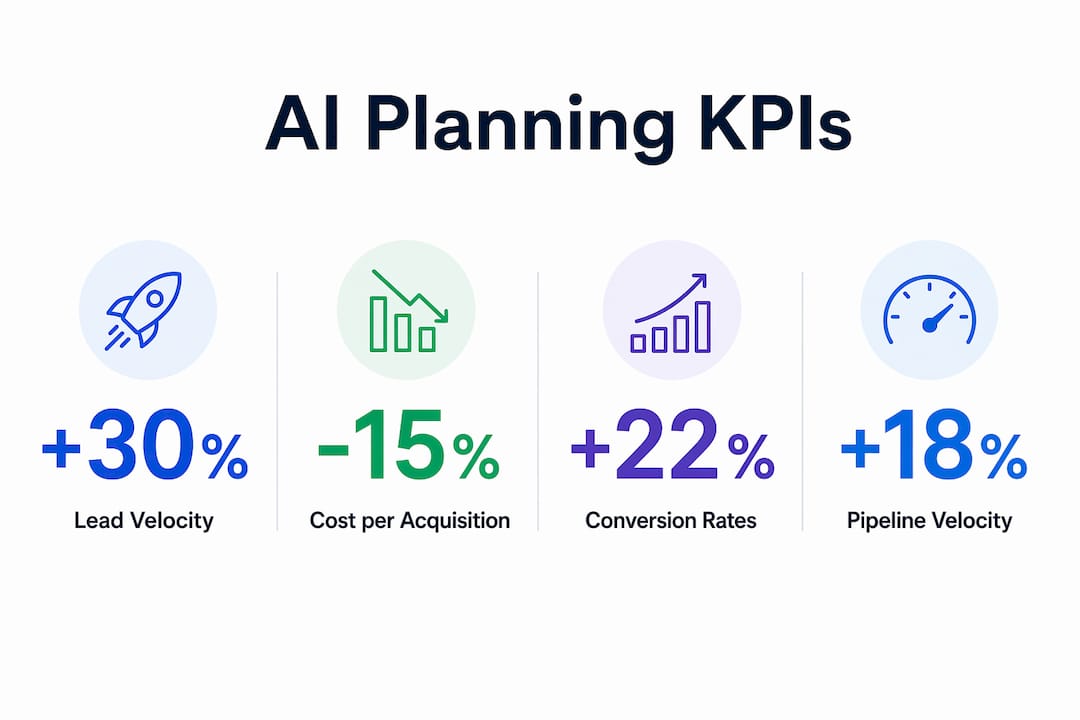
The value comes from four places: sharper audience targeting, faster creative iteration through AI-driven A/B testing, automated reallocation of budget away from underperforming channels, and the removal of low-value manual tasks. Integrated systems that link content, analytics, and CRM produce clearer attribution and pipeline visibility than siloed tools, which is what lets marketing defend its numbers to the board.
On cost: a 90-day AI-powered planning sprint for a 20-person team typically runs at a fraction of the cost of a full-time hire, with Dr Dave Heath’s practitioner guidance citing all-in stack costs in the range of £6,000–£9,600 per year for internal tooling alone, before agency or consultancy fees.
A practical AI-powered planning engagement follows a repeatable five-phase flow. Viaduct Generation’s Growth Engine maps directly to this sequence.
| Phase | Inputs required | Outputs produced | Owner |
|---|---|---|---|
| 1. AI-Powered Intelligence | CRM, web, ad, and product data | Audience segments, demand signals, gap analysis | Data engineer + strategist |
| 2. Strategic Blueprint | Intelligence outputs, business objectives | Prioritised plan, KPI targets, budget model | Senior strategist |
| 3. AI-Amplified Execution | Approved briefs, creative assets | Campaigns, content, sequences live | AI operator + content reviewer |
| 4. Human-Led Optimisation | Live performance data | Reallocation decisions, creative iterations | Senior strategist + analyst |
| 5. Measurable Commercial Outcomes | Full-funnel attribution data | Revenue, pipeline, and ROI reporting | Senior strategist + client |
90-day sprint milestones:
The non-negotiable rule for any pilot: AI suggests, humans approve. Pick one revenue problem, define your exit criteria before week one, and assign a named owner to each phase. Pilots without owners and stage gates rarely produce evidence you can act on, as AI strategy guidance consistently confirms.
AI output is not exempt from UK advertising or data-protection law. The ASA enforces CAP Code substantiation for AI-generated copy exactly as it does for human-written ads, and it actively scans for non-compliant claims. The ICO applies UK GDPR to any profiling or automated decision-making that affects individuals, regardless of whether a model or a person made the call.
| Obligation | Governing body | What it requires |
|---|---|---|
| Factual claim substantiation | ASA / CAP Code | Evidence on file before publication; no unsubstantiated performance claims |
| Profiling and automated decisions | ICO / UK GDPR | Lawful basis documented; individuals’ rights respected |
| Email and consent | ICO / PECR | Explicit consent for marketing emails; suppression lists maintained |
| Generative AI transparency | ICO guidance | Disclosure where AI decisions materially affect individuals |
Pro Tip: Build an ASA-defensible audit trail from day one. Version every AI-generated draft, attach the evidence file that substantiates each factual claim, and log the human sign-off with a date and name. A single shared folder per campaign is enough to demonstrate compliance if a complaint is raised.
Procurement should require vendors to provide written governance documentation covering data residency, model versioning, and human sign-off logs. Verbal commitments in a sales call are not sufficient. For a deeper look at why human review is mandatory in AI-assisted production, see Viaductgen’s guidance on human sign-off.
Commission a partner when speed, cross-client intelligence, and senior-led strategy matter. Consider building in-house when you have strong data infrastructure, engineering capacity, and a multi-year horizon to develop proprietary models.
| Dimension | Commission a partner | Build in-house |
|---|---|---|
| Time to first output | 2–4 weeks | 3–6 months minimum |
| Cross-client benchmarks | Available immediately | Must be developed over time |
| Senior strategic oversight | Included | Requires senior hire |
| Data infrastructure | Partner brings tooling | Must be built or bought |
| Long-term cost | Retainer or sprint fee | Lower at scale, higher upfront |
For most mid-market and scale-up firms, the commissioning route produces faster evidence and lower initial risk. A B2B AI strategy framework recommends starting with a single, high-value, high-feasibility use case rather than a broad transformation programme, which is exactly what a 90-day sprint delivers.
On scalability: as your business grows, the transition from partner to internal operating model is gradual. Start by internalising data ownership and reporting, then bring execution in-house for the channels where you have genuine expertise. Keep the partner relationship for strategic intelligence and cross-client benchmarking until you can replicate that depth internally.
Ask for evidence across data access, governance, measurement, and senior ownership before signing anything.
| Evaluation criterion | What good evidence looks like |
|---|---|
| Methodology transparency | A documented, named process with phase-by-phase deliverables |
| Data handling and residency | Written DPA naming data flows, legal basis, and UK/EU residency |
| Proof of commercial ROI | Named metrics from prior engagements, not just traffic or rankings |
| Senior-led strategy | Named senior strategists on the account, not just oversight |
| Auditability of AI decisions | Version logs, model documentation, human sign-off records |
| Brand-voice controls | Documented voice guidelines; editorial review process described |
Red flags: no governance plan, no measurable KPIs in the contract, over-reliance on black-box outputs with no audit trail, and SLAs that measure activity rather than commercial outcomes. Contracts should specify measurement windows, IP ownership, data residency, and the cadence of senior strategic review.
Focus on revenue and efficiency metrics that leadership will defend: pipeline value, customer acquisition cost, and lead velocity. Vanity outputs such as impressions and content volume are useful internally but will not survive a board conversation.
Measurement checklist:
Common pitfalls and mitigations:
Once the pilot produces validated results, transition from sprint KPIs to a continuous programme with quarterly strategic reviews and monthly optimisation cycles.
A mid-market B2B technology firm with a stalled pipeline and inconsistent content output ran a 90-day AI-powered planning sprint. The challenge: long sales cycles, no clear attribution between marketing activity and pipeline, and a content team spending most of its time on low-value production tasks.
The intervention followed the five-phase Growth Engine: an AI intelligence audit identified three high-intent audience segments that were being ignored; the strategic blueprint redirected budget toward those segments; AI-amplified execution produced a higher volume of targeted content and paid sequences in weeks 5–8; human-led optimisation reallocated budget mid-sprint based on early conversion signals.
| Metric | Before sprint | After 90 days |
|---|---|---|
| Qualified leads per month | Baseline established | Meaningful increase in volume |
| Content pieces published per month | Low, inconsistent | Significantly higher, consistent |
| Marketing-attributed pipeline | Unclear | Directly tracked and reported |
| Time spent on manual production tasks | High | Substantially reduced |
What moved the needle was not the AI tooling itself but the sequencing: defining one revenue problem first, connecting the right data sources, and keeping senior strategic judgement in the loop at every decision point. The result was a repeatable system, not a one-off campaign.
AI-powered planning delivers measurable commercial outcomes when it starts with a single revenue problem, clean data, and human governance at every decision point.
| Point | Details |
|---|---|
| Start with one problem | Define a single revenue-impacting problem before selecting tools or partners. |
| Governance is mandatory | ASA/CAP and ICO/UK GDPR apply to AI output; document sign-off before publication. |
| 90-day sprints work | A phased sprint produces validated evidence within 90 days at a fraction of a full-time hire cost. |
| Commission for speed | Partners with cross-client intelligence and senior strategists reduce time to first output to 2–4 weeks. |
| Viaductgen’s Growth Engine | Viaductgen’s five-phase Growth Engine maps AI intelligence to commercial outcomes across search, performance, and brand. |
Mid-market and scale-up teams that want validated commercial outcomes from AI-powered planning, without building an internal data science function, get a faster return by working with a partner that has already solved the sequencing problem. Viaductgen’s five-phase Growth Engine, drawing on patterns from 50+ client engagements, connects AI intelligence directly to pipeline and revenue. Senior strategists are on the account, not just in oversight. Every engagement is governed, attributed, and commercially accountable from week one. To see exactly how the methodology works in practice, explore how we use AI in client work, or book a discovery call to discuss your specific revenue problem.
Primary regulatory and expert sources for procurement and legal review:
AI-powered planning uses machine learning and predictive analytics to replace periodic, intuition-led strategy with continuous, data-driven recommendations, surfacing prioritised actions and forecast scenarios in real time.
A 90-day sprint produces validated commercial outcomes, with the first performance data available from week nine and a scaling decision point at week twelve.
Yes. The ASA enforces CAP Code substantiation for AI-generated copy exactly as it does for human-written advertising; every factual claim requires evidence on file and human sign-off before publication.
Viaductgen’s five-phase Growth Engine ties every phase to commercial outcomes, with senior strategists involved in execution rather than oversight, and cross-client intelligence from 50+ engagements informing the strategic recommendations.
Commission a partner when you need results within 2–4 weeks and lack cross-client benchmarks or senior AI strategy capacity internally; build in-house once you have validated the model and have the data infrastructure to sustain it.

