
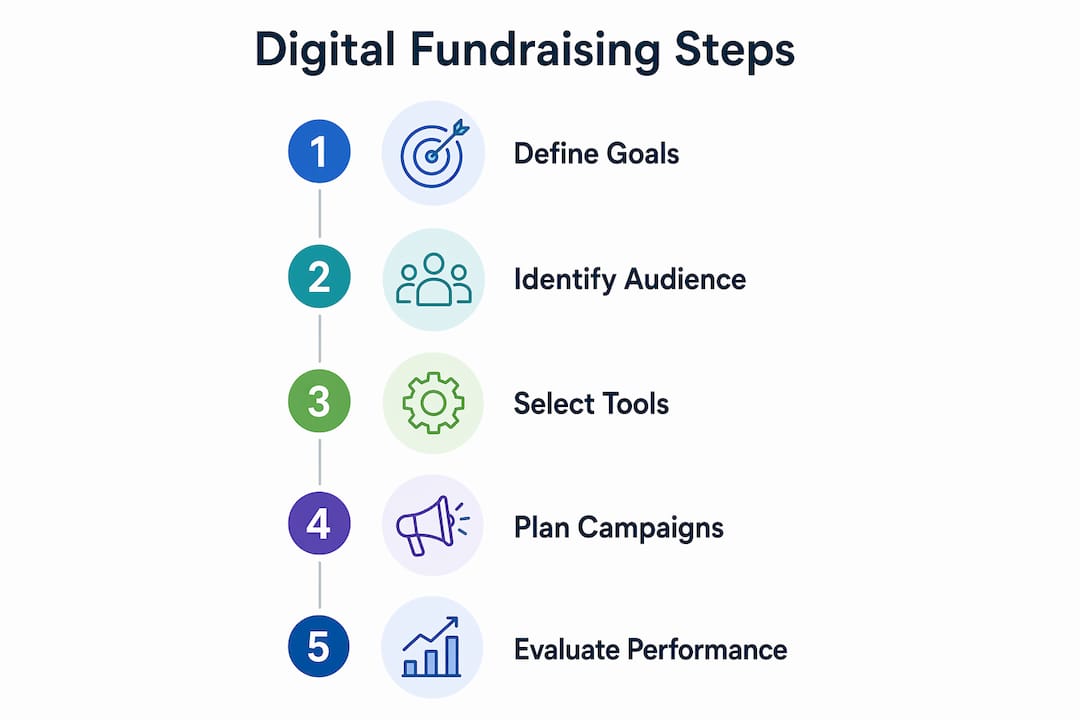
Effective digital fundraising follows a clear sequence, and skipping any phase is the leading cause of failure for UK nonprofits. The process runs in this order: review past performance, define objectives, identify your audience, select tools and channels, execute campaigns, and measure results rigorously. Before you ask anyone for money, you need a permission-based list of people who have opted in to hear from you. After someone gives, your job is to thank them repeatedly and make the next gift as frictionless as possible.
The metrics that genuinely move the needle are donor retention rate, cost per acquisition, average gift value, and recurring revenue share. Vanity metrics like social media impressions tell you almost nothing about whether your fundraising is working.
Here is the full sequence at a glance:
Start with your data, not your ambitions. Pull your last 12–24 months of campaign reports, email open rates, donation page conversion figures, and donor retention numbers. If your CRM is incomplete or inconsistently updated, fix that before you set a single target, because data integrity is the foundation everything else rests on.
SMART goals give your team a shared definition of success. A weak goal sounds like “raise more money this year.” A SMART version looks like “acquire 200 new online donors giving a minimum of £25 each by 31 March 2026, through a paid social campaign targeting 35–55-year-olds in London.” The difference is that the second version tells you exactly when you have succeeded and exactly what to measure. NCVO’s fundraising strategy guidance recommends defining your income model first, whether that is one-off gifts, recurring giving, event-based income, or a blend, before you set channel-level targets.
Assess your external environment too. The Charity Commission’s annual statistics, the Charities Aid Foundation’s UK Giving report, and sector benchmarks from bodies like the Institute of Fundraising all give you a realistic picture of what comparable organisations are achieving. If the sector average retention rate is around 45%, and your organisation is sitting at 30%, that gap is your first priority, not a new acquisition campaign.
Common pitfalls when setting objectives:
Pro Tip: The Fundraising Regulator’s Code of Fundraising Practice sets the compliance baseline for UK nonprofits. Cross-check your objectives against it before you finalise your plan, particularly if you are planning to use paid advertising or direct messaging.
Your permission-based email list is your most valuable digital asset, full stop. Social media reach is rented; your email list is owned. Build it deliberately by offering genuine value in exchange for an opt-in: a free resource, an impact report, an event invitation. Every contact on that list should have explicitly consented to hear from you, which is both a legal requirement under UK GDPR and a practical filter for engaged supporters.

Segmentation turns a list into a fundraising engine. Split your contacts by giving history (lapsed, active, major donor), channel preference (email, SMS, social), demographic profile, and engagement level (opened last three emails vs. not opened in six months). Donor personas help here. A persona is not a demographic spreadsheet; it is a narrative description of a real supporter type, including their motivations, objections, and preferred communication style. Most organisations need three to five personas to cover their donor base meaningfully.
Choosing tools comes after you have defined your model and audience, not before. The categories you need to fill are:
| Tool category | Primary function | Key selection criteria |
|---|---|---|
| CRM | Donor records and segmentation | Integration with giving platform, data export |
| Giving platform | Donation processing | Fee structure, Gift Aid automation, branding |
| Email marketing | Donor communication | Segmentation depth, automation triggers |
| Analytics | Campaign performance tracking | Event tracking, CRM data connection |
| Peer-to-peer platform | Community fundraising | Social sharing tools, campaign page builder |
Evaluate channels by asking where your personas spend time and where you have existing permission to communicate. Email consistently outperforms social media for direct donation conversion. Paid social on Meta platforms works well for acquisition when your targeting is tight. Search advertising via the Google Ad Grants programme gives eligible UK charities up to $10,000 (approximately £8,000) per month in free Google Ads spend, which is worth applying for early in your planning cycle.
Campaign planning works backwards from your goal. If your target is 150 new recurring donors by the end of June, you need to know your current email-to-donation conversion rate, your list size, and your average cost per new donor acquisition. Those three numbers tell you whether your target is achievable with your current resources or whether you need to grow your list first.

Seasonal moments drive a significant share of online giving in the UK. The period from late November through to the end of December, including Giving Tuesday and the Christmas appeal window, typically generates the highest donation volumes. Plan your campaign calendar around these peaks, but do not ignore the quieter months: a well-timed spring campaign targeting lapsed donors can recover significant income at a fraction of the acquisition cost.
Your campaign page needs to work as a story, not a form. A clear headline that states the impact, a short video or strong photography, specific donation tiers with named outcomes (£25 feeds a family for a week), a progress bar, and a brief explanation of how donations are used all contribute to conversion. Research on campaign page design consistently shows that donor transparency, showing exactly where money goes, builds the trust that turns a browser into a giver.
Pro Tip: Balance your recurring and one-off giving campaigns deliberately. Recurring donors have a significantly higher lifetime value, but one-off campaigns generate faster cash flow. A good rule of thumb is to include a recurring giving option on every campaign page, even when the campaign itself is framed as a one-off appeal.
Key elements every digital campaign page should include:
An editorial calendar keeps your messaging consistent across channels. Map out every email, social post, and paid ad for the campaign period before you launch. Gaps in communication mid-campaign are one of the most common reasons momentum stalls.
The metrics that matter most are donor retention rate, cost per acquisition, donor lifetime value, and recurring revenue share. Sector data puts the average donor retention rate at approximately 45%, with the strongest organisations reaching 60–70%. If your retention is below 45%, improving it will almost always generate more income than launching a new acquisition campaign.
Retention benchmark: The sector average donor retention rate sits at approximately 45%. Organisations hitting 60–70% typically have structured stewardship programmes, not just better campaigns.
Vanity metrics are the enemy of good fundraising decisions. Page views, social media followers, and email open rates are useful context, but they do not tell you whether your fundraising is working. An email with a 40% open rate that generates zero donations is a failure. An email with a 12% open rate that generates £8,000 in gifts is a success. Always trace the metric back to income or donor behaviour.
Build a regular review rhythm into your calendar: a weekly check on live campaign performance, a monthly review of pipeline and retention, and a quarterly strategic review where you assess whether your goals still reflect your organisation’s priorities. Each review should generate a hypothesis: “We think donor retention is low because our post-gift communication is too infrequent. We will test a three-email thank-you sequence and measure 90-day retention against our baseline.”
Common evaluation pitfalls:
The most common reason digital fundraising fails is not a bad campaign. It is launching a campaign before the relationship infrastructure exists to support it. Donors rarely give the first time they encounter an organisation. Building that relationship takes time, which means your digital fundraising programme needs a nurture phase before a solicitation phase. Do not skip it because it feels slow.
Post-donation stewardship is where retention is won or lost. Thanking a donor once, in the automated receipt email, is the floor, not the ceiling. A structured thank-you sequence, spread across the days and weeks following a gift, transforms a transactional moment into the beginning of a relationship. The sequence might include an immediate automated receipt, a personal email from a senior staff member two days later, an impact update at the 30-day mark, and an invitation to a supporter event at 90 days.
Stewardship matters: Organisations that build structured, multi-touch thank-you programmes consistently outperform those relying on a single automated receipt, particularly on 12-month retention rates.
Small organisations do not need a full website to fundraise digitally. A hosted giving page linked from social media profiles and a WhatsApp group is enough to start. Build complexity as your income and team capacity grow.
AI-driven segmentation is changing how mature fundraising programmes operate. Rather than sending the same appeal to your entire list, AI tools can predict which donors are most likely to upgrade their gift, which are at risk of lapsing, and what ask amount is most likely to convert for each individual. The underlying principles of AI-driven personalisation apply directly to fundraising email, moving programmes away from batch-and-blast towards genuinely individual communication. This shift in AI-driven marketing strategy is already reshaping how forward-thinking nonprofits plan their donor communications.
Crowdfunding and peer-to-peer fundraising work best for discrete, compelling campaigns with a clear deadline and a specific target. They are poor vehicles for general operating income because they rely on social momentum that is hard to sustain. Reserve them for capital projects, emergency appeals, or anniversary campaigns where the story is inherently shareable.
Unique tactics worth building into your programme:
Pro Tip: Blending digital and offline fundraising consistently outperforms either channel alone. A direct mail piece that drives recipients to a personalised donation URL, or a telephone thank-you call that references a donor’s online giving history, creates a joined-up experience that strengthens retention on both sides.
UK GDPR and the Data Protection Act 2018 govern how nonprofits collect, store, and use donor data. The practical implications for digital fundraising are significant. You need a lawful basis for every piece of personal data you hold and every communication you send. For fundraising communications, that basis is almost always explicit consent, meaning the person actively opted in, or legitimate interests, which requires a documented balancing test showing that your interest in communicating does not override the individual’s right to privacy.
The Privacy and Electronic Communications Regulations (PECR) layer on top of UK GDPR for electronic marketing, including email and SMS. Under PECR, you need prior consent to send marketing messages to individuals, with a narrow exception for existing donors who gave recently and were given a clear opportunity to opt out at the time. The Information Commissioner’s Office (ICO) publishes detailed guidance for charities, and the Fundraising Regulator’s Code of Fundraising Practice sets additional sector-specific standards.
Practically, this means your donation forms must include a clear, unbundled consent tick-box for marketing communications, separate from the Gift Aid declaration. Your CRM must record the date, method, and wording of each consent. Donors must be able to withdraw consent easily at any time, and you must act on withdrawal requests promptly. Data minimisation applies too: collect only what you genuinely need to manage the donor relationship, and do not retain data longer than necessary.
A data audit before you launch any new digital fundraising programme is time well spent. Map what data you hold, where it came from, what you use it for, and how long you keep it. Gaps in that map are compliance risks and, more practically, signs that your CRM is not fit for purpose.
Email remains the highest-converting channel for direct donation appeals among UK nonprofits. The key variables are list quality, subject line, send timing, and the clarity of the ask. A clean, segmented list of opted-in supporters will consistently outperform a large, poorly maintained one. Subject lines that create genuine curiosity or urgency, without resorting to clickbait, lift open rates. The ask itself should be specific: “Will you give £30 today to help us reach our target?” converts better than “Please donate if you can.”
Automation makes stewardship manageable at scale. A welcome sequence for new subscribers, a lapsed donor re-engagement sequence, and a post-donation thank-you sequence can all run without manual intervention once they are built. The content strategy for these sequences should reflect where the donor is in their relationship with your organisation, not just where you are in your campaign calendar. For a deeper look at building content for nonprofits, the principles of editorial planning apply directly to fundraising email.
Social media works differently. It builds awareness and social proof rather than converting directly. The most effective approach treats social platforms as the top of a funnel that leads to your email list or donation page, not as the place where giving happens. Organic content that shows real impact, real people, and real stories performs better than polished graphics with donation links. Paid social on Meta platforms allows you to target by interest, location, and lookalike audiences built from your existing donor list, which is particularly useful for acquisition campaigns.
A few practices that consistently improve results across both channels:
Improving your donation page’s search visibility compounds the effect of every other channel. SEO for charities is often overlooked in fundraising plans, but organic search traffic from people actively looking to support a cause like yours is among the highest-intent traffic you can attract.
A structured, sequential approach to digital fundraising, built on clean data, permission-based communication, and rigorous measurement, consistently outperforms ad hoc campaign activity for UK nonprofits.
| Point | Details |
|---|---|
| Sequence adherence | Skipping foundational steps like list-building and audience segmentation is the leading cause of wasted spend. |
| Retention benchmark | Sector average donor retention sits at approximately 45%; top organisations reach 60–70% through structured stewardship. |
| SMART goal setting | Every target needs a specific number, a deadline, and a named owner before a campaign launches. |
| Post-donation stewardship | A multi-touch thank-you sequence, not a single automated receipt, is what converts a one-off gift into a long-term relationship. |
| UK GDPR compliance | Every marketing communication requires a documented lawful basis; consent records must be stored in your CRM with date and wording. |

