
A commercial-first mindset anchors every growth activity to a financial outcome: pipeline, CAC, LTV, and profitability rather than traffic, impressions, or engagement. The single next step is to audit your current baseline metrics and name one executive who is accountable for them. Everything else in this article, the implementation sequence, governance model, and board reporting cadence, flows from that one decision.
The gap is stark. According to the 2026 aibl survey of 755 UK mid-market leaders, 82.5% of companies have a board mandate to invest in AI, but only 54% of C-suite leaders can prove measurable return on investment (ROI), revealing a significant gap where commercial-first thinking lives.
The UK market has moved past “what is AI?” The question now is “how do we scale it without burning budget on initiatives nobody can justify at board level?” That shift is the UK AI adoption tipping point: companies that audit usage, select high-value workflows, and move from experimentation to integration are pulling ahead. Those that cannot prove ROI are losing board confidence and, with it, budget.
The competitive arithmetic is unforgiving. Google research cited in the UK context suggests AI could lift productivity once systematised across teams. If your competitors capture that gain and you cannot measure yours, the gap compounds every quarter.
Advertising Week frames it plainly: AI should be an enabling tool, not the strategy itself. Treating AI as the north star distracts teams from the actual job, which is generating revenue. A commercial-first culture keeps the north star where it belongs: on the financial outcome.
Key market signals for UK mid-market leaders:
Marketing that reports in CFO language — pipeline, CAC, LTV, LTV:CAC ratio — shifts from cost centre to growth engine. That is the structural shift at the heart of commercial-first thinking. It is not a campaign philosophy; it is an operating model with five components.

Measurement architecture. Define the financial metric before any campaign or AI tool goes live. No baseline, no proof.
Named ownership. One executive holds accountability. A committee is not a substitute. Named executive ownership strongly correlates with measurable ROI: in the aibl data, only 54% of C-suite leaders can prove measurable ROI.
Cross-functional workflows. Marketing acts as connective tissue across product, sales, finance, and customer success. Siloed channel teams cannot produce a coherent commercial story.
Governance cadence. Weekly operational reviews, monthly leadership check-ins, quarterly board reporting. Each cadence serves a different audience and a different level of decision.
CFO-facing metrics. Every marketing output maps to a number the finance team already tracks.
Pro Tip: To translate marketing outputs into CFO language quickly, build a single conversion chain: Spend → Leads → Qualified Pipeline → Closed Revenue → CAC. One chain, one slide, one conversation. Pair it with scalable lead generation thinking to keep the top of that chain healthy.
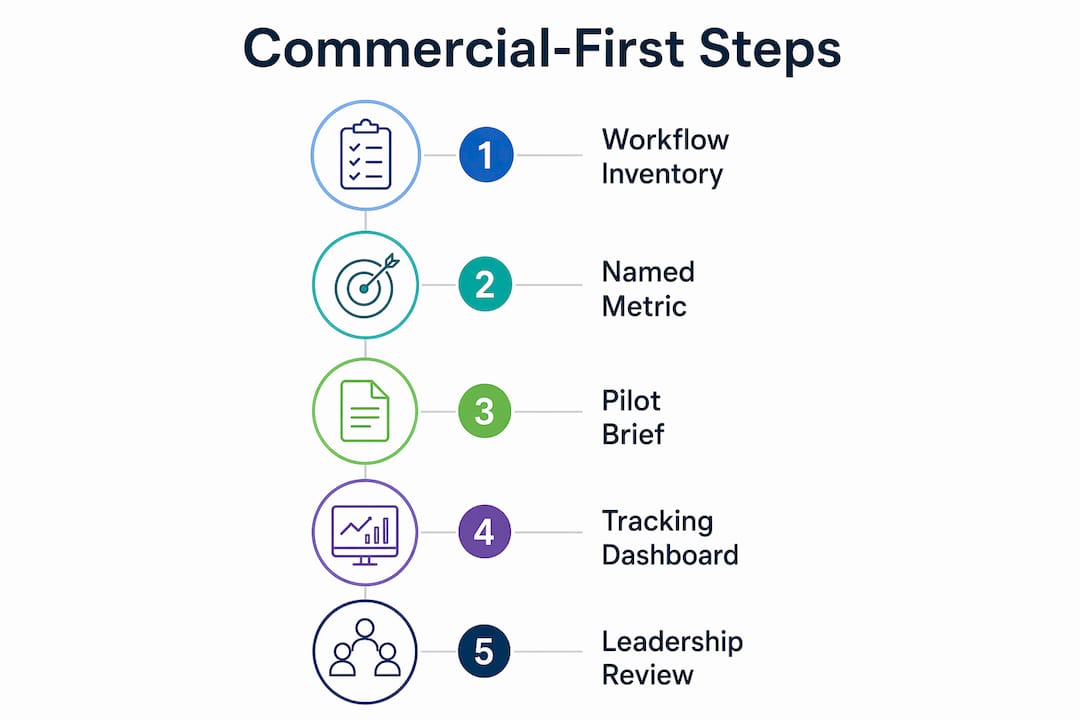
The sequence is: Audit → Define metric → Pilot → Measure → Scale. Run it in order. Skipping steps is where most AI initiatives stall.
Deliverables per step: a workflow inventory, a named metric with baseline, a pilot brief, a weekly tracking dashboard, and a quarterly board narrative.
Commercial ownership sits with the CEO, COO, or a named executive. Full stop. A working group with no single accountable leader produces reports, not results.
Immediate (0–3 months):
Medium-term (3–12 months):
At the £2m–£5m revenue inflection, fractional senior directors in finance, commercial, or operations are a practical way to close capability gaps without the cost of a full-time hire. Sequence their engagement: bring in the fractional CFO or Commercial Director first to set the measurement architecture, then layer in operational support. Proper prospect segmentation at this stage also sharpens which channels deserve resource and which do not.
Show pipeline-to-revenue, CAC, LTV, and ROI. Nothing else belongs in a board-level commercial dashboard unless it connects directly to one of those four numbers.
| Metric | Owner | Baseline | Frequency | Board narrative |
|---|---|---|---|---|
| Pipeline generated | Marketing lead | Set in audit | Weekly / Monthly | “We generated £X pipeline this quarter against a £Y target.” |
| Customer acquisition cost | Finance liaison | Set in audit | Monthly / Quarterly | “CAC is £X, down/up from baseline of £Y.” |
| LTV:CAC ratio | Finance liaison | Set in audit | Quarterly | “Each £1 of acquisition spend returns £X over customer lifetime.” |
| Revenue attributed to AI channels | Marketing + Finance | Set in pilot | Monthly / Quarterly | “AI-assisted channels contributed £X to closed revenue.” |
| ROI on AI investment | CFO / Executive owner | Set in audit | Quarterly | “Total AI spend of £X generated £Y in attributable revenue.” |
Cadence matters as much as the metrics. Weekly reviews catch operational problems early. Monthly leadership reviews assess whether pilots are on track. Quarterly board sessions are where the commercial story is told, with numbers that connect spend to revenue. Viaductgen’s revenue attribution approach is built around exactly this sequencing.
Canvvs came to Viaduct Generation needing to convert marketing activity into demonstrable commercial outcomes. The first move was measurement-first: before any new channel went live, Viaductgen established baseline metrics and named the KPIs that would define success.
The five-phase Growth Engine then ran in sequence: AI-Powered Intelligence surfaced the highest-value audience segments and content gaps; the Strategic Blueprint defined the channel mix and commercial targets; AI-Amplified Execution produced content and campaign assets at scale; Human-Led Optimisation reviewed every output before publication; and Measurable Commercial Outcomes closed the loop with board-ready attribution reporting.
The Canvvs engagement demonstrates the core principle: the technology is not the hard part. Governance, sequencing, and measurement architecture are.
Score one point for each “yes.” Ten is full readiness; seven or above means you can begin scaling. Below five, fix governance and measurement before adding any new AI capability.
7–10: You are ready to scale. Focus on compounding the pilots that are already working. 4–6: Fix ownership and measurement architecture before adding new capabilities. 0–3: Pause new deployments. Run the audit and define your baseline metrics first.
A commercial-first mindset converts AI investment into board-level revenue evidence by anchoring every growth activity to CAC, LTV, and pipeline before a single tool goes live.
| Point | Details |
|---|---|
| Audit before you deploy | Record baseline metrics for every initiative before any AI capability goes live. |
| Name one owner | A single accountable executive produces measurable ROI; a committee does not. |
| Sequence, not simultaneous | Pick two or three workflows, prove them, then scale. Multi-capability deployments at once produce noise. |
| Report in CFO language | Pipeline, CAC, LTV, and ROI are the only metrics that survive board scrutiny. |
| Viaductgen’s Growth Engine | Viaduct Generation applies a five-phase measurement-first methodology to convert AI activity into attributable commercial outcomes. |
Senior marketers at mid-market businesses do not need another agency that reports on traffic. They need a partner that can walk into a board meeting and show what digital investment actually returned. That is what Viaductgen is built for.
Viaduct Generation’s Growth Engine methodology runs the full sequence from AI-powered intelligence through to commercial outcomes, with revenue attribution built in from day one. Engagements typically begin with an audit and baseline-setting phase, move into a structured pilot, and scale once the measurement model is proven. Senior strategists are involved in execution, not just oversight.
If you are at the point where the board is asking for ROI evidence and your current reporting cannot provide it, see how Viaductgen works and find out whether the Growth Engine is the right fit for your business.
A commercial-first mindset is an operating model that anchors every growth activity to financial outcomes — CAC, LTV, pipeline, and profitability — rather than channel metrics such as traffic or impressions.
An AI-first approach treats AI as the strategy; a commercial-first approach treats AI as an enabling tool and judges it solely by its contribution to revenue and ROI.
The £2m–£5m revenue inflection is the critical point, when founder-led decisions must give way to systems-led growth with named ownership and structured measurement.
Viaductgen applies its five-phase Growth Engine — from AI-powered intelligence through to measurable commercial outcomes — with revenue attribution built in from the audit stage, as demonstrated in the Canvvs engagement.
Pipeline generated, CAC, LTV:CAC ratio, revenue attributed to AI channels, and total ROI on AI investment, each with a named owner, a baseline, and a quarterly board narrative.

