
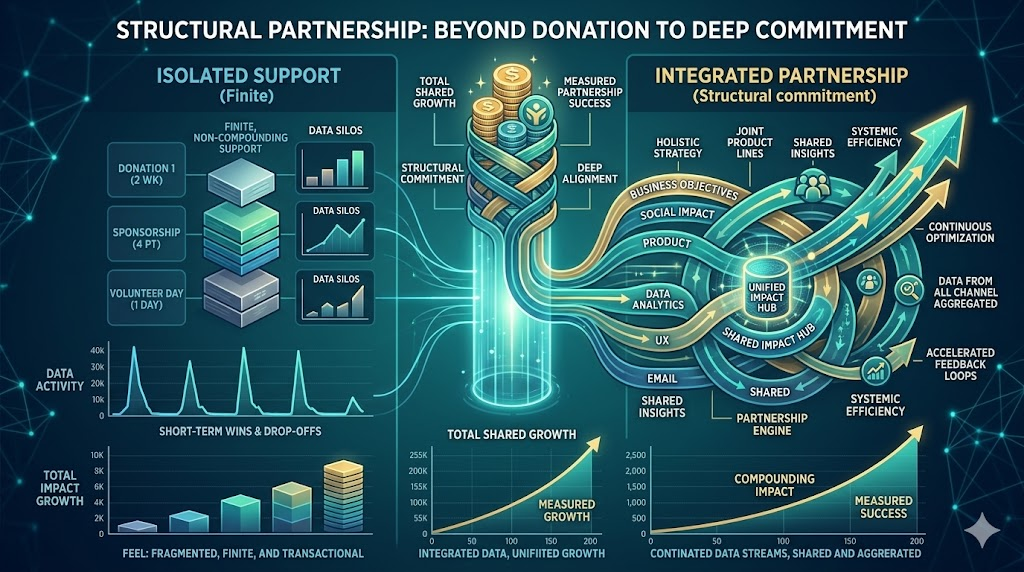
Let me describe a pattern I’ve seen a dozen times. A business reaches a certain size or visibility. Someone on the leadership team, or a PR advisor, or a new hire fresh from a larger corporate, suggests the company needs a CSR strategy. So a committee forms. They identify a local cause, maybe a food bank, maybe a children’s hospital appeal. A donation gets made. A photo is taken. It goes in the annual report.
Everyone feels good. The process repeats next year, or it doesn’t, depending on whether anyone remembers.
I’m not saying the intention is cynical. Most people involved in these programmes genuinely want to do something meaningful. But the structure is wrong. When giving is treated as a communication exercise, it gets designed around visibility rather than impact. When it sits outside the financial model, it becomes optional. When it’s optional, it vanishes the moment the business faces pressure.
This is what people mean when they say CSR has a credibility problem. The problem isn’t that businesses are lying. The problem is that the architecture doesn’t match the language.
At Viaduct, we made a different architectural choice. Five percent of annual profit goes to charity. Not a round number when the year has been good. Not a percentage of revenue that sounds larger than it is. Profit: what’s left after the business has covered its costs, paid its people, and invested in its future. Five percent of that, every year, directed to three specific organisations.
This was not added to the business later. It was built in at the start. It sits in the financial model the way salaries and operating costs sit in the financial model: as a committed line, not a discretionary one.
That distinction might sound minor. It is not. A discretionary commitment is a statement of intent. A structural commitment is a statement of values. The difference shows up when things get hard, when a year underperforms, when a client is lost, when margins compress. A discretionary commitment gets reviewed. A structural one holds.
We don’t spread a small amount across a long list of causes because it feels inclusive. We direct it across three organisations that each address a different face of structural injustice.
Camfed works to get girls into education across rural sub-Saharan Africa and to develop them into the leaders their communities need. The barriers they remove are financial and social. The outcomes are generational. A girl educated through Camfed doesn’t just benefit herself. She becomes part of a network of women who go back into those communities as teachers, nurses, and entrepreneurs. The return on investment, to use a term that feels both appropriate and inadequate here, is extraordinary.
Frontline AIDS has spent more than three decades supporting community-led organisations in over 100 countries, working to eliminate the social, political, and legal barriers that prevent a future free from AIDS. They work with sex workers, LGBTQI+ communities, people who use drugs, and others that mainstream systems consistently fail. Their model is not to impose solutions but to build and sustain local leadership in the communities that need it most.
Anti-Slavery International is the oldest international human rights organisation in the world, founded in 1839. Modern slavery, including human trafficking, forced labour, child slavery, and forced marriage, is not a historical problem. It runs through global supply chains right now. Anti-Slavery International works to dismantle the structural conditions that make it possible: legal gaps, poverty, opacity in commercial systems. This is painstaking, unglamorous work. It is also essential.
Here is what I’ve noticed, the more I’ve talked about this with clients and partners: when people understand that this commitment exists, something shifts.
It’s not that they start working with us because of it. Nobody commissions an SEO strategy primarily because their agency donates to charity. The commercial case has to stand on its own, and we believe ours does through the work we do via our growth engine.
But the context changes. When a client knows that their investment in their digital growth is, through the chain of revenue and profit, indirectly funding girls’ education in rural Africa, funding community health leadership in the most marginalised places on earth, and funding the dismantling of modern slavery, they relate to the relationship differently. It’s no longer purely transactional. There’s a broader reason to care about the work going well.
I think this is healthy. Business relationships that are purely transactional are thin. They hold for as long as the commercial terms hold, and not much further. Relationships grounded in shared values have more substance. They weather the difficult conversations, the missed targets, the pivots. They feel less like contracts and more like partnerships.
That shift is real, and it starts with transparency about what you stand for.
I want to be direct about what this means for Viaduct as a business and as a set of values.
We believe that commercial success and genuine social accountability are not in tension. We believe that how a business uses its profit is a reflection of what it actually values, not just what it says it values. We believe that the people served by Camfed, Frontline AIDS, and Anti-Slavery International are not peripheral to the world of business. They are part of the same world, subject to structural conditions that business choices can either reinforce or challenge.
We choose to challenge them.
If you are a business that shares this outlook, that wants to work with partners who are accountable not just commercially but in a deeper sense, we’d genuinely like to talk. The commercial case for working together is strong. But the fact that we’re aligned on what growth is ultimately for makes it stronger.
Get in touch here. Let’s build something that matters.

