
The average CRO team generates hypotheses from analytics reviews, heatmaps, session recordings, and stakeholder opinions. These inputs are valuable, but also narrow. Each captures a slice of what is happening on a site; none captures the full picture.
AI-driven testing addresses this gap not by replacing the strategist, but by changing where human judgement is applied. The question shifts from "What should we test?" to "What objective should we optimise for, and what does success look like for this business?"
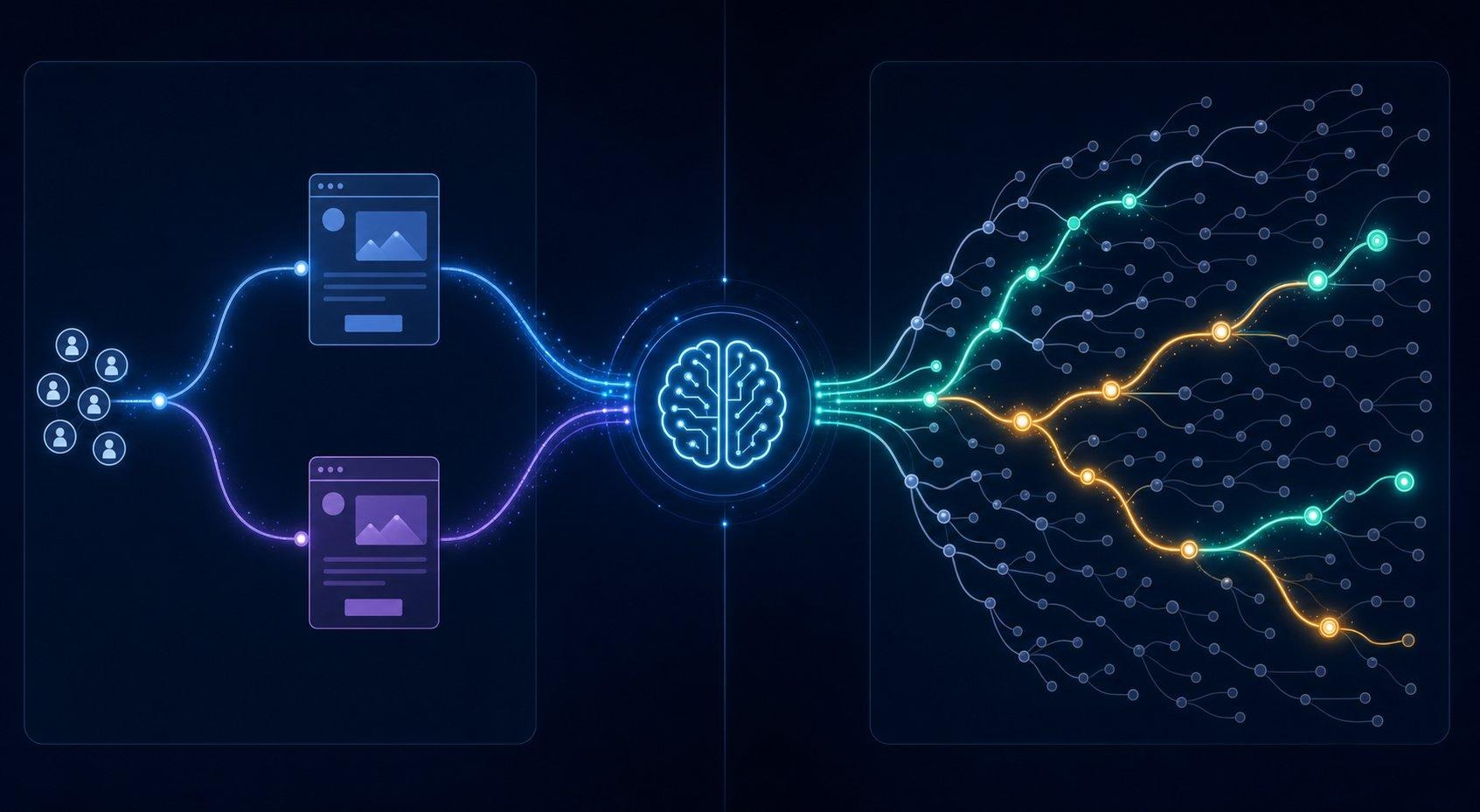
Traditional CRO hypothesis generation follows a predictable pattern. The team reviews analytics, identifies a page with high exit rates, watches session recordings, forms a view on the problem, and proposes a solution to test.
This process works reasonably well for obvious friction points. It struggles with subtlety. When conversion is influenced by the interaction between multiple page elements, user segments, browsing history, and contextual variables, human analysis becomes unreliable. We tend to find patterns that confirm what we already believe, weight recent evidence too heavily, and miss interactions that do not fit a familiar template.
The result is a testing backlog that reflects the team's existing mental models more than it reflects the actual drivers of conversion. AI models do not have this problem.
Modern machine learning models can process behavioural data at a scale and dimensionality that is impossible to replicate manually. Rather than analysing pageviews and exit rates, an AI model might simultaneously consider scroll depth, click sequence, time-on-page by section, device type, referral source, time of day, product category, and dozens of other variables to identify which combinations predict conversion or abandonment.
These models surface interactions that would be invisible in a standard analytics review. A particular combination of traffic source, device type, and product category might predict abandonment with high reliability, but no analyst would think to filter for it in a traditional funnel report.
This is where tools like Evolv AI create a different kind of testing programme. Rather than testing one hypothesis at a time, Evolv uses evolutionary algorithms to run thousands of micro-variations simultaneously, learning which combinations perform best across different audience segments in real time.
Traditional A/B testing splits traffic equally between control and variant for a fixed duration, then makes a binary decision at the end. This approach is statistically clean but commercially inefficient: you are knowingly sending a proportion of your traffic to an underperforming experience throughout the test.
Multi-armed bandit algorithms solve this by dynamically reallocating traffic toward better-performing variants as evidence accumulates. Rather than spending equal time on each option, a bandit algorithm shifts more traffic toward variants showing better returns while still exploring the others.
For high-traffic sites with significant revenue at stake, bandit testing reduces the commercial cost of experimentation. The trade-off is a slight reduction in statistical certainty compared to a fixed-allocation A/B test. For most commercial programmes, this is an acceptable exchange.
One of the more significant developments in AI-driven testing is the ability to predict likely outcomes before a test reaches traditional statistical significance. By modelling the trajectory of results across multiple segments simultaneously, predictive systems can identify with increasing confidence which variants are likely to win, allowing teams to act faster or redirect resources.
Dynamic Yield applies this logic to personalisation at scale: rather than waiting to declare a single winner for all audiences, its models serve different variants to different segments based on predicted performance for each. The result is not a single optimised experience but a portfolio of experiences, each calibrated to a specific audience.
Adobe Target uses similar logic within the Adobe Experience Cloud, applying automated personalisation to allocate variants across segments based on modelled propensity to convert. These capabilities shift CRO from a linear testing programme to a continuously optimising system.
The quality of AI-driven testing depends directly on the behavioural data feeding the model. Richer signals produce better models.
Comprehensive event tracking, clean data pipelines, and consistent tagging are not just analytics hygiene: they are the raw material for the predictive models that drive competitive advantage. The Viaduct Generation intelligence capability covers how we approach data infrastructure as a strategic asset rather than a technical detail.
The most important decisions in an AI-driven testing programme are still human decisions.
Defining the objective function is the most critical. When you instruct an AI system to optimise for conversion rate, it will do so, including in ways that may conflict with average order value or brand experience. The system is only as aligned with business goals as the objective you give it.
Interpreting results in business context matters equally. A model might identify a variant that improves conversion for a segment while producing copy that conflicts with brand positioning. The model does not understand brand equity. The strategist does.
AI-driven testing creates a genuine risk of optimising into local optima: narrow, incremental improvements that prevent the larger creative jumps that produce step-change conversion gains. If a system is continuously optimising variations of an existing page, it will get very good at that page, but it may never identify that a fundamentally different structure would outperform it by a margin no iterative test can reach.
Brand consistency is the other risk. Automated systems selecting and serving variant content at speed can produce experiences that are individually optimised but collectively inconsistent. Testing systems need guardrails to preserve the coherence that makes a brand recognisable.
The most effective AI-driven programmes are the ones where automation handles scale and pattern recognition, and human strategists handle the objectives, constraints, and interpretation. Getting that balance right is where the real competitive advantage lies.
For brands looking to build a testing programme that combines analytical rigour with strategic coherence, the Viaduct Generation optimisation service outlines how we structure this work. The Growth Engine Explorer is a useful starting point for understanding where AI-driven testing fits within a broader growth model. To explore whether this approach is right for your business, reach out via the contact page.

