
Campaigns are what you send. Flows are what you earn.
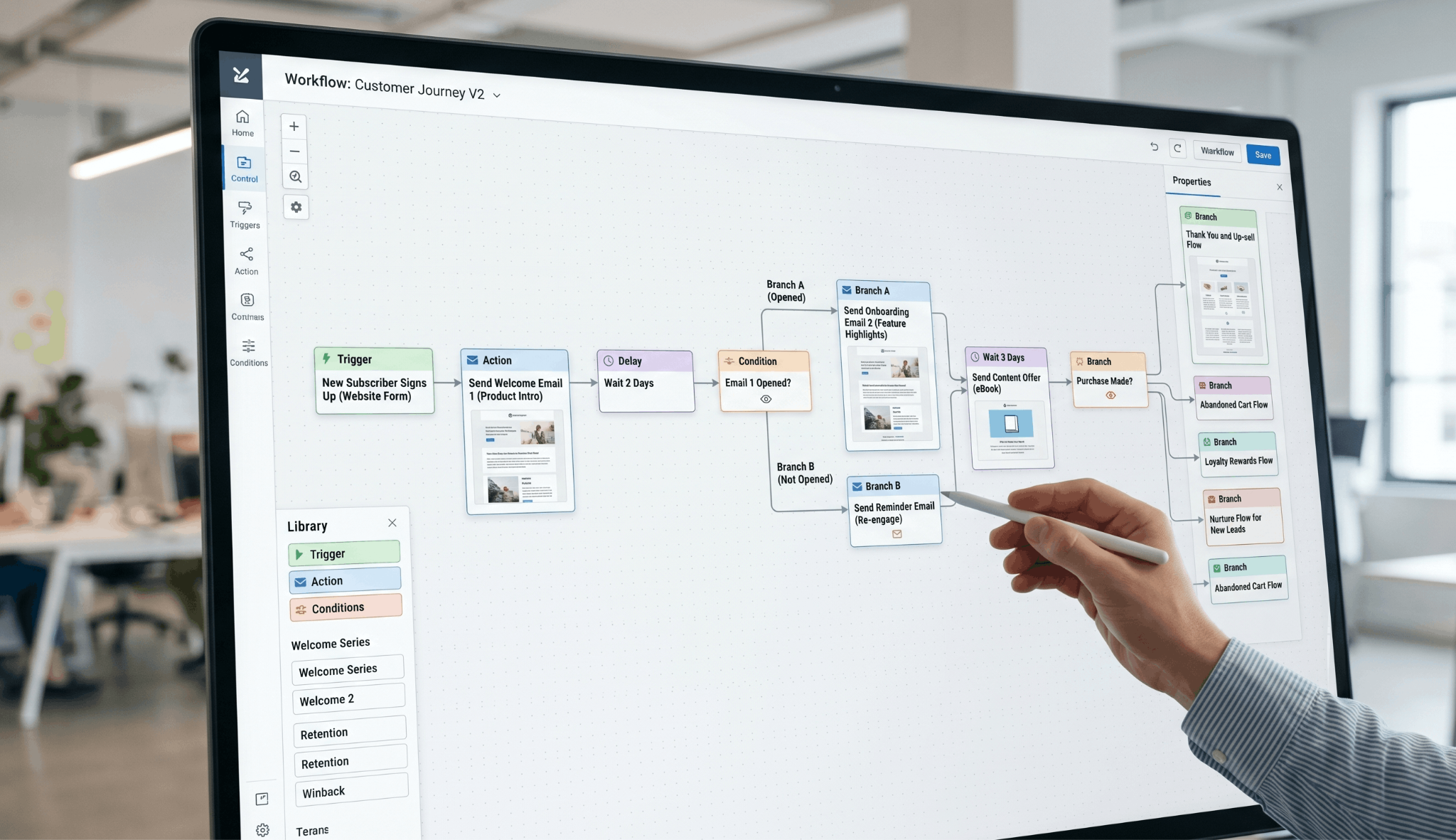
The distinction matters because Klaviyo benchmark data shows automated flows generate an average of $1.94 per recipient, compared to $0.11 per recipient for standard campaign emails. Abandoned cart flows alone average $3.65 per recipient. The leverage is not marginal; it is structural.
Yet most e-commerce brands have two or three flows running at best, and often those are configured with default copy from platform setup wizards. Below are the seven flows that should be live in every e-commerce email programme, with benchmarks, timing guidance, and setup principles for each.
Trigger: New subscriber joins the list (via sign-up form, pop-up, or checkout opt-in).
Sequence length: 3 to 5 emails.
Timing: Email 1 immediately, Email 2 at 24 hours, Email 3 at 72 hours, with subsequent emails spaced two to three days apart.
Expected performance: Welcome emails generate an average of $2.35 in revenue per recipient and achieve open rates averaging 51%, according to Klaviyo's welcome email benchmarks. That open rate is three to five times higher than typical campaign emails. Subscribers are most attentive in the first 48 hours after joining a list; that window is when you establish expectations, brand voice, and purchase intent.
Subject line approach: Email 1 is the fulfilment email if you offered an incentive for sign-up. Email 2 shifts to brand story and credibility signals. Email 3 introduces bestsellers or category entry points. Avoid loading all promotional content into Email 1; it conditions subscribers to expect offers before they have formed any relationship with the brand.
Trigger: Subscriber adds to cart, begins checkout, but does not complete purchase within 60 minutes.
Sequence length: 3 emails.
Timing: Email 1 at 1 hour post-abandonment, Email 2 at 24 hours, Email 3 at 72 hours.
Expected performance: According to Klaviyo's abandoned cart data, the average RPR for abandoned cart flows is $3.65, the highest of all flow types. The top 10% of brands achieve $28.89 per recipient. Three-email sequences generate dramatically more revenue than single sends, with one analysis showing $24.9 million in recovered revenue from three-email flows versus $3.8 million from a single email.
Subject line approach: Email 1 is a straightforward reminder, often copy-free beyond the subject and a product image with a clear CTA. Email 2 introduces scarcity if genuine (low stock levels). Email 3 is the decision email, where a time-limited incentive can be introduced if your margin supports it.
Cart abandonment represents the most recoverable revenue leak in e-commerce. If you do not have this flow live, it is the first one to build.
Trigger: Subscriber views a product page (or a set of product pages) but does not add to cart.
Sequence length: 1 to 2 emails.
Timing: Email 1 at 2 to 4 hours after final browse activity.
Expected performance: Browse abandonment flows have lower conversion rates than cart abandonment by definition (the intent signal is weaker), but they extend the recoverable pool of revenue significantly. Expect RPR in the range of $0.50 to $1.50, with performance correlating closely to how tightly you can match the email content to the specific product browsed.
Subject line approach: "Spotted something?" or "Still thinking about [Product Name]" outperforms generic "You left something behind" copy. Use dynamic content to render the specific product viewed. If browse data spans multiple sessions, surface the most recently or most frequently viewed product.
Trigger: Order confirmed.
Sequence length: 3 to 4 emails.
Timing: Order confirmation immediately (often handled by the transactional system), then a follow-up sequence beginning 3 to 5 days after estimated delivery.
Expected performance: Post-purchase flows that include a review request generate review volume that improves conversion rate for future buyers, compounding the value over time. Upsell and cross-sell emails in this sequence typically achieve conversion rates of 1% to 3%, but because the audience has demonstrated purchase intent recently, the revenue per send is above average.
Sequence structure: Email 1 (Day 3 to 5 after delivery): shipping confirmation and brand reinforcement. Email 2 (Day 7 to 10): review request with a single direct CTA to leave a review. Email 3 (Day 14 to 21): cross-sell based on the purchased product category, using purchase history to recommend a logical next product.
Trigger: Subscriber has not opened, clicked, or purchased within 90 to 120 days (adjust threshold based on your typical purchase frequency).
Sequence length: 3 emails, then suppression.
Timing: Email 1 at the lapse threshold, Email 2 at 7 days later, Email 3 at 14 days later. If no engagement follows Email 3, move the subscriber to your suppression list.
Expected performance: According to Braze research on win-back campaigns, an open rate of around 12% can be expected from win-back sequences. That may sound modest, but recovering even a small percentage of lapsed subscribers is meaningful when the alternative is suppression, and the cost of re-engaging an existing subscriber is far lower than acquiring a new one.
Subject line approach: The first email should be direct: "We have not heard from you in a while." The second can lean on urgency or curiosity. The third is the explicit "last chance" email, which often achieves the highest open rate of the sequence because it signals consequence.
Trigger: Subscriber crosses a purchase frequency or total spend threshold that qualifies them as a VIP customer.
Sequence length: 1 to 2 emails at the qualification moment, then ongoing elevated-treatment communications.
Timing: Trigger email within 24 hours of qualifying.
Expected performance: VIP flows have variable revenue benchmarks depending on segment size and tier definition, but their primary commercial value is in retention. Customers who feel recognised purchase more frequently and have materially higher lifetime value. Research consistently shows that the top 5% of e-commerce customers generate around a third of total revenue, making VIP treatment a high-leverage investment.
Subject line approach: The trigger email should name the achievement explicitly: "You’re officially one of our best customers." The tone should be warm and direct, with an exclusive benefit (early access, a personalised discount, or a curated product recommendation) that reinforces the tier status.
Trigger: Predicted replenishment date based on average purchase cadence for consumable products, or a subscription renewal approaching.
Sequence length: 1 to 2 emails.
Timing: Email 1 at 7 to 10 days before the predicted replenishment window. Email 2 (if no purchase) at 2 to 3 days before.
Expected performance: Replenishment flows work best for consumable categories: supplements, skincare, food and beverage, pet products, and household goods. Conversion rates for replenishment emails are among the highest in e-commerce email because the need is real and predictable. Klaviyo data shows replenishment flows can deliver RPR comparable to abandoned cart for brands in high-frequency consumable categories.
Subject line approach: "Running low on [Product Name]?" is a more effective frame than "Time to reorder." The former anchors to the customer’s experience; the latter feels administrative.
For practical benchmarks across flow types, Omnisend's email benchmark reports provide industry-level data across sectors and send volumes.
If you need support mapping these flows to your current e-commerce stack, the Viaduct Generation Execution page covers how we build and implement these automation systems. For an audit of your current programme, start with the Growth Engine Explorer.

